Tampilkan postingan dengan label Healthcare IT failure. Tampilkan semua postingan

BLOGSCAN: Forensic Statistics

Several interesting points are raised in the newsletter of the American Association of Physicians and Surgeons (AAPS) in a post entitled "Forensic Statistics" in their July 2011 newsletter headlined "Numbers." Healthcare Renewal is cited:

Forensic Statistics

While claims from RCTs fail to replicate about 20% of the time, the problem with epidemiology is so bad as to constitute a crisis, writes S. Stanley Young (“Everything Is Dangerous: a Controversy,” National Institute of Statistical Sciences, June 2008, www.niss.org). Fewer than 20% of nonrandomized trials [e.g., observational studies - ed.] replicate; i.e. 80%-90% of epidemiologists’ claims are false.

More than $1 billion in grant/tax money flows to institutions with reproducibility problems, Young states. A fundamental flaw in their methodology is to ask multiple, often hundreds to thousands of questions, of the same data set. It’s like playing “maverick solitaire”: given 25 randomly selected cards from a deck of 52 playing cards, the probability of being able to arrange them into 5 “pat hands” (e.g. a full house) is 98%.

Since data miners are good at concealing their footsteps, critics need full access to the raw data and the code used for the statistical analysis—often not forthcoming.

The EHR software that is supposed to support all this “research” and to guide medical treatment also needs a forensic evaluation, writes Scot Silverstein, M.D., of Drexel University (see http://hcrenewal.blogspot.com). He cites such an evaluation of the Cerner FirstNet system used in New South Wales, Australia, done by Prof. Jon Patrick. The authoritarian implementation processes of the governmental HIT “support” staff were familiar to Silverstein, such as disenfranchising the clinical staff and failing to acknowledge the validity of complaints.

“Healthcare reform” demands acceptance because it claims to be based on science. But then, so did Communism.

The "maverick solitaire" data mining issues (to be used, no doubt, in future "comparative effectiveness research" based on EHR data) are a additional concern to those I raised in an essay "The Syndrome of Inappropriate Overconfidence in Computing: An Invasion of Medicine by the Information Technology Industry?" in the AAPS journal several years ago (PDF).

I can also add: where are the RCT's of EHR/CPOE systems?

-- SS

Hospital system has major computer breakdown with "resultant chaos"; patients not adversely affected (of course)

As mentioned on this blog numerous times. Healthcare IT outages never, but never, adversely affect patients in any manner whatsoever:

Traverse City Record-Eagle [Michigan - ed.]
June 30, 2011


Munson has 4-hour communications failure

By Bill O'Brien

bobrien@record-eagle.com

TRAVERSE CITY — Munson Healthcare officials are trying to figure out how to avoid a repeat of a four-plus-hour data systems crash and "resultant chaos" that gripped local hospitals and clinics this week.

A system failure Tuesday morning shut down computers, telephones, pagers and other telecommunications systems at Munson Medical Center and its Munson Healthcare affiliates in Frankfort and Kalkaska, an incident that administrators described as "unacceptable." [That sounds about right - ed.]

Munson officials still aren't sure why a back-up fiber optic circuit failed during a planned outage that started Tuesday at 7:30 a.m.

"You can rest assured we're looking very carefully at that," Munson Medical Center CEO Kathleen McManus said. "Of course, we need to know what happened."

McManus said no patients were adversely affected during the outage. Even with the "resultant chaos" that gripped the local hospitals and clinics, no patients were adversely affected.

Amazing. There must be a cybernetic angel department in heaven that prevents patients from harm - i.e., from missed or delayed treatments or treatment mistakes - during the "resultant chaos" of major systems outages.

I'm sure insurers and risk managers have full confidence in Providence when these mishaps occur.

-- SS

July 1, 2011 update:

The Traverse City Record Eagle has published a memo explaining the outage:

Munson Healthcare officials distributed a memo on Wednesday that explained Tuesday’s systems failure that affected Munson Medical Center, Paul Oliver Memorial Hospital and Kalkaska Memorial Health Center and various clinics. The following memo is attributed to Chris Podges, Munson’s vice president of information systems.

“As you are all aware, we experienced an unplanned network downtime (Tuesday) that had widespread operational and clinical implications. Briefly, here is what happened:

Munson’s data centers’ connectivity to the outside world runs primarily on two redundant high speed fiber optic circuits administered by Traverse City Light and Power. We were informed by them that they needed to take one of the circuits off-line in order for them to do maintenance.

This would leave us operating on one circuit for the duration of their planned, 12-hour downtime. This shouldn’t have been any problem for us and is precisely why we have parallel, redundant technology on our most important systems and infrastructure. We have frequently tested for an event like this (losing one of the circuits) by manually “switching off” a fiber circuit.

In our testing, the remaining circuit took on all the traffic, just as it was architected to do; no hiccups, no instability, no impact on users, no downtime. And that is what we fully expected yesterday morning when one of the circuits was taken off line.

In medicine, or in any complex domain, one must expect the unexpected...

Unfortunately, that isn’t what happened. The core switch of the remaining circuit became confused, couldn’t take over the role as the primary switch (a transition which is measured in milliseconds) and ultimately shut down. Once down, everything running on the network – applications, paging systems, wireless devices, IP phones, etc., went down with it.

(I hear Kate Winslet humming in the background...)

Anthropomorphism aside, it seems to me that switches and other inanimate objects don't become "confused." The engineers/programmers who designed them just didn't anticipate the event that sinks the Titanic.

But let's roll the technology out nationally, now, rush...rush...rush...before it's too late. Computer bits get stale after awhile, after all....

Re: "Unplanned network downtimes." In the long running TV series Stargate SG-1 there's a character, Walter Harriman, who runs the command console. Just about the only line he gets to say over the base PA system over 10 seasons is ...

"UNSCHEDULED OFF-WORLD ACTIVATION!"

... when some person or alien attempts to come through from another Stargate somewhere in our galaxy or others nearby.

Perhaps hospitals can use him as a role model to announce "unscheduled down time"...

... During the downtime, we assembled a small army working on three objectives:

1. Make sure the hospitals and clinics could operate - especially as to the provision of patient care – on downtime procedures

2. Communicate as comprehensively and as often as we could

3. Fix the technical issues

Aside from the fact that these "objectives" are obvious, now hospitals need "small armies" to protect patients when a network switch gets "confused." Pen and paper offer no analogous bellicose hostilities.

While the reports are that all hospitals and clinics did a fantastic job surviving the down-time, we fully understand that it was very difficult to manage the resultant chaos and that downtimes like this are unacceptable.

But no patient was hurt (as they never are when the IT goes down).

Thursday morning at 2 a.m. we are going to re-introduce the second fiber optic circuit into our network architecture. While we expect no issues, we’re planning otherwise. This afternoon your organizations will receive specific instructions on how to prepare for the event of another network outage; What to print in advance of 2 a.m., what resources are available to you during the downtime, how to get needed clinical information without the use of computers, who to call for help, etc.

Thank god.

Again, we do not expect any downtime tomorrow morning, but we did re-learn some valuable lessons yesterday and the safety of our patients is the number one objective should the network experience another issue. We’ll be ready at 2 a.m. and we want your organizations to be ready, too.

Why do such "lessons" need to be "re-learned" - EVER?

We are working diligently to understand what happened yesterday and will share with you what we learn and our plans to remedy whatever may need attention.

In effect, they really don't understand what caused the outage.

This is similar to other cases of outages written about at Healthcare Renewal. There's never certainty, because these IT systems have become so complex and the support relatively diffused (via outsourcing, consultants, etc.)

This is a fertile ground for patient injury and death when luck runs out. As stories like "Failures in care alleged after premature birth - $1,000,000 Settlement" from the Virginia Lawyer's Weekly I referenced here imply, the cost of ownership of HIT will likely go way up once the multimillion dollar lawsuits start adding up.

Considering the track record of health IT as it is in 2011 regarding reliability, risk/benefit and security, spending hundreds of billions of dollars to put patients at risk of life and limb, and risk of potentially career-ending or bankrupting loss of privacy, en masse nationally, is increasingly brainsick.

-- SS

Electronic medication prescribing: The Magic Bullet Theory of IT-Enabled Transformation once again bites the dust in the real world of medicine

Computers once again are proving not to be the plug-and-play-panacea they've been made out to be in the complex world of medicine. The Magic Bullet Theory of IT-Enabled Transformation once again bites the dust in the real world of medicine:

Errors Occur in 12% of Electronic Drug Prescriptions Matching Handwritten
Bloomberg
By Michelle Fay Cortez
Jun 29, 2011

As many as 12 percent of the drug prescriptions sent electronically to pharmacies contain errors, a rate that matches handwritten orders for medicine from physicians, researchers said.

An analysis of 3,850 computer-generated prescriptions written over a four-week period found 452 contained errors, including 163 that could harm the patient, according to a report published today in the Journal of the American Medical Informatics Association. The rate was consistent with past studies reviewing the risk of errors when a doctor writes a prescription and hands it to the patient, the researchers said.

Pens and prescription pads are orders of magnitude less expensive than multimillion dollar computer systems, I might add.

The results undermine the expected safety benefits from computer-generated prescriptions, said the study authors led by Karen Nanji of Massachusetts General Hospital’s anesthesia, critical care and pain department. The U.S. paid more than $158.3 million to doctors and hospitals in the first half of 2011 to encourage adoption of electronic health records, which President Barack Obama has advocated as a way to lower health- care costs and reduce medical errors.

"Expected benefits?" Expected under what assumptions? [The assumptions that computers are a 'magic bullet' of some sort for complex real-world problems, and that technological determinism applies, are my best guesses as to the major ones - ed.]

“Providers appear to be rapidly adopting electronic health records and computerized prescribing, and one of the major anticipated benefits is expected to be through medication-error reduction,” the researchers wrote. “Many of these benefits will not be realized if the electronic prescribing applications are not mature and either do not catch or even cause new medication errors.”

If health IT are indeed medical devices (as per CDRH Director Shuren, see this link) but they are "not mature", then why are they on the market without pre-marketing validation, post-marketing surveillance and other regulatory requirements faced by other medical devices?

“With more than 3 billon prescriptions written annually in the U.S. alone, this could amount to 385 million errors each year, with 128 million of them having the potential to cause patient harm, said researcher Jeffrey Rothschild, from the center for patient safety research and practice at Brigham and Women’s Hospital in Boston.

If the technology is this unreliable at this time, then perhaps investing hundreds of billions of dollars in it in 2011 is premature?

Feeling a bit like Harry Markopolos once again, I offer what I am going to call Healthcare Renewal's Rule #1 of Cybernetic Common Sense in Medicine:

"Computers can only solve problems amenable to be being solved by computers, and only when all steps in their design and implementation are led by bona fide, domain-experienced, competent problem solvers."

This will not happen in the Wild-West health IT ecosystem that currently exists.


USB-equipped Magic Bullets. Click to enlarge.

I have been asked what is needed for this industry to mature.

Conceptually, the first step is: regulatory consistency.

As previously mentioned, Jeff Shuren MD JD of FDA's Center for Device & Radiological Health (CDRH), a physician and a lawyer, called health IT a "medical device". On Feb. 25 2010 he stated:

... Under the Federal, Food, Drug, and Cosmetic Act, [that regulates all drug, medical devices, etc. in the United States -ed.] HIT software is a medical device.

Currently, the FDA mandates that manufacturers of other types of software devices comply with the laws and regulations that apply to more traditional medical device firms. These products include devices that contain one or more software components, parts, or accessories (such as electrocardiographic (ECG) systems used to monitor patient activity), as well as devices that are composed solely of software (such as laboratory information management systems).


Treating "HIT software" as such - as a medical device - with all that implies, would be a first step. Instead - for whatever political reasons - HIT is given special accommodation.

We could do the reverse to achieve regulatory consistency as well. What about de-regulating other medical devices and drugs? Might that not work out well?

One might also ask, if that's a ridiculous option, then why does HIT, even more potentially dangerous than a drug, stent or defibrillator get a pass?

Why is HIT even more potentially dangerous
than a drug, stent or defibrillator?

There's a critical, infrequently addressed issue that arises as IT capabilities advance.

HIT is much more than a medical device like a stent or defibrillator, since it increasingly acts as a "coach" in the sports meaning of the term, or a "conductor" of clinicians in the sense of, say, a Herbert von Karajan or Eugene Ormandy as conductor of musicians.

The computer increasingly calls the shots, so it in effect is increasingly a cybernetic intermediary or "proxy" between doctor and patient. (In essence, the "learned intermediary" metaphor is obsolete; for instance when a doctor fired up some expert system, posed a question about what antibiotic to best use, and then either used or ignored the outputs. The computer is now between doctor and patient.)

Here are tragic, if accurate, allegations of a computer in control of clinicians: the child death lawsuit complaint #2 at my post "Babies' deaths spotlight safety risks linked to computerized systems" at http://hcrenewal.blogspot.com/2011/06/babys-death-spotlights-safety-risks.html :

Count 42: Defendants told Plaintiffs that the incorrect date on the image caused the x-ray not to be read by a radiologist in the night the image was taken, and that if the image had been correctly dated February 27, 2010, it would have been reviewed by a radiologist immediately, who would have alerted Defendants that the PICC line was improperly positioned and had to be moved back to a safe position. However, since the film was incorrectly dated February 23, 2010, the film was classified as “old” [BY THE COMPUTER PROGRAM - ed.] and was not put in line for immediate review [BY THE COMPUTER PROGRAM - ed.], and was not reviewed in time to prevent injury to Plaintiffs Decedent.

Count 45: Defendants told Plaintiff that the x-ray from the 27th, which was mislabeled as being from the 23rd, would have been reviewed by the neonatologist on duty on the morning of the 28th, but this did not happen because the computer which places films in line to be reviewed would have ignored such an “old” film. [That is, the computer cybernetically made the decision that the radiologists need not read the film, and in doing so exerted deadly interference with the clinicians' work - ed.]

If a machine is to be given this kind of authority, i.e., as a conductor or governor of clinicians, its competence to do so needs to be extensively and robustly validated.

A neurosurgeon doesn't cut into someone's head before their skills in that regard have been extensively validated.

Why do cybernetic intermediaries get special regulatory accommodation, especially when evidence is increasingly mounting that, as of 2011, they are often deficient?

-- SS

Babies' deaths spotlight safety risks linked to computerized systems

Two new tragic cases. (A third, earlier case of infant death was posted in March 2011 here).

Case #1. See Baby's death spotlights safety risks linked to computerized systems by Judith Graham and Cynthia Dizikes in the Chicago Tribune.

A baby died at Advocate Lutheran General Hospital due to an intravenous solution containing a massive overdose of sodium chloride — more than 60 times the amount ordered by the physician. The authors write:

Although a series of other errors contributed to the tragedy, its origin — a piece of data entered inaccurately into a computer program — throws a spotlight on safety risks associated with medicine's advance into the information age, a trend being pushed aggressively under health reform.


One wonders - what happened to the alerting features, for the tens or hundreds of millions of dollars the hospital spent on health IT?

I've also left a number of comments to the Chicago Tribune story in its comments section, in response to the usual pro-health IT-at-all-costs posts.

Case #2. There's also been a baby death locally to me that is allegedly due to HIT (PACS) interference in otherwise simple care processes.

See "Blake vs. Abington Memorial Hospital" at this link. The Complaint in the latter case, a public document, is available as a .tif image at this link (1 MB; you may need to use IE to download beyond the first page).

(July 8 addendum: since this blog post was published, I've noted multiple "hits" on it from the IP of the hospital involved, 65.216.195.x , at different times of the day, as well as on my Drexel website on HIT failure. Clearly they are aware of the issues noted herein.)

A critical x-ray of a PICC (peripherally inserted central catheter) line placement allegedly was never read due to misdating. See for example counts 17 - 25, and 39 - 45. It was dated several days earlier than it was taken.

Counts 39-49 (emphases mine):

39. Defendants also described that the February 27, 2010, x-ray was digitally transmitted to radiology, and the technician attempted to match the image to doctors’ orders, and then put all the identifying information on the film, including the patient’s name, date of birth and date of study.

40. Defendants told Plaintiffs that the radiology technician picked the wrong name and put it on the x-ray, and then later realized it was the wrong name and then somehow changed the information on the image.

41. Defendants told Plaintiffs when the technician changed the information on the image, she typed the date of birth where she should have typed the date of study. [Puzzling; my $99 Canon camera embeds date information in the image itself, as do PACS systems - ed.]

42. Defendants told Plaintiffs that the incorrect date on the image caused the x-ray not to be read by a radiologist in the night the image was taken, and that if the image had been correctly dated February 27, 2010, it would have been reviewed by a radiologist immediately, who would have alerted Defendants that the PICC line was improperly positioned and had to be moved back to a safe position. However, since the film was incorrectly dated February 23, 2010, the film was classified as “old” and was not put in line for immediate review, and was not reviewed in time to prevent injury to Plaintiffs Decedent.

43. The Defendants told Plaintiffs that an older x-ray has less significance than a newer image and is, therefore, not as critical to review. [This is exactly the reverse of good radiological practice. 'Old' - but never officially read - means 'potential danger' - ed.]

44. The Defendants told Plaintiffs that the x-ray was reviewed by Dr. Griffith on the morning of February 28, 2010. At that time, Dr. Griffith, thinking that the image was from the 23rd, compared it to the next most recent image, which was from the 25th In reviewing these x-rays, Dr. Griffith reportedly concluded that the PICC line shown in the image she believed was from the 23rd had been removed by the 25th. [Gevalt - what a tragic error. In healthcare, critical attention to detail at all times is required, or your patient's dead. There is no room for computer fritter. - ed.]

45. Defendants told Plaintiff that the x-ray from the 27th, which was mislabeled as being from the 23rd, would have been reviewed by the neonatologist on duty on the morning of the 28th, but this did not happen because the computer which places films in line to be reviewed would have ignored such an “old” film.

[Note the accusation of the computer acting as cybernetic 'governor' or 'conductor' of care, deciding what the humans should or should not look at. This is not uncommon in HIT. Yet, who qualified these machines to play this role? More on this critical issue
at this link. - ed.]

46. The Defendants told Plaintiffs that the next 24 hours were uneventful, but late in the day on Monday May 1, 2010, Destinee’s condition began to deteriorate rapidly.

47. The Defendants told the Plaintiffs that the during the efforts to reverse Destinee’s deterioration, they discovered that the PICC line was in the wrong position, and that they confirmed this by sampling the fluid from around the heart, which was found to be full of hyperalimentation fluid, and then pulled the line back from its incorrect and dangerous position in the heart.

48. The Defendants told Plaintiffs that they did not know if the PICC line caused a hole in the heart, but that just having the line in the heart was enough for it to push the hyperalimentation fluid into the pericardium.

49. As a direct and proximate result of Defendants’ negligence, Plaintiff’s Decedent’s suffered injuries, including but not limited to: [numerous catastrophic complications followed by death - ed.]

If these counts are accurate, I ask the same question as in case #1: if an x-ray was accidentally dated five days or so before it was taken (how can that even happen?), why was an alert not triggered that an "old" (and unread) x-ray needed an official radiologist reading ASAP?

What are hospitals getting for their tens to hundreds of millions of dollars they are throwing at clinical IT?

This latter story really disappoints me if true. I was a Resident in Internal Medicine in this hospital in the mid 1980's and used my knowledge of radiology, in which I spent a year of formal postdoctoral education, and of computing to fix a CT scanner in the middle of the night and save a young man's life (as documented in a letter from my former Residency Director, now the Chief of Staff here and here , pgs. 1 and 2 respectively).

Ironically, even after all these years, I probably could have read that PICC line placement x-ray.

Technology can be a great blessing in medicine. I am alive and healthy in 2011 thanks to it. The medical condition referred to in the aforementioned letter was in fact cured as a result of advances in cardiac electrophysiology science, as here and here, pgs. 1 and 2).

However, technology cannot be applied cavalierly, lawlessly (per Sharona Hoffman), experimentally, without regulation, and without informed patient consent as is often done in the world of HIT.

-- SS

June 27, 2011 addendum:

In further review of the dockets in case #2, I find there seems to be a wee problem getting the hospital's Chief of Staff Jack Kelly to a deposition.

In a motion filed June 10, 2011 by the plaintiffs, "BY ADMINISTRATOR ERICA L ALLEN-BLAKE; RICARDO BLAKE; ESTATE OF DESTINEE LOTOYA BLAKE DECEASED MOTION TO COMPEL DEPOSITION OF DR. JACK KELLY" (.tif file at this link), in Exhibit "J" the plaintiff's attorney writes to the defendants' attorney (emphases mine):

I received your faxed letter of May 2, 2011. I don’t agree with any of your sophistry, and want to depose [Chief of Staff] Dr. Kelly. I remind you that you objected to the Complaint, claiming the meeting with the Plaintiffs had a specific purpose under MCARE (which never made any sense, but you wrote it, not me). Your objection raised issues of fact. If you don’t want to back them up, or can’t, then withdraw the objections.

If you’d like to ask the Plaintiffs one question at a deposition taken pursuant to your pending objections - i.e., whether they were told by your clients that MCARE written notice was purpose of the meeting or not - I’d agree to let you do that. I can represent to you that their answer will be "no.”

Be advised that I am tired of Abington’s dilatory tactics in this clear liability case in which an infant was killed by, among other things, some of the most egregious professional malpractice imaginable. On top of that, Abington refused to provide the name of the radiology technician until suit was filed. Now, you’re playing ticky-tack games about depositions, and my clients are understandably not impressed.

Under cover of separate letter you will find a Notice of Deposition for Dr. Kelly for this Friday, May 6, at 2 pm in my offices.

Wow.

A motion to compel was filed on 6/22/2011 so apparently the May 6 deposition did not take place.

I add the the MCARE Act of 2002 ("MEDICAL CARE AVAILABILITY AND REDUCTION OF ERROR ACT") in Pennsylvania (PDF at this link) states:

MCARE Section 308. Reporting and notification.

... B. Duty to notify patient.--A medical facility through an appropriate designee shall provide written notification ['written' - this word would appear to mean "in writing" - ed.] to a patient affected by a serious event or, with the consent of the patient, to an available family member or designee within seven days of the occurrence or discovery of a serious event. If the patient is unable to give consent, the notification shall be given to an adult member of the immediate family. If an adult member of the immediate family cannot be identified or located, notification shall be given to the closest adult family member.

Allegedly from the June 10 Plaintiff's Motion, as it appears to me, the hospital seems to be trying to claim a verbal meeting with the family satisfied the MCARE Act's notification requirements even though nothing in writing was apparently given, but that the information exchanged in that family meeting is not admissible in court.

It seems hospitals (perhaps pushed by their insurers) attempt to play legal games to try to avoid culpability for their "computer-anecdote" patients, some who end up as roadkill on the experimental racetrack of health IT.

Again, this is doubly disappointing if accurate, as I knew some of the principals on the defendants' side two and a half decades ago.

Also see another case at my aforementioned March 2011 post "Thanks to the wonders of EHR, this premature baby went to the grave, prematurely" at this link, from an Oct. 2010 story in Virginia Lawyers Weekly ("Failures in care alleged after premature birth - $1,000,000 Settlement"). A PICC line was also involved.

-- SS

EMRUpdate's thoughts on health IT

I had posted about my mother's demise at the EMRupdate.com site here where I have written or cross-posted a number of essays over the years. The site's proprietor Nick Harrington of the U.K. replied. In his bio:

Managing Director of UK based document management software vendor Ambay Software providing hosting and support to emrupdate.com

I recognized a number of familiar themes in his reply.

In turn, I replied to his reply as follows:

Nick Harrington replied on Mon, Jun 20 2011 10:12 AM

Dr. Silverstein,

We're sorry for your loss. Genuinely.

However, I don't think this is the right place for you to start a campaign against EMR. The Healthcare industry is making big progress in the quality of patient care directly as a result of using Information Technology. The single act of providing computerized Electronic Health Record for a patient - whatever shape or form from many vendors - makes available important medical information to the whole team involved in patient care. It allows information to be readily available, to be carried with the patient as they move within the health system, it allows Doctors to be more aware of previous treatments, drug regimes and how best to care for this patient now in this consultation or emergency.

Unfortunately laying blame at the door of IT and Electronic Medical Records isn't at all reaslistic and is unlikely to win your anything more than genuine sympathy. Certinaly no support for your premise that EHR is a direct cause of death, however unfortunate its circumstances.

I do wish you peace and strength in your sad bereavement.

Nick


My reply:

Nick Harrington wrote:

Dr. Silverstein,

We're sorry for your loss. Genuinely.

However, I don't think this is the right place for you to start a campaign against EMR.

Thanks for the expression of sympathy. It is appreciated.

A few clarifications though:

I have never maintained a "campaign" against EMR. I merely hold views that experimentation on patients with problematic, poorly engineered, unregulated medical devices (that are deliberately given special accommodation with regard to the federal FD&C act per Jeff Shuren at CDRH, see FDA Decides Regulating Implantable Defibrillator Medical Devices a "Political Hot Potato"; Demurs), and without informed consent, is unethical. As per Hoffman & Podgurski at Case Western School of Law, what I am against is the lawlessness of the industry today.

Nick Harrington wrote:

the Healthcare industry is making big progress in the quality of patient care directly as a result of using Information Technology

Much current and emerging literature refutes that (such as the sampling at this link). In consideration of this literature, today's commercial health IT is not yet ready for large scale rollout from an ethical perspective. Doing so is experimentation by definition. Doing s, especially without patient awareness or consent, is in violation of decades of policy on human experimentation (e.g., see HHS "Human Research Protections Frequent Questions.")

These are first principles, not open to debate. Even modest NIH research grant proposals involving health IT undergo strict review for human subjects (and researcher) protections. I know first hand, as a sat on a Study Section on health of the population and provided Medical Informatics expertise to such proposals.

Nick Harrington wrote:

"The single act of providing computerized Electronic Health Record for a patient - whatever shape or form from many vendors - makes available important medical information to the whole team involved in patient care. It allows information to be readily available, to be carried with the patient as they move within the health system, it allows Doctors to be more aware of previous treatments, drug regimes and how best to care for this patient now in this consultation or emergency."

Ideally, yes. However, we're still quite far from the ideal. At present, what we have is an unknown level of "health IT roadkill" on the way to perfecting the technology. As predicted by the field of Social Informatics, there are also other unanticipated and likely adverse side effects (such as at link), outcome unknown.

Nick Harrington wrote:

Unfortunately laying blame at the door of IT and Electronic Medical Records isn't at all reaslistic

That depends in what setting, and to whom, the blame is laid.

In any case, per my previous post on my mother:

"May she rest in peace, and may my efforts [i.e., at whistleblowing on health IT problems] result in others not having to suffer similar mistakes at the hands of IT."

Nick Harrington wrote:

I do wish you peace and strength in your sad bereavement.

Nick

Thanking you kindly.

-- SS

My mother passed away

My mother, affected catastrophically by an EHR error last year, passed away yesterday evening.

In her memory, a photo of her and me from 1957 I found in her possessions.

Betty Silverstein, 1925-2011

Her children were always Number One.

May she rest in peace, and may my efforts result in others not having to suffer similar mistakes at the hands of IT.

-- SS

Healthcare Renewal Cited in Pittsburgh Post Gazette on Health IT Issues

Healthcare Renewal was cited in the Pittsburgh Post Gazette today on health IT issues.

Specifically, regarding issues I raised at my May 25, 2011 post "Transplant Team at UPMC Missed Hepatitis Result - Suspicious for Health IT Failure?"

I have several additional amplifying comments.

Doctor, nurse disciplined by UPMC
Failed to detect hepatitis C in kidney donated for transplant
Friday, May 27, 2011
By Jonathan D. Silver and Sean D. Hamill, Pittsburgh Post-Gazette

A surgeon and a nurse were disciplined by UPMC for their roles in missing a positive hepatitis C test result in a kidney donor earlier this month that might have stopped the transplant, the hospital system said Thursday.

The surgeon was demoted and the nurse suspended, though neither has been identified.

In addition, after a discussion with federal officials, the hospital system voluntarily suspended its live-donor liver program as a precaution, three days after shutting down its live-donor kidney program on May 6, following the transplant error. Both programs remain closed.

But while UPMC has taken action against the two staff members, health care technology experts say UPMC's information technology might have played a role in the incident.

"Checking for all types of hepatitis is so ingrained in the culture of doctors," said Scot Silverstein, a medical informatics expert and adjunct professor at Drexel University in Philadelphia. "If they didn't check for hepatitis C, that means they didn't check for hepatitis A or B either, and that means they didn't check for anything."

"That just isn't credible," said Dr. Silverstein, who explored the possible ways the technology played a role in the kidney transplant error in the blog Health Care Renewal.

"There are two possibilities," he said. "Either you have a dozen or more people on that transplant team who are just stupid, or, more plausibly, when they looked at the record the hepatitis C record was just not there or it was incorrect when they saw it."

The incident first came to light May 6, when UPMC notified the Centers for Medicare and Medicaid (CMS) as well as the United Network for Organ Sharing, that it had detected an error in a recent kidney transplant.

It was a living kidney transplant between a woman and a man who are a couple, sources have told the Post-Gazette. The woman did not know she was hepatitis C positive, and she was tested, but the test results were somehow missed by people on the transplant team, and the transplant went forward.

... Because of the error, UPMC had decided on its own on May 6 to shut down the living donor kidney program.

Then, on May 9, when UPMC officials were discussing the situation with the U.S. Health Resources and Services Administration, they mutually decided to shut down the living donor liver program, too, said Michele Walton, a CMS spokeswoman.


Read the entire article.

I strongly feel there is much more going on here than a careless surgeon and nurse. Closing down these transplant programs for now is a major, major step that actually endangers patients on waiting lists. As per an anonymous comment received in my aforementioned May 25 post (link to full comment):

I surely hope they get this figured out soon as there are MANY lives on the line here. A very good friend of mine is on the list there and has myself as a willing paired donor and another mutual friend of ours as a perfect match donor that has one test to be done and then it is a go. With all of the testing that we both have had to go through - and by the way, myself now a second round as it has been more than a year since the original testing and no paired match has been located as of yet, that these things are known as soon as the tests are ran. I would have to agree that this must be beyond human error.

... This needs to be addressed and corrected like YESTERDAY. We have many out their literally dying on the lists.

I was also cited as follows later in the Post Gazette article:

... Dr. Silverstein and other experts say the current electronic health records systems that highly wired hospitals like UPMC have in place routinely flag test results for everyone connected to a surgery to see.

But those systems have been known to cause the same kinds of errors they were designed to prevent over the old-fashioned paper records. [E.g., as per the FDA internal memo on HIT risk I described at this Aug. 2010 post; see tables 4 and 5 - ed.]


I do think the reliability of existing alerting systems has been over-represented. "Flagging" a test result awaiting someone to note the flag amidst a sea of screens, icons and clutter, and setting off aviation-like stall alarms and other fail-safes that nobody can miss, are two different matters.

For the hundreds of millions of dollars spent on health IT by organizations like this, and the hype proffered about this technology, events such as the post-facto discovery of a tainted transplanted organ should truly be considered "cybernetic 'never' events."

One might also wonder if the informational issues, whatever their source, occurred more than once: that is, if prior transplant recipients who participated in these programs need to be checked for tainted organs.

That the Post-Gazette article was published on the one-year-to-the-day "anniversary" of my own mother being cybernetically turned into a train wreck due to the toxic effects of HIT -- in an ED where I once worked in the paper era where I do not recall EOT mistakes of the kind that nearly killed my mother ever happening -- is ironic.

Finally:

If health IT is indeed implicated in the UPMC error, and if UPMC knew of system unreliabilities that could have caused the clinical errors, both patients and affected clinicians can likely raise charges of criminal negligence on the part of those responsible for these IT systems.

Politics and an overall 'lawlessness' (per Hoffman & Podgurski) in the health IT sector needs to be replaced with the scientific and regulatory methods of medicine, such as intensive pre-marketing evaluations, clinical trials and post marketing surveillance of these systems.

Perhaps some jail time for the cavalier would remind people these are not toys, gaming computers, or slot machines, and that the subjects of health IT systems are human beings, not lab rats.

-- SS

Addendum May 27, 2011:

A reader reminded me of my 2009 post "UPMC as Proving Ground for IT Tests On Children: Pioneers in Health IT, or Pioneers in Ignoring the Past?"

-- SS

Twelve Hour Health IT "Glitch" at Allegheny General Hospital - But Patients Unaffected, Of Course...

At "Transplant Team at Univ. of Pittsburgh Medical Center Missed Hepatitis Result" I wrote about a kidney transplant gone bad at UPMC that may have been due to a computer "glitch."

Now Allegheny General Hospital in Pittsburgh has suffered a "glitch" that shut down their entire health IT system for approximately 12 hours:

Allegheny General Hospital's records system back online

By Pittsburgh Tribune-Review
Wednesday, May 25, 2011
Last updated: 10:26 pm

Allegheny General Hospital's electronic medical records system was online Wednesday afternoon after a morning shutdown caused by a glitch in a vendor's computer software, a spokesman [Dan Laurent] said.

... The hospital's system underwent a routine upgrade during the weekend, Laurent said. Staff shut down the system about 5 a.m. Wednesday after noticing it was running too slow. New Jersey-based software vendor Allscripts made repairs, and the system was online by 5 p.m., he said.

One might think the vendors of mission critical hospital systems would check their upgrades better before roll out to hospitals teeming with real, live, sick patients.

Of course, patient care was unaffected. It never is when a "glitch" occurs, despite the massive inconvenience to doctors who actually have patients to care for, and the need for backloading paper data - with inherent opportunity for error - after the computer system is resuscitated.

At a Jan. 2011 post "Orderless in Seattle: Software glitch shuts down Swedish Medical Center's medical-records system" I observed:

There's that word "glitch" again that I see so frequently in the health IT sector when a system suffers a major crash that could harm patients. Why do we not call it a "glitch" when a doctor amputates the wrong body part, or kills someone? ... the shutdown likely affected about 600 providers, 2,500 staffers and perhaps up to 2,000 patients, but no safety problems were reported.

As I've noted at this blog before, it is peculiar how such "glitches" never seem to produce safety problems, or even acknowledgments of increased risk.

Same in this Allegheny General Hospital case:

... [spokesman] Dan Laurent said staffers took drug and lab orders on paper forms, and that patient care was not affected by the shutdown.

If patient care is never affected by shutdowns even as long as an entire working day, one wonders why the tens or hundreds of millions of dollars spent on these systems is needed in the first place...

I have a solution.

Cloud computing!

-- SS

Transplant Team at UPMC Missed Hepatitis Result - Suspicious for Health IT Failure?

A story suspicious for EMR malfunction appeared in the Pittsburgh Post Gazette:

Transplant team missed hepatitis result

Kidney donor, recipient unaware of virus' presence
Saturday, May 21, 2011


This hepatitis-C fiasco to my eye seems a likely case of IT error of omission or transmission (EOT, see Tables 4 and 5 at the FDA internal memo I cached at http://www.ischool.drexel.edu/faculty/ssilverstein/Internal-FDA-Report-on-Adverse-Events-Involving-Health-Information-IT.pdf).

It's inconceivable to me experienced transplant personnel, used to checking for data such as HIV, hepatitis status of donor and recipient, and other blood abnormalities would just miss this.

I would believe the hepatitis status, e.g., Hepatitis A, B, C, would be presented on the same screen. (If not, that's a design flaw itself.) That the Hep-C value could be missed by more than one person [possibly many people; see addendum below -ed.] seems very unlikely - even if the presentation screen(s) were cryptic and poorly organized.

A more plausible explanation to me is that a positive result simply wasn't present at the time when it was needed, e.g., due to a Laboratory Information System (LIS)-Hospital Information System (HIS) interface problem, or a HIS data erasure or misidentification error after the data was correctly received.

Another issue:

For the hundreds of millions of dollars spent on computers at this medical center, I wonder why their "system" in critical areas such as transplantation (as it would appear from the reports) is entirely dependent on two people looking at data.

After all, the IT is "supposed" to reduce error by infallibly calling attention to critical abnormalities such as this. The EMR alerting systems should have been going off like cockpit stall warnings at the data combination of "transplant" and "hepatitis C". That's not rocket science.

This further supports my hypothesis of a health IT malfunction, as does what I read about their "shutting down the living donor transplant program" for now - an extreme measure if this medical error were merely the result of a person or persons simply forgetting to check a data screen or sheet.

More generally, in a nutshell: commercial health IT from the current sellers is a fiasco. It alone among medical devices is unregulated under the FD&C Act even though FDA admits it is a medical device, it is unsafe, the literature shows its benefits grossly exaggerated, it probably cannot be made to work considering the current HIT "ecosystem" and its pathologies and incompetents, and has only captured the market through the purveyors "controlling the channel" of information and memes through their massive trade association HIMSS and political connections to HHS.

Think tobacco circa 1940's-1950's.

Yet UPMC could get away with this debacle scot-free:

Despite the way it occurred, UPMC will probably not be found in violation of any federal guidelines for the failure of the transplant team to review the positive hepatitis C test [or failure of the health IT system to properly transmit it, if that is indeed what occurred - ed.]

That's because while current guidelines from the United Network for Organ Sharing, the organization that oversees the nation's transplant centers and could suspend or shut a program down for deficiencies, do cover deceased donor transplants, they do not specifically cover living donor transplants, except in a limited way.

Emily Blumberg, an infectious disease specialist at the University of Pennsylvania, said that it is because live donations are still a relatively new medical advancement compared to cadaver donations.

"What has happened is that live donations in the United States have really taken off in the last decade, and there's only been a push to standardize live donation processes recently," said Dr. Blumberg.


In other words you're supposed to test dead people and their organs for disease before transplanting them, but live people get a pass? This is the height of absurdity.

One of the factors driving the push to finally address guidelines for living donor transplants is the rapid emergence of so-called paired kidney donation networks. In the networks, a willing living donor, who isn't a match to a friend or relative who needs a kidney, gives their kidney to someone else in the network. That recipient then has a friend or relative give a kidney to someone else, and so on.

Over the last five years, the rise of such networks have allowed hundreds of people to get kidney transplants from people they previously did not know, including a chain involving 32 donors and recipients -- 16 of whom got new kidneys -- that UPMC was part of earlier this year.

"Everybody is [testing for viruses] but it would be helpful if we could all be doing it the same way -- especially with paired donation networks," said Dr. Blumberg, who also chairs UNOS's disease transmission advisory committee.

This seems a smokescreen for this error. Missing a positive hepatitis C test has nothing to do in my mind with "everyone testing for viruses in the same way." The issue is being aware of the results.

Through that committee, UNOS is now beginning to craft new guidelines that are specific to live donation transplants. A conference in July in Baltimore that Dr. Blumberg is helping to organize will act as a public forum on the proposed new guidelines that will address everything from which viruses should be tested for, to which tests should be used, to how the results are communicated and other issues.

Non-communication of results will surely be forbidden.

The guidelines that do exist now don't spell out how information about a test is to be conveyed and confirmed by people on the transplant team, which are protocols that are left to each individual hospital to establish.

This is entirely absurd. "Protocols" are needed to check the most fundamental of tests in a mission critical medical area? Why does this process have to be "spelled out?" In other areas such as blood transfusion, isn't the precess of someone actually looking at test results very straightforward? I did it as a medical student....

Those same guidelines -- which were written for the more common deceased donor transplants -- also don't explicitly require testing of living donor organs for viruses like hepatitis C, though, as a rule, transplant centers like UPMC do so anyway. "I can tell you every transplant center in the country already screens donors for things like hepatitis C or other infections that would affect our use of that organ," Dr. Blumberg said.

That's great, as long as the information doesn't end up in '/dev/null', a.k.a. the bit bucket.

The rest of the Gazette article discusses the obvious regarding a simple issue of testing and reporting prior to sticking an organ into someone else's body.

I believe if this incident was indeed related to a computer error:

  • UPMC needs to reveal this publicly ASAP per Joint Commission Safety Standards, as similar flaws could affect other medical centers (such flaws that cause intermittent data erasure are known to exist; see Dr. Jon Patrick's study here on a Cerner system, for example.)
  • Repeats of episodes like this could reflect criminal negligence (not of clinicians, but of the administration for installing faulty medical devices), or may already represent criminal negligence if the health IT systems in use were known to have bugs causing intermittent data loss.
-- SS

Addendum May 25, 2011:

It occurs to me that hepatitis is a rather routine type of lab test.

Everyone who looked at the electronic chart, usually a cornucopia of people in an academic medical center, had opportunity to review tests like that. They range from medical students, to interns and residents, to fellows to attendings, nurses, and other allied health professionals, not just a few specific people on the transplant team.

In my mind the most likely explanation for so many people missing such a crucial piece of data is that it was simply not there.

-- SS

Addendum May 27, 2011:

A reader reminded me of my 2009 post "UPMC as Proving Ground for IT Tests On Children: Pioneers in Health IT, or Pioneers in Ignoring the Past?", where UPMC made claims it was a "proving ground" for experimental health IT development.

-- SS

Key lesson from the NPfIT - The Tony Collins Blog

ComputerWorldUK.com

Key lesson from the NPfIT - The Tony Collins Blog

Listening to critics is critical to the success of big projects. But has this lesson been learnt?


Published 07:56, 20 May 11

A US doctor Scot Silverstein, who has an expertise in clinical IT design, says of the NAO report on the NPfIT that the initials should stand for: "National Programme of Failed IT.”

He says on the blog Health Care Renewal:

"Perhaps the NPfIT (National Programme for IT in the NHS) should be renamed the "National Programme of Failed IT in the NHS." No new acronym will be needed.

Read the entire ComputerWorldUK piece by Tony Collins. Some of the excuses and rationalizations described during this programme are simply stunning.

This idea, though, I find fascinating:

One of the lessons that emerges from disastrous business decisions, as recorded on the excellent BBC2 series "Business Nightmares" with Evan Davis, is that expensive new ideas should be tested, and repeatedly tested, by the harshest critics of those ideas.

-- SS

NPfIT: National Programme of Failed IT in the NHS

I have a suggestion for the Queen:

Perhaps the NPfIT (National Programme for IT in the NHS) should be renamed the
"National Programme of Failed IT in the NHS."

No new acronym will be needed.

For this pleasure, the UK has spent upwards of £13 billion.

Of course, we as the progeny of the UK are going down the same path, surely soon to have a "National Program for Failed IT in the US." Ours will be a bit more expensive, unfortunately.

Excerpts from the US and UK press (read the entire pieces at the links):

http://online.wsj.com/article/SB10001424052748703421204576330691233267966.html
Wall Street Journal
Auditor Blasts UK HIT
BY STEN STOVALL
LONDON

The billions of pounds spent so far on England's much-delayed electronic patient record system within the National Health Service have been poorly used and the project urgently needs to be reassessed to ensure taxpayers get value for their money, the U.K.'s National Audit Office said Wednesday. A report released by the independent body concludes that the £2.7 billion spent on the records systems so far "does not represent value for money."


http://www.dailymail.co.uk/health/article-1388224/NHS-IT-project-cost-billions-delivering-ANY-benefits.html
Dailymail.co.uk
NHS IT system 'has cost billions without delivering ANY benefits'
By Sophie Borland
18th May 2011

Health Minister damns project as 'expensive farce'

The NHS’ controversial project to computerise all patient records has cost billions of pounds without delivering any benefits, according to a damning report.

It warns the project is running years behind schedule and will probably never happen.

The £11 billion scheme, launched under Labour in 2002, was meant to create a central computer database of all patient records which could be easily be accessed by GPs and hospitals.

But from the outset it has been hit with technical glitches and arguments between the companies installing the systems.

The scheme has also been heavily criticised by leading doctors and privacy campaigners who warned patients’ personal details would be vulnerable if stored on a database that could be easily accessed by thousands of NHS staff.

... The project was meant to be completed last year but the report warned that it was unlikely to be finished even by 2016, when the contract with one of the main firms installing the system expires.

So far only a few hospitals across the country have installed the new system – and there have been widespread problems.

Doctors have said it is too slow to use during busy clinics and other staff have reported the system suddenly crashing.

Ministers last night described the project as an “expensive farce” and demanded it was scrapped immediately.


http://www.computerworlduk.com/news/public-sector/3280340/official-failed-nhs-national-it-programme-has-no-chance-of-delivering-value-for-money/
Computerworld UK
Official: Failed NHS National IT programme has no chance of delivering value for money
Time to turn off the life support machine?
By Leo King
Published 00:02, 18 May 11

The NHS National Programme for IT, which is now budgeted at £11.4 billion, has no chance of delivering value for money and has failed on all of its crucial elements.

That is the verdict of a sharp report, compiled by the National Audit Office, that the prime minister has publicly insisted on assessing before any more deals are signed with suppliers. The report will be followed by Public Accounts Committee hearings and a Treasury report, which will also precede any signature.

National audit of the £11.4bn, 10-year UK program to automate all NHS patient records concludes "the project has not been value for money for the Dept of Health."


http://www.bbc.co.uk/news/health-13430375
BBC News
£7bn NHS electronic records 'achieving little' for patients

Patients are getting "precious little" from the NHS electronic care records system in England, a watchdog says.


The £7bn system to replace paper files is falling further behind schedule and in places where it has been introduced it is not working as it should.


The National Audit Office also said some patients would not even get one as large chunks of the NHS had pulled out.


In conclusion, the NAO said the system was not providing value for money - something the government rejected.


Electronic care records are the key part of the overall £11.4bn NHS IT project.


The scheme was launched in 2002 with the aim of revolutionising the way the health service uses technology and also includes developments such as digital x-rays and fast internet connections.
It is the third time the NAO has looked at electronic records - and each time the findings have been more damning.


http://www.guardian.co.uk/society/2011/may/18/government-urged-to-abandon-nhs-it-programme
The Guardian
Government urged to abandon NHS IT programme
Polly Curtis, Whitehall correspondent
guardian.co.uk, Wednesday 18 May 2011 12.03 BST

The government is coming under increasing pressure to abandon plans for a new NHS patient record system after the official spending watchdog said the scheme was very likely to waste another £4.3bn in the next four years.

The original aim of the £11.4bn NHS IT programme – to install a patient record database accessible from any point in the NHS in England by 2015 – will fail, the National Audit Office (NAO) warned.

The £2.7bn spent so far on the system has not been value for money, the watchdog said, adding it had no confidence that the remaining £4.3bn would be any better spent.

The nine-year-old project – the biggest civilian IT scheme attempted – has been in disarray since it missed its first deadlines in 2007. While its ambitions have been downgraded in recent years, the bill from the suppliers has remained largely unchanged, the report said.

MPs appealed for the remaining contracts to be abandoned to prevent the £4.3bn from going to waste. It amounts to more than one-fifth of the £20bn efficiencies the NHS is attempting to achieve.

I think it fair to say the UK has been massively fleeced and abused by its suppliers, consultants and health IT pundits.

The people of the UK have paid for this boondoggle. They should think of it as a form of taxation without representation, an abuse of their rights.

Perhaps they can learn a valuable lesson from this document:

The Declaration of Independence of the United States

Truth brings freedom.

-- SS

Toward Meaningful Usability: Five Keys to Creating Physician- Centric CPOE (Wait - The Terms "Safety", "Risk" and "Error" Are Missing)

In a 2011 "White Paper" from a company PatientKeeper entitled "Toward Meaningful Usability: Five Keys to Creating Physician-Centric CPOE" (PDF), an organization whose motto is "Enabling Physicians to Focus on Patients ... Not Technology", I again note a common phenomenon.

Certain verboten terms are absent.

What might those terms be? More on that in a moment...

They speak of "the failure of CPOE":

The failure of CPOE to date can be attributed to many factors that ultimately lead to a lack of physician adoption. CPOE systems have historically been designed to support the workflow of the departments responsible for fulfilling the orders rather than the physician workflow around entering orders. As a result, entering orders electronically can take significantly longer than written or verbal orders and often requires the physician to change the way they currently practice medicine.

That's a problem, considering the following observation (paraphrased from a "why-pharma-fails" post at this link):

"The machine was made for Clinicians, not Clinicians for the Machine."

But still, words are missing from the White Paper. Again, more on that in a moment.

... Hospitals often purchase CPOE on the premise that standardization of care through evidence-based order sets is the optimal way to improve patient care delivery and reduce healthcare costs. In fact, most standardized care is not
supported by evidence so spending months or even years to achieve order set consensus only serves to delay implementation and use while increasing the overall cost of the order entry system.

Well, yes, but where are those missing words?

Most CPOE systems expose physicians to all clinical alerts regardless of severity.
The preponderance of these alerts disrupts the ordering process, leads to alert fatigue, and results in
frustration on the part of the physician. Finally, the number of available workstations, including those on the hospital floors and in patient rooms, is limited, and physicians may have to wait in queue to enter their orders. This may lead to an increase in verbal orders from the physician to the nurse, pharmacist, etc. as well as frustration with a process that requires more physician time than simple pen and paper.


There must be a lot of frustrated doctors out there. Still, the shibboleth terms are missing.

Cited are the usual KOL's:

1 D. W. Bates, J. M. Teich, J. Lee et al., “The Impact of Computerized Physician Order Entry on Medication Error Prevention,” Journal of the American Medical Informatics Association 6 (July/August 1999): 13–21.
2 D. W. Bates and A. A. Gawande, “Improving Safety with Information Technology,” New England Journal of Medicine 348 (June 19, 2003): 2526–34.
3 Jason Hess, KLAS Enterprises (Orem, Utah), “Are We There Yet? Getting to Meaningful CPOE Use”, July 13, 2010

Still no mention of the missing critical terms.

The next generation of CPOE solutions must ultimately save physicians time, rather than simply being time-neutral. Otherwise, they will suffer the fate of most previous attempts to implement this required functionality – at the cost of improved patient care, better outcomes, and lost ARRA stimulus dollars.

In other words, the worst-case scenario is wasted promotional dollars and maintenance of the clinical status quo.

Still, key terms are missing.

What are those terms?

Here they are, the unaccounted-for outcomes of CPOE and its toxicity in its present form:


  • Safety (as in, "reduction of")
  • Risk (as in, "of injury, increased")
  • Danger (as of, "putting patients in")
  • Error (as in, "the outcome of toxic HIT")
  • Harm (as in, "injury and death")

This was no mere White Paper. A more appropriate term might be a "Snow White" paper:

CPOE, An Enchanted Technology. Find the Prince!

Health IT, including dysfunctional and toxic CPOE, causes frustration among doctors. CPOE failure is merely "physician nonacceptance."

But the
frustration among injured or dead patients and their families seems never to be mentioned or considered in this industry.

I pointed out that similar terms were missing from the PCAST (President’s Council of Advisors on Science and Technology
) report on health IT at my Feb. 2011 post "Brief Comments on the PCAST Report on Health IT."

Shhhh!

-- SS

Mission Hostile Health IT Obstructs Physicians From Ordering Life Saving Drugs In Critical Emergency

"You should not have to work around something that is not in the way" - SS

This post can be considered Part 9 of my multi-part series on the mission hostile user experience presented by commercial healthcare IT.

Note: Part 1 is here, part 2 is here, part 3 is here, part 4 is here, part 5 is here, part 6 is here, and part 7 is here, and part 8 is here.

Special K® Red Berries is one of my favorite cereals.


In this context, however, "Special K Red Berries" is a metaphor for cerebral and other hemorrhages caused by health IT getting in the way -- actually obstructing -- physicians ordering emergency medications such as vitamin K given via the fastest route, intravenously.


A cerebral hemorrhage at post-mortem (obviously). Note the "red berry." Similarities in appearance to above cereal bowl ironic.


This EHR system has been deployed for approximately a half decade in a hospital I'll leave unnamed.

It is stunning to me that no clinician has apparently ever complained about the following informatics/relational database integrity "glitch" regarding a not-uncommon clinical scenario, over-anticoagulation (too much blood thinner). If they did complain, however, it would be criminally negligent if the following issue was not corrected.

Atrial fibrillation (Afib) is a heart rhythm disturbance that makes a person prone to throw blood clots from the heart and suffer strokes, and is treated in part by anticoagulant drugs such as heparin and coumadin.

Atrial fibrillation is a disorder found in about 2.2 million Americans. During atrial fibrillation, the heart's two small upper chambers (the atria) quiver instead of beating effectively. Blood isn't pumped completely out of them, so it may pool and clot. If a piece of a blood clot in the atria leaves the heart and becomes lodged in an artery in the brain, a stroke results. About 15 percent of strokes occur in people with atrial fibrillation. The likelihood of developing atrial fibrillation increases with age. Three to five percent of people over 65 have atrial fibrillation

A patient with Afib on coumadin was found to be over-anticoagulated, with a dangerously high INR value, greater than 5. This patient already had a history of a life threatening subdural hematoma (bleeding hemorrhage under the lining of the brain, potentially fatal) a few years prior.

This, the patient was at great risk of catastrophe.

The international normalized ratio (INR) test is a measure of the extrinsic pathway of blood coagulation. It is used to determine the clotting tendency of blood...A high INR level such as INR=5 indicates that there is a high chance of bleeding.

Vitamin K (Aquamephyton) reverses the blood-thinning effects of coumadin. It acts most quickly and is most effective when administered intravenously.

That is, if the computer, now mediating and regulating an increasing amount of healthcare operations, allows the physician to order it that way.

It takes perhaps 3 seconds to write an order such as "aquamephyton 10 mg IV STAT", and a minute or less for the order to be called down to pharmacy by a clerk.

The computer version of the same task worked a bit differently for a very ill patient:

A hospital resident physician, when told to order IV Aquamephyton for urgent administration to this over-anticoagulated patient with atrial fibrillation who had already suffered a subdural hematoma, could only order it subcutaneously due to computer restrictions.

A half-hour of investigation, IT experimentation and phone calls needed to be made to the attending physician and the pharmacy to override that limitation, while the patient lay at critically high risk for another life threatening bleed.

Here are actual de-identified screen shots displaying the mayhem:


Screen 1. Click to enlarge. The physician typed the partial search term "aquam" to locate "aquamephyton", but the order menu stated that "no matching entries found."


Screen 2. Click to enlarge. The physician as a guess then typed "aqua" (instead of "aquam") and the drug and dosing options are listed (but spelled wrong in 2 ways - "aquaAMEPHYTOIN" - which is why "aquam" failed to match anything).


Screenshot 3. Click to enlarge. The physician clicked on the drug to override the fixed options presented in the listing, but the IV route of administration was not available in the drop down box, nor could it be entered in any way.


Screenshot 4. Click to enlarge. Same as #3 but with dose "10 milligrams" filled in. Still no option for IV route on the drop down.


Screenshot 5. Click to enlarge. Continuing the doctor's waste of time and IT misadventure, the doctor typed in "aqu", which leads to the same options. Still no IV route available! Note that there is no automatic reference for the drug offered by the computer.


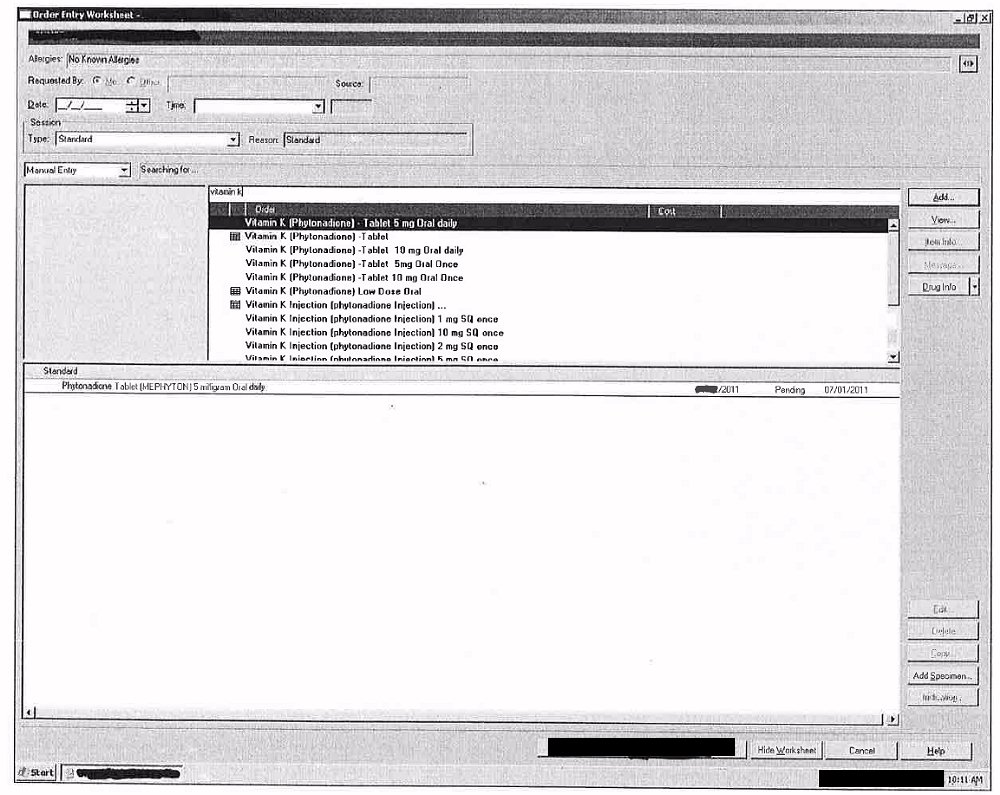
Screenshot 6. Click to enlarge. After consultation on phone with pharmacist, more time wasted, physician now typed in "phy" (part of the generic name for the drug, i.e., "phytonadione"). BINGO! More options are now available, that are continued on screenshot 7 after scrolling down.


Screenshot 7. Click to enlarge. Med list has been scrolled down. Finally, an IV option is located after a bit of wild goose chasing. ("IVPB" stands for intravenous piggyback). Why were these choices not available under the drug's brand name? It's the same drug!

I won't even go into the computational-linguistics and HCI backwardness of forcing clinicians to go on a distracting 'treasure hunt' through a list of permutations of drug doses and routes, or a menagerie of widgets for parameter specification, for each drug they order, as compared to more advanced methods of command entry. Such methods would have the computer (via the programmers) algorithmically do the bulk of the work. The concept of "parsing" seems alien to health IT vendors, who seem stuck in the paradigms of an earlier data processing era.


Screen shot 8. Physician typed in "vitamin K" and the same options appeared as with "phy." The computer response and administration options to the physician for any of these synonymous drug names should have been exactly the same (even with the "aquaamephytoin" misspelling, once the physician located the drug by luck).

The simple has been turned into the complex, with misspellings, delays and frustration, while a patient at great risk for literal red berries accumulating in his or her head lay in bad, waiting for treatment.

There are parallels between this "glitch" and glitches reported in a competitor's EHR reported by Dr. Jon Patrick in Australia at these links, e.g., regarding faulty data and linkages, user interface problems obstructing clinical work, etc.:


Several questions:

  • Is this a configuration/formulary problem local to this organization, or is it a generalized problem with this system originating at the manufacturer? (I've personally reported health IT defects in this software I'd observed in hospitals to FDA's MAUDE database, discovering that the institution itself, whose officials I alerted to the problems, did not. An example of a possible systemic problem is in MAUDE here.)
  • What other drugs are misspelled, and/or listed under different names with different (and incomplete) ordering options, with no easy and quick override?
  • How did these errors get into the system, and why were they not corrected earlier?
  • Were patients ever injured by this or other similar IT defects within this system?
  • Is this the technology that will reduce errors and "revolutionize medicine"?
  • Would you, the reader, want to be that patient waiting for the vitamin K or other critical drug while the doctors fritter away their time and energy on mission hostile computer systems?
Some day you or your family member might be.

-- SS

Label