Tampilkan postingan dengan label John D'Agata. Tampilkan semua postingan

Joe Wenderoth - Jolts of violent humor and brainy surrealism: most apt, able, and adventurous ars poetica to be produced for and by Generation X

Joe Wenderoth, Letters to Wendy's (Verse Press, 2000)

«Outrageous, brilliant and tragic, the genre-bending novel Letters to Wendy's was written over the course of a year on comment cards from a Wendy's restaurant. Through the letters, the book traces a year in the life and thoughts of an unnamed narrator obsessed not only by Biggies and Frosties, but also by consumerism, pornography and mortality.»

«What kind of person is inspired by a fast-food restaurant? If this new book is any indication, it's one who is by turns worshipful, disturbing and just plain weird. Conceived as a series of comment cards to a local Wendy's, this unconventional fiction chronicles the life (or lack thereof) of an unnamed narrator who spends his days drinking oversize sodas and contemplating the meaning of the fast-food icon. In his more lucid moments, the narrator imagines Wendy's as a cradle-to-grave institution, supplying IV nourishment for a person's last days in the form of "liquid fries." He also posits that Wendy's would serve well as a site for state-sponsored executions, providing both the correct quality of light and an abundance of refreshments. He's just as likely, however, to devolve into soft-porn daydreams involving the counter help and prepackaged foods. About the narrator himself, we learn very little - no name, no profession, no home address: just an Everyman as fast-food customer. In its best moments, the book delivers some insights into the social mores of people thrown together in a public place of business, people who share the same space and general eating habits but are unwilling to share much else. In short snippets, the narrative can be intriguing; excerpts have appeared on the Web site Nerve.com. But there's no plot to speak of, and spending time with this voyeuristic stranger quickly grows both creepy and tedious.» - Publishers Weekly


«What first comes across as a cute gimmick - a gathering of strange notes written on Wendy's comment cards (Tell us about your visit - WE CARE!), displays a stunning depth that you wouldn't expect. Spanning a time of 13 months, the unnamed scribe of these thoughts and confessions (and yes, sometimes even comments) chronicles the slow demise of mankind's sanity. A sanity that is urged to consume Biggie portions of food and eat baked potatoes that even the Virgin Mary discovers are "dry as fuck."
Wenderoth, a young Minnesota poet whose work has been compared to Philip Larkin and Jack Gilbert, has stretched everything in this book: the use of language, the function of fiction, the context of humor, and the etiquette of philosophy. Some of the entries even read like pornstore smut ("I'd like you to take your fat tongue and run it from my asshole to my clit over and over again," he imagines Wendy saying to him one day). Yet, besides the writer's fascination with sex, there is also a need - based on the ritual of GOING to Wendy's--to feel a belonging, a part of a living scene: "It would bring me to despair to think that I could get a Frosty in my own kitchen. I need believe that a Frosty can only be gotten 'outside' of where I ordinarily dwell. 'To be constantly' in the place of real Frosties - this is unthinkable, somehow unbearable. The fact is: to be a subject of language is to desire an Event, and an Event needs a nothing to move out of, to seem to begin."
The writer's reality predictably gets more skewed as the book tumbles onward, yet the dozens of references to pop culture figures, which I expected, were missing. Instead, the closest things to name-dropping are mentions of Foucault and Artaud. Not even Dave Thomas is mentioned. It seems that the writer indeed exists in his own world, where only his visits to Wendy's and their "attractive" employees are allowed (although once he even admits to thinking that their name tags are untruthful). The other customers seem to fade in and out of his focus. He alternately ponders what it would be like to rub their heads or to be their doctor, and in one scene says: "Standing there waiting for fries, me and this older man. He said to me, 'You'd think they had to grow the potatoes!' I replied, a bit too loud, 'Daddy fucked me!' The man seemed angry - I don't think he understood what I meant. It's as though we were on the same field, playing different games." Later on, the Wendy's muzak even comes under suspicion, the writer claiming to be swayed by what he calls "tranq-bath songs."
I was constantly amazed by this book (portions of which had appeared in Harper's months ago) and the forest of green bookmarks sticking out of its pages are reminders to me of how many times I demanded friends to read parts of it. In fact, despite nothing resembling real closure and many entries that simply left me puzzled, Wenderoth has constructed a creation that kept me enthralled and entertained with its jolts of violent humor and its brainy surrealism: "Today I walked in and they wrapped me in meat. They stitched the meat to me with empty sentences. They smeared the stitches with faces - I don't know whose. They wrapped it all up in my voice, but this never really worked. When I spoke you could only hear the faces smeared into the stitches the color of meat. So I began, without confidence, to try to take off my voice." Letters to Wendy's is an amazing performance of subversion.» - Kevin Sampsell

«Imagine, first, 10 BC.
Virgil is dead. Augustus is king. Cicero's severed head is still nailed to the Rostrum, the public lectern in the Forum where his opinions did him in.
In these first few years of Empire, the dominant theme in Roman literature is a consciousness of decline. This is before Petronius and his outspoken Satyricon. Before Apuleius and The Golden Ass. This is before Latin authors snapped out of their fear of the Empire that swallowed them whole. It is 10 BC. Horace at this time is the first court poet of Rome and sees himself surrounded by the degenerate efforts of the present to blandly blend into the past. In this year he sits down to compose 23 farewell letters to his friends, each set into conversational iambic hexameter. "This letter to you," he writes in one, "will therefore be the last of my words that I allow myself to set into print." Within nine months he is dead.
The Epistles, as we have come to know the last of Horace's letters to his friends, include what is considered the very first ars poetica to be written, "Epistle to the Pisones." Lively, entertaining, quick-witted, but stern, the letter begins with the opinion that all great poems should be a unified whole—yet dissolves itself into ramblings. Jumping from ruminations first on poetry, then on family, then history, war, faith, the poem is so ironically audacious in its structure that it expresses, formally at least, more than a little sympathy with the wild, amorphous work of the mad poet who is ridiculed so famously at its end:
As with the man who suffers from a skin disease or jaundice …
sensible people are wary of touching the crazy poet
and keep their distance; children unwiselyfollow and tease him.
Away he goes, head in the air, spouting his verses….
A poem on poetics: it was a highly original achievement in first-century Rome, however ordinary it seems today. Long before Aristotle's Poetics was rediscovered in Turkey in 1535, Horace's "Ars Poetica" was the only definitive guide to the classical literary tradition of criticism, and as such it is the oldest essay on criticism that has been known with continuity from the time of its conception. Where the poem retains its most disarming novelty, however, is in its awkward relationship between argument and form. Horace's "Ars Poetica" may argue for decorum in poetry, but it is joltingly arbitrary in its organization of that claim. And yet almost immediately following Horace's death and the publication of his Epistles, Quintilian declared the work genius, coining the term "ars poetica" especially for it. It is the combination of Quintilian's own return to Ciceronian ideals at this time, his publication of the Institutio Oratoria in which is outlined the proper training expected of a citizen, and the spotlight he casts on the "Ars Poetica" as a primer that finally jolts Roman writers out of the doldrums of the bland literary franchise that had been passing for art under the fist of empire.
IMAGINE, NOW, GENERATION X. If you are having trouble doing so, that is perhaps the point of Joe Wenderoth's new book, Letters to Wendy's, an unclassifiable mix of genre, tone, and intention. "I love you," Wenderoth writes, "even if you don't understand me, even if you burn my attempts to reach you, even if you are no one, nowhere. After all, I warm my hands by the same fires."
At once a love story, cultural critique, and commentary on literary theory, Letters to Wendy's combines Horace's conflicting mix of argument and form to create what has already become an underground Internet favorite, and what is likely to be known eventually as the most apt, able, and adventurous ars poetica to be produced for and by Generation X.
One watches the others order. An aesthetics develops. It's not the worst thing that could happen. Yes, a weariness lurks, often, in the obvious next step—the dream of a school. The only thing worse than endeavoring to create a school is endeavoring to maintain a school. Which is why I like, above all, those customers who, in the middle of their order and quite without warning, change their minds.
Conceived as a year's worth of daily responses on customer comment cards to the Wendy's restaurant chain's claim that "WE CARE!", the collection is comprised of approximately three hundred epistolary prose poems of one hundred words or fewer in length, detailing the speaker's love of chocolate shakes, plastic seats, bowel movements, fellatio, language, and meat. "Today I had a Biggie," Wenderoth writes: Usually I just have a small, and refill. Why pay more? But today I needed a Biggie inside me. Some days, I guess, are like that. Only a Biggie will do. You wake up and you know: today I will get a Biggie and I will put it inside me and I will feel better. One time I saw a guy with three Biggies at once. One wonders not about him but about what it is that holds us back.
Where this book's popular appeal lies, I am thinking, is in its willingness to not hold back: not its embarrassingly bald thoughts; not its uncomfortably familiar feelings; and not even its very, very rough spots. Raised, trained and now writing in the aftermath of American postmodernism, Wenderoth and his generation are the products of a cultural empire that has even managed in recent years to commercialize the aesthetics of irony. Called as well "the cynical generation," as children they watched the space shuttle Challenger explode, reached puberty just as AIDS was spreading to America, and with the help of the Internet earned their first million dollars by the time they were thirty. Then lost it all by 31. It is a generation, in other words, that has known impermanence. Having come of age just as MTV was coming into power, their cultural milestones are more like franchises recycled from earlier generations: punk in the early 1990s; swing in the mid 1990s; Woodstock in the late 1990s. If the core tenet of postmodernism was that there is no single right way to do anything, is it any wonder that, in the squishy nameless days following postmodernism, Wenderoth's generation is seemingly indifferent to everything? That "irony" has evolved into mere insincerity?
"Post-irony," therefore, is what many emerging writers of Wenderoth's generation have been calling their aesthetic of choice—an attempt to satisfy, as one writer has put it, "a desire to see the world directly, without distortion, and without reflecting back on how and from where one is looking." The New Sincerity, as some have been calling it.
In the fast-food world, Wendy's is about as close as one can get to sincerity. It is a restaurant that has somehow fashioned for itself a peculiarly unironic atmosphere of decency. Named after the daughter of founder Dave Thomas, the corporation annually donates an undisclosed but rumored 15 percent of its proceeds to adoption programs. And it has consistently refrained from joining the promotional wars that rage every year between McDonald's and Burger King. (You may have seen this past year's dueling commercials by the Backstreet Boys and 'NSync on behalf of those two fast-food giants.)
Where better, then, for Joe Wenderoth to set up camp for a year during his post-ironic ars poetica experiment? "I wonder what 'beauty' really is," he writes in the first philosophical turn in the book:
I know that the little girl, Wendy, who is pictured on your cups and bags, is beautiful, and so is the green green descent into the valley. Within this descent, I can feel the overpowering order within which I am but a temporary eccentricity. This overpowering, anticipated but absent, is beauty. I'd like to spank Wendy's white ass and fuck her hard.
The abruptness of that transition is Wenderoth's key interest. Here the juxtaposition of those two exaggerated tones—one a brand of thinking that is heavy with theory and the other a crude outburst of red ground emotion—is attempting to prepare the reader for what will be, throughout the book, a conversation—or collision—between these two tones, two worlds. For Wenderoth, language, and therefore poetry, has essentially been stripped of all authentic forms of expression that it might have, once, long ago held—
I was overwhelmed by the chicken sandwich pictured there, but had no words for it. I kept saying, 'there, that one… the man dressed like a woman.' It's hard to get served when one understands the signifier as a process—
but this is not, of course, a new predicament in literature. Instead, the new thing here is Wenderoth's insistence on confronting the deconstructed world that his generation's been reared in, and making it confront the heartbreak of inexpressive language. "Wendy is not a girl," Wenderoth writes at the height of his infatuation with her, "she is a sign…. She is only a girl in the mind of the customer, the lonely hermaphroditic homestead of significance."
One can feel Wenderoth searching in this book for an in, a return to perhaps what Allen Grossman has termed "the lyric shift"—that moment that marks the origin of poetic speech—before irony, before "post-irony," before the franchise of American language. "American poetry has moved, for the most part, away from dwelling in this moment," Wenderoth has written elsewhere:
Many of our esteemed poets have implicitly declared that the origin of poetic speech is not this moment, but is the everyday someone who has always weathered this moment, and who speaks from near it, from after it—not from within or under it. Such an everyday someone, when claiming to speak poetically, is not given to this moment in a creative way but, rather, is using this moment. Such a poet is, ironically, warding off the opportunity for poetic speech to begin…. If one is truly in the need for a poem to begin, one is, in some sense, where nothing has ever been said.
Whether nothing in Letters to Wendy's has ever before been said is difficult for me, alone, to discern: I have not read everything. But the book is an earnest one, an ambitious and charming and bold innovation. Wenderoth's encounter with the Virgin Mother, for example, is priceless ("She was holding two baked potatoes with sour cream and chives"); his "Butt-Fuck Week-End with the Lord" is uproarious; and his unrelenting suggestions that Wendy's loop soundless pornography on monitors in its dining rooms ("just a reassuring view of the signifier itself as it finds its way to its ancient hiding place") are unnerving in their consistently matter-of-fact tone.
The book's conceit is one of irony, certainly—set in a fast-food restaurant, tonally ambiguous, prefaced with a disclaimer that these poems make up a novel ("imaginary figures, possible images, the stuff of collective dreams")—yet Wenderoth's argument within it, we sense, is deeply felt. "Let's say Wendy's is an airplane," he writes, toward the end of the book, "[t]raveling at ten thousand feet":
Let's say there's no landing gear and nowhere to land. And fuel is limited. And one has a general idea of when the fuel is going to run out. Given this knowledge, is travel really the right word? And if not travel, then what? One sees one's life quite differently when one knows it isn't going to land.
It is, in the end, a book about faith. "Some kids drift by, talking," Wenderoth notes one afternoon with awe. "One of them says, 'that sucks dead donkey dicks,' and the other agrees. Imagine." Language, one senses ultimately for Wenderoth, is not dead. It is just, perhaps, on vacation. In its stead is a kiosk on the outskirts of town, selling bad burgers on a monthly lease. "Poetic speech," Wenderoth has written, "betrays this country more deeply than any other country in history…. It is, therefore, increasingly difficult to resist settling for a poetry that arises from near, or after, the painful moment of its origin." Resistance, he insists, is called for. "Reality itself is at stake."
Urging us back toward that moment of origin, Wenderoth's ars poetica, like Horace's very first, is formally incongruous with its rather conventional argument. But I am thinking for the moment that this is all intentional: its avoidance of lines; its classification as fiction; its choice as the publisher's flagship debut, hoping as the press does "to rescue American poetry from the high tower of Post-Romanticism." It is not ironic that Wenderoth's form is not mimetic of his argument. It is—more painfully, more potently—elegiac of what's at stake.» - John D'Agata

«Joe Wenderoth's fourth book of poetry — Letters to Wendy's — is odd by any stretch of the imagination. The book is made up of over 150 short, short pieces written on customer forms from Wendy's restaurants, each dated between July 1, 1996 and August 7, 1997. Yet the collection is original as well as peculiar, and while many of the pieces are duds, a few shine through with a poise and peculiar sincerity about a subject that — and I feel pretty safe in saying this — no one in their right mind has ever considered addressing before.
At its best, these pieces (officially "prose poems," but that's a term ridiculous beyond any need for further discussion) plumb the depths of the fast food experience, something millions of Americans participate in every day yet never think twice about. Wenderoth's speaker (who is, I hope, not Wenderoth himself) is solitary and lonely — one gets the distinct impression that a trip to Wendy's is about the only human contact he gets all day. Writing his inner thoughts out on cards is his only form of therapy. More than that, they ask questions like "why is it wrong to stare at other customers?" — questions that seem asinine until we admit that, yes, we've all probably thought the same thing at some point, if only fleetingly.
The majority of the pieces — each no more than a few sentences, with no consistent form — are offbeat paeans to America's greatest fast-food also-ran. They center on things like Biggie drinks, Wendy's coffee and the chain's employees. Some are pieces of advice ("I think you need painkillers on the menu"), while others are meaningless slices of humor ("Today I bought a small Frosty. This may not seem significant, but the fact is: I'm lactose intolerant"). There are a few expressing longing for Wendy herself ("Wendy is possessed of — or possessed by — a barbaric coquettishness"), and still others, well, read for yourself:
December 8, 1996
To stroke another customer's head. Run my fingers through his hair and whisper to him: "You're going to be all right …" I would be called responsible if he were bleeding to death on the floor, but I would be called inappropriate if I did it when he was in good health. I would be, like all trustworthy prophets, called a nuisance and promptly arrested.
If the Wendy's-centric pieces are those written while the speaker sits alone in the restaurant, eating his Biggie Fries, then the rest — about sex, mostly, but also random things like dwarves and chickens — are the ones written late at night while the speaker sits, still alone, in his messy studio apartment, dreaming of killing a celebrity. Where else could the inspiration for August 16, 1996's entry come from?
My penis, it sounds like confetti. My face is too strong, so forget it. My sleep is burning, so let it. There is just so much to prove since I've come. Too much to prove all alone. Too much to prove since I've come. Too much to prove all alone. And time, time rolls on like a mountain — there's just so much to prove. And I just can't prove it's undue.
Letters to Wendy's is, unfortunately, a lot more fun and interesting to talk about than it is to own. At $14, you wonder, ultimately, if part of the joke isn't on you, the customer, for buying what is basically an uneven (albeit original) collection of missives. It's one of those books they always place up near the register — smaller than most, and with a funky cover — to tempt you into buying just one more book. The kind of book you'll tell everyone you saw, but wouldn't be caught dead buying. Often, this is a bad instinct, as some of those books are pretty good. In this case, your instincts will serve you right.» — Clay Risen

«No degree of familiarity with Joe Wenderoth's first two poetry collections will quite prepare readers for Letters to Wendy's. If the gauzy, enigmatic lyrics of Disfortune and If It Is I Speak (both from Wesleyan) at times seemed written on the air by the white cotton glove of a mime, then the prose poems in Letters — or "epistolary fiction," as the Library of Congress subject heading would have it—were scrawled on Wendy's restaurant comment cards, possibly in ketchup, mustard or blood, by the white-knuckled hand of a psychotic loner.
That's one possible characterization of Wenderoth's speaker, a compulsive diarist who submits near-daily missives to his local burger emporium. This character may well have a counterpart in the real world, but just imagine the manager who gathers up the day's mundane requests for cleaner restrooms or less salt on the fries, and finds this suggestion:
December 24, 1996 (Christmas Eve)
If we must put people to death why not at Wendy's. Is
midnight in a prison basement better? Wendy's provides
the two things an execution needs most: plenty of light,
and refreshments. The light allows the condemned to feel
death as an inevitable blending. The refreshments allow
the audience to take in their own hands the tamed
substance and to feel themselves securely on this side of
the blender.
By the last sentence we are no longer in Wendy's as a physical place, but in Wendy's as a polymorphic conceptual construct, one that permits metaphysical interrogation ("Why is there somewhere that is not Wendy's?"), self-analysis ("I seek respite from tolerance, in every sense."), religious experience ("The Virgin Mother appeared to me today. She was holding two baked potatoes with sour cream and chives."), linguistic delirium ("Null successors squirming in the quickness try not to hear the undersinging that predicts them..."), and of course sexual fantasy ("I'd like to spank Wendy's white ass..."). Indeed, Wenderoth may be the first American poet to depict human sexual intercourse with a milkshake. The pieces are generally no more than seven lines long, about what would fit on a 3" by 5" card, a borrowed formal constraint that nevertheless enforces concision and compression; they are something like half-sonnets.
When I first read a selection of Letters in American Poetry Review two years ago, I disrupted the peace of a library reading room by laughing out loud. Their earnest naiveté, when juxtaposed with philosophical argument or outright violence, created an uneasy tension, prompting an almost involuntary reverse reaction akin to that experienced on scary amusement park rides—the sudden, zig-zag jerking into darkness or light:
May 20, 1997
I'd like to have my muscles removed. Resume the inanimate.
Wendy's allows me to extract myself from the retarded
narcissism of animal thrivings. I sit still in a warm booth
and get thought. All movement wants, in the end, is stillness;
the animate is just the failure of movement to get what it
wants—one sleeping body. The road to heaven is paved
with meat: the road to meat is not paved at all.
The inane and the quasi-sublime share the same paragraph with an odd affinity, as if, say, David Spade and Juliet Binoche starred opposite each other in a movie that critics would deem "profoundly moving."
Letters to Wendy's is intentionally subversive and randomly offensive. It is to American letters what South Park is to television drama—a compliment in my book. Its length, though, may be its undoing. The volume contains approximately three hundred pieces, and sooner or later the poet's modus operandi shows too obviously through their skins. A peculiar observation or declaration ("I'd like to have photos of your employees for my home") is developed in the abstract for a few sentences, which are then tersely resolved by some logical or illogical conclusion. They begin to mutter or whine, and the initial voyeuristic interest wanes. Still, Wenderoth's flair for invention and quirky aphorism ("...yearning itself almost imperceptibly binds us into countless discomforts.") finds a fertile medium here. Like any poetry collection—and I believe Letters has more in common with lyric poetry than with prose—it's best read episodically, a few sections at a time, perhaps over a Biggie order of fries and one of those seductive, come-hither shakes.» - Fred Muratori

«You’re known as a poet, although your most famous work, Letters to Wendy’s, is, at least according to your descriptions, a novel, however poetic the prose pieces that comprise it are. In other interviews, you have described the impulses that directed you to write Letters to Wendy’s in what you call the “post-poetic” mode, one whose speaker is not quite as obliterated as that ‘self’ that often speaks in/from the poetic moment. Your newest book, however, will be a collection of essays. This won’t be a new form for you, but how would you characterize the speaker, mode, and directional impulse(s) of your essays? I assume there are obvious differences between your approach to poetry and prose and your approach to the essay, but are there any similarities or areas that overlap?
- Allen Grossman, in Summa Lyrica, describes the moment from which poetic speech emerges in terms of a disabling of the autonomy of the will. I like that description, and I have used it to describe the difference between the more conventional poems I’ve written and the Letters. When I say the speaker of the Letters is post-poetic, I am saying that his very presence demonstrates that the autonomy of the will has been re-established, even if its re-establishment means to hold on to a sense of the failure it has weathered. The Letters are comical because they reminisce (either in celebration or in grief) the poetic moment; any text that reminisces upon the poetic moment is comical (though not always intentionally, of course). (The height of comedic reminiscence upon the poetic moment is Beckett.) As I wrote the Letters, I was aware, of course, of their comical aspect, but I tried to maintain, at the same time, the seriousness of the poetic moment. It took me awhile to figure out how to achieve this, or even to figure out that this was what interested me and what I wanted to do. I am a fairly witty person and can come up with funny things to say, and part of the Wendy’s project depends on this talent, but ultimately I came to understand that I was trying to do something more than be funny. The key to achieving this ambiguity, I found, was in understanding and making apparent the devotion of the narrator. To what was he devoted? To showing up, to being engaged with his own process, to the specificity that it is possible to expect or to reminisce, to the autonomy of the will. And I came to understand that this devotion is key because it—our devotion to the personae by which we manifest ourselves and make ourselves history—is precisely what is funny and dead serious at the same time. More often than not we laugh at a buffoonery from outside of it, as though there is an outside of it, which we presume ourselves to be the sovereigns of. But if a buffoonery is able to convey that there is nothing outside of buffoonery, no firm ground from which one can laugh at it, then the buffoonery itself is changed, and the sort of knowledge it allows for is changed. It ceases to produce practical knowledge and produces instead a sadder—dare I say a poetic—knowledge. I called Letters To Wendy’s a novel because I wished it was, I guess, at first (ah, to be a novelist!), and I suppose there are ways to define novel so as to include it, but more recently I’ve come to think of the Letters as more poetic than I had originally suspected. This may have to do with the point I’ve made above, but it has to do also with some work I did recently with writing in forms. As I did that work, and as I looked at poems students had written via formal exercises, I came to understand more keenly the real structure of poems, which is always three-parted. In part one, the poem opens up a scene of some sort. In part two, something happens, i.e. that scene is developed/complicated. Part two, while it is a developing and a complicating of the scene, provides the components from which a closure might be constructed. Part three is the achievement of that closure. Thinking about the Letters in this light, I came to realize how squarely they fit this description; their requisite brevity, I now realize, was attractive to me, and I loved writing them because I loved the challenge of having to be concise in 1. making an assertion or establishing a scene; 2. complicating that assertion or scene; 3. finding a satisfactory closure. As for the essays I’ve collected in the new book, for the most part they are a different matter because they have a quite different relationship to the failure of the autonomy of the will. I want to say that they have no relationship to it at all, but it is better to say that they have no emotional relationship to it. They are instead rhetorical, and they progress by way of logics. If they have a poetic aspect, I suspect it’s by way of their subject matter more than by way of their manner of engaging with that matter. But then I have thrown a pretty wide variety of texts into the book—some are quite conventional and earnest, some are quite satirical, and some are I-don’t-know-what. I think the thread that runs through them, the thing that inclines me to call them essays, is above all their intention, which is to make a point. Works of art—at least the most potent of them—do not seek to make a point.
In many of my favorite poems of yours, a speaker is placed in or directed toward a particularly ‘pedestrian’ setting, say a Go-Go Bar, a fast food restaurant, a working class lounge. Plenty of writers and poets frequent and then celebrate (albeit in a patronizing way) such places. And there are, of course, the other kind, say like James Wright or Richard Hugo, to whom a literary relationship to such places signifies a kind of pride in one’s identity stemming from humble origins. But unlike these writers/ poets, your work addresses but never seems to indicate any particular relationship TO such places. That is, not only does the speaker in your work refrain from romanticizing or taking pity on such places and their inhabitants, ‘he’ also makes no direct claims to come from them. It’s as if the speaking ‘self’ is not directed from any one particular group toward such a setting. Is this in keeping with your explanation of the speaker in the poetic moment as “falling through” the security of ‘self,’ the security of someone with a personality, a particular status, a set of tastes and opinions? And if so, why situate such a speaker in these locations rather than, say, a school room? To what extent can the speaking ‘self’ in the poetic moment be extracted from a particular, historically-located ‘self’?
- That was what the Letters To Wendy’s book meant to explore—that last question. And the answers it found varied. Some of the Letters, that is, are more comical, more resonant with the absurdity of the historical particulars, than others. The main thing that distinguishes the speaker of the Letters from the speaker of my poems is desire; the speaker of the Letters is desirous, and is situated wherein his desires are (to some extent, at least) satisfiable. The speaker of the poems—or I would prefer to say the voice of the poems—is not desirous; it speaks from after desire, telling the story of desire’s failure. Thus, the different relation to the scene that you’ve spoken of. I agree that my poems do not evidence a pride in the scene they speak of, or at any rate not the usual sort. I think that all poems are celebratory, but again, not in the usual sense—not in the sense that they mean to distinguish one scene from another. They are celebratory in that the autonomy of the will has been disabled… but this disabling has not achieved silence. They are celebratory in that they speak at all. If the scene of a poem is, at bottom, particular, then that poem has failed to do what good poems are able to do, which is to produce a sense of the site of scenes—the site of all scenes. Thus, when I am describing a go-go bar, I am doing so because that particular scene, for me, evokes the site of scenes—it evokes the scene that does not change, which is to say, the conditions in which our selves must dwell. Diving Into The Wreck is a great poem not because it evidences the identity or the lifestyle of a proud or humble diver; it is great because its metaphor works to describe the site of scenes. If I am drawn in my poems to working class scenes, this is probably because that’s where I’ve happened to live. Also, one might argue that, because the conditions in which we dwell are essentially cruel, it is more likely that poets will turn to scenes of particular cruelties to evoke those conditions.
I once heard you explain, at one of your readings, that Letters to Wendy’s is a novel, mainly because, as you explained, the letters form a kind of progression. I always understood you to mean that the speaker in the novel undergoes this progression. If you still feel this to be the case, could you elaborate on the kind of progression you have or had in mind?
- I do not think that the Letters work in the way that good novels work. If the book works, it works over and over, not by way of narrative developments.
In 1996, you wrote an editorial in The American Poetry Review in which you responded to A. R. Ammons’s claim that ‘poetry is action.’ Your response seemed to argue that poetry is, in fact, the very opposite of action, that it presents itself as a moment of in-action, of hesitation before and questioning of any and all actions. I always understood this to mean that poetry is not activism, that it cannot afford to be limited to any particular kind of activism, political or otherwise. Now, almost nine years later, and given the urgency of the national, political climate, do you still feel that poetry cannot afford to venture towards the realm of action or toward exposition?
- Yeah, I have still seen no evidence to make me believe that a poetry of action can be any good. I don’t see that this is a problem, though. Let’s say someone is attacking you, and you have a knife, a baseball bat, and a small sack of opium. You should use the knife and/or the baseball bat, and you should not lament the fact that you cannot use the small sack of opium at that moment. It has its own usefulness, its own time. I have turned to writing essays more often in these past ten years, I suspect, because of the worsening of the political situation. It may seem obscene to indulge in the arts while certain things are going on in the world, but I think that if we disallow ourselves the dignities of art… we are letting the terrorists—i.e. the current administration—win.» - Interview with Peter Ramos


«CALGARY. It's often bizarre, sometimes nonsensical and always funny - Bruce McCulloch is obviously involved.
Fans of McCulloch's work in the seminal Canadian sketch comedy troupe Kids in the Hall, will enjoy his turn in One Yellow Rabbit's latest production, Letters To Wendy's.
The one-hour show - which premiered Tuesday at the Big Secret Theatre - is an irreverent and eccentric comedy featuring McCulloch and OYR artistic director Blake Brooker as the unified voice of an obsessed fast food customer.
Based on the cult book by Joe Wenderoth -- who will have a signing session following Saturday and Sunday's performances - Letters To Wendy's is essentially a year in the life of a regular patron.
Clad in identical black pants, grey shirts and ties, The Joes (Brooker and McCulloch) volley about sardonic, rude, hilarious and downright nutty dialogue gleaned from suggestions on fictional Wendy's customer comment cards.
McCulloch and Brooker's adaptation is fleshed out by Tracy Ryan, who dons the copper-top pig tails of that famous face that smiles down on millions of customers each day.
Ryan explains some of the background behind the Wendy's chain and its founder, the late Dave Thomas. She also acts as a focal point for Brooker and McCulloch's love, rage and philosophical meanderings.
Meanwhile, Brad Payne, in goth get-up, provides much of the show's laughs, playing the universal teenage fast food employee (sarcastically dubbed "Register Boy" by The Joes.)
There's some point made about consumerism in modern society, but its hidden beneath a blanket of esoteric prose - "The Virgin Mother appeared to me today. She was holding two baked potatoes with sour cream and chives" - and outlandish visuals.
At one point, Wendy gives birth to the above-mentioned baked potato (it's not as gross as it sounds) while another moment has McCulloch mixing up a hamburger, a chocolate drink and a ketchup packet in a blender and drinking the concoction (it is as gross as it sounds.)
Throw in breakdancing, Enya and references to pot-smoking fast food mascots and you've got yourself one of the most original theatre offerings Calgary has seen in a while.
Now, if you'll excuse me, I have a craving for a Frosty.» - Lisa Wilton

Read an excerpt:
http://findarticles.com/p/articles/mi_qa3692/is_199905/ai_n8833653/

Joe Wenderoth, The Holy Spirit of Life: Essays Written for John Ashcroft's Secret Self (Wave Books, 2005)

"The bold and surprising imagination of Joe Wenderoth is everywhere present in these essays moving fluidly between aesthetics, obscenity, America, censorship, and the craft of poetry. Fans of his previous work know he is one of those rare figures who travels between pop culture, poetry, and cultural critique, and all will be thrilled to find his uncompromising and inimitable sensibility on brilliant display."

"Wenderoth's Letters to Wendy's (2000)- irreverent, witty prose poems written on comment cards from the eponymous burger chain-racked up unheard-of sales and made the young writer a poetry-world celebrity. Wenderoth's first post-Wendy's publication collects equally irreverent, equally biting and sometimes frankly sexual efforts in prose, along with a few poems and photographs: it shows his wit, and his desire to shock, undimmed. Individual essays explore the semiotics of Mayberry RFD and the phenomenology of Wile E. Coyote; reinterpret a poem of Sappho's to describe a seizure; rewrite a poem by Robert Hass so that it describes junkies in Cleveland; invent new drinking games; and advise academic colleagues, "Be glad that in truth you are... not in control of what comes into your mouth." "An Eye for an Eye for an Eye" proposes updates on the TV show Queer Eye for the Straight Guy, among them "Drug-Users' Eye for the Corporate Zombie." Wenderoth also reproduces correspondence with magazine editors regarding another essay (also printed here) whose portrayal of a promiscuous female Jesus led the editors to kill the piece. Though some pieces suffer as their occasions pass, most remain disorientingly smart, and funny." - Publishers Weekly

"Joe Wenderoth is a relentless antagonist to the dominant inanities of culture and politics. There are some who would like to dismiss him at every turn: he is too foul-mouthed, too self-absorbed, too sarcastic, too silly, too reckless. But as soon as one begins to think Wenderoth’s mind is permanently stuck in chakra two, he reels off inspired, compressed vignettes about seemingly minor or preposterous issues (citizens on television’s Mayberry and drinking games such as “The Lumberjack’s Melancholy Pussy”) that reveal desperate humanity in all manners of action. In his new book, The Holy Spirit of Life, Wenderoth imbues these essays with such concerned philosophical purpose (and drama) that the reader is led to believe in their deeper significance, and the tension between his earnest rhetorical choices and somewhat seriocomic tones and content leaves us laughing disturbingly. When he proposes that it is time to make Martin Luther King Jr. white so that the white population can love him, one finds oneself caught between the absurdity of the proposition and the terror that our culture might be so fundamentally racist and irrational that this just might make sense. This is Wenderoth at his best, championing ridiculous possibilities of change that deride this country’s culpabilities and hypocrisies, not to mention pursuing an argument ad absurdum: “Wasn’t it King who insisted that one should be judged without concern for the color of one’s skin? Poetic justice, then, to refashion him white, if only as a demonstration of the irrelevance of skin color.” The book also includes 24 photographs of Wenderoth at various stages in his life, including one on a park bench with a disarming Ronald McDonald, a wedding photo, and a four-part x-ray of his colon. As in his previous book, Letters to Wendy’s (2000), Wenderoth proves himself one of our country’s most daring satirists—no one is more willing to follow issues through to the rawest conclusions, or to show the slick world the other side of its smile." —James Wagner

"Letters from the American Poet" is a collection of emails written by an editor at American Poet to Joe Wenderoth regarding a solicited submission. They are the letters of an editor who has no real editorial power, an editor who wishes to support a solicited author, but who must please his/her readership. The editor attempts to work with Wenderoth to edit the submission. Judging by the editor’s letters (Wenderoth does not include the emails he wrote), Wenderoth seems amenable to censoring his work, but not to the extent necessary for publication. Wenderoth’s solicited essay doesn’t run in American Poet.
The essay in question is “The Holy Spirit of Life.” The essay begins:
'The question of irreverence, of course, is the question of reverence. To revere… or to refuse to revere… From the point of view of The Authorities, to refuse to revere is a dangerous thing, a thing to be punished. This kind of thing—the censor as a punisher—is not, however, what I want to talk about in this essay. Looking at the irreverence I am given credit for, I am struck by something more important.'
What Wenderoth is struck by is that “reverence [is] implicit in my alleged irreverences.” Wenderoth proceeds to write an apologia for his poetry, specifically the poem, “Semiotics: Dehiscence Is Never/Always Sought.”
“Semiotics…” features Jesus Christ as a woman “initiating an orgy of sorts” with the apostles, who are shocked to discover that Jesus is a woman. American Poet chose not to run the essay because of Wenderoth’s description of his own poem—at least that’s what the editor from American Poet tells Wenderoth. Reading the essay “The Holy Spirit of Life,” I can’t help but wonder if the editors of American Poet opted not to publish Wenderoth’s essay because it’s such a silly bit of writing.
The essay’s logic: irreverence is reverence for what The Authorities (a term left undefined) find taboo, impolite, not Christian, etc. Wenderoth’s example is the poem “Semiotics….” He writes, “One poem I wrote last year can be traced to the watching of pornography. In the pornography I’ve watched, there is sometimes a woman doubly or triply penetrated. I revere this woman.” What Wenderoth tends to do is to mock: as he says—“I understand the current rules of Conventional Reverence, and I chose to mock them…” he tries, then, to claim to do more than “merely to have mocked them.” He argues, defensively, that he has created a Jesus—a female porn actress Jesus—who is worthy of reverence, who he reveres.
He concludes his essay with a note that his essay was eventually published in Fence and that the poem “Semiotics…” was “enthusiastically accepted for publication” by Nerve.com but eventually rejected, “…due to an editor’s fear of controversy.” (Did Nerve.com give “fear of controversy” as their reason for rejecting the poem? Given the opportunity, I would have rejected the poem based on the mediocrity of Wenderoth’s language.) Wenderoth’s note concludes, “I neglected to archive the small string of email I got from Nerve.com, as they were not imbued with much more than unselfconscious cowardice.” This is petty. Publishing the emails from the editor at American Poet is petty.
To what purpose does Wenderoth include “Letters from the American Poet” in his book? My suspicion is that Wenderoth sees himself as a chastised crusader for free speech, as a writer punished for challenging the status quo, and he wants his readers to see him that way too.
The second part of Wenderoth’s book begins with another note from the author. Wenderoth feels the need to tell his readers how to read his essays—an act of cowardice on his part. He writes:
'...they [the essays] are more explicitly political than the other essays in this book. For me, just residing in Marshall [Minnesota] was a kind of political activism, and perhaps the best kind: largely spontaneous and uncontrived.'
In other words, any political activity on the part of the author was merely a reaction to where he found himself. He didn’t move to Marshall to confront white Christianity with his ballsy ideas, he moved to Marshall “to teach in the English Department at what was then called Southwest State University.” To claim that residing in Marshall was a form of activism is revisionist fantasy.
He berates himself for “drifting in and out of shameful silences” in the face of “capitalist, white supremacist, homophobic, Christian-privileging patriarchy.” When he snapped out of his shameful silences, he wrote little articles for the local and the campus newspaper.
“Bringing Freaks to Campus” is the best of the essays in this section, and in the book. Wenderoth is rightly annoyed that a liberal-arts university is spending money to bring in speakers who present little educational value—a former The Real World participant and a parent who lost a child during the massacre at Columbine. Wenderoth ends this essay with a vague and pitiful attempt to preserve his cool: “Please believe me when I tell you that I am not against freak shows—and not even necessarily against self-righteous superstitious freak shows.”
In “The Souls of White Folk,” he suggests we “transform our image of Martin Luther King Jr.” by producing images of MLK as Caucasian. Wenderoth is ironically suggesting that while white people like MLK, white people would love him if he were re-imaged white. As is typical of Wenderoth’s essays, he fails to go beyond his startling concept, he fails to push deeper. At this point in my reading, I began to suspect that Wenderoth fails to press beyond the superficial because he can’t: as a thinker, there’s nothing more to Wenderoth than the first spark of idea.
The provocatively titled “Twenty-Five Ways to Make Love Without Having Sex” is among the biggest disappointments in the book. Calling this piece of writing an essay is a stretch (it’s a stretch to call many of the pieces in this book essays). “Twenty-Five Ways…” is a list, a list made by a heterosexual male who has a very narrow idea of what sex is, i.e., he believes sex equals penetration of the vagina by a penis. This is evidenced by his inclusion of oral sex (“6. Eat your partner out.”) as not “having sex.” This list also displays a narrow concept of what making love is, i.e., that love-making is physical or involves watching people engaged in sexual intercourse. Call me a romantic or old-fashioned, but I believe making love includes oh-so-much more: serenading, holding hands, etc.
The press-release for The Holy Spirit of Life describes what topics Wenderoth tackles, a list that concludes, “and of course, poetics.” Of course. The third part of Wenderoth’s book is a hodge-podge of materials, some of which discuss poetry. I don’t see a real poetic presented in the book, except that for Wenderoth, poems are like magic elves that sneak up on you when you’re day-dreaming (I paraphrase, of course).
He writes about a Robert Hass poem, “Meditation at Lagunitas,” a well-known poem that begins with the lines, “All the new thinking is about loss./ In this it resembles all the old thinking.” Wenderoth’s description of and comments on Hass’s poems are tedious reading indeed. He writes,
'When he says that ‘everything dissolves,’ he means that, in ‘thinking,’ or in poetry that is the careful articulation of the coming of a scene that can’t be kept, there is ultimately nothing meaningful—that all meaning, all being, is simply dissolved by such a poetry. 'Thinking’ ‘about loss,’ then, for those of us who always grasp the world in its truly radiant specificity, is a simple waste of time; thinking might even be implied as an irresponsibility, a failure to celebrate our good essence, our being the good keepers of the genuine realm.'
Wenderoth reveals himself as one who glorifies those who do not think, who live only in the world of physical pleasure, immediate gratification and emotion. Wenderoth claims to be a clever animal, farting, fucking, and regurgitating without thought applied to any experience/reaction he has. And yet, if this were true, he would not bother to analyze a poem, he would only let us know if he liked it or didn’t. Which, in fact, he fails to do. Ultimately, his analysis comes across—in the context of this book—as a failed attempt to show intellectual gravitas, as yet another pose to impress his readers.
He then follows this essay with a parody of the Hass poem. This is an unfortunate decision. By locating the parody after a dry swipe at seriousness, Wenderoth gave me the impression that the Hass essay was only a set-up for a gag—a dumb gag. The parody inserts into Hass’s poem drugs where loss was, and mixes in some dirty words “poopy, pussy, peenie…”
Included in this section are several Wenderoth poems, the “Semiotics…” poem, the Hass parody, “Ex-Lover Somewhere,” and “Outside the Hospital.” The last two poems appear within essays; as with “Semiotics…,” he cites these poems as examples of various ideas he’s had—so, though the poems may have stood on their own somewhere, here he explains his poetry. Perhaps his own poetry is the only poetry he is capable of talking about with any intelligence and vibrancy. I find that that the essays in which he discusses his own work read like answers to interview questions: witty enough, but off-the-cuff and without depth.
Wenderoth’s collection of essays, prose nick-knacks and poems reveal the author as insecure and self-righteous, and demonstrates his inability to push an idea beyond superficiality. The Holy Sprit of Life is a book that John Ashcroft would love: he would love it because it purports to be intelligent liberal thought, but is in fact inarticulate and crude. A shot in the foot for those struggling against the ignorance and complicity of so many Americans.
I was baffled by Ben Marcus’s jacket blurb: “Joe Wenderoth is a brilliant writer, original and subversive, sensitive and strange. I read his work with awe and admiration.” I was baffled because Marcus is a much better writer than Wenderoth, and should know better. (To give Marcus the benefit of the doubt, I assume all the quotes Verse Press are using are responses to Letters to Wendy’s, Wenderoth’s previous book from Verse Press, which, while greatly overrated, produced a few real moments of quality.)
Let Ben Marcus’s blurb serve as a segue. There is brilliant, original and subversive work, doing what Wenderoth only wishes he could do. Ben Marcus’s book, The Age of Wire and String is worth reading. Diane Williamson's This is About the Body, the Mind, the Soul, the World, Time, and Fate is flawed, but is more often than not successful. Brian Evenson’s The Wavering Knife, is also imperfect but powered by a real mind, a thinker who is forging a unique and lonely path. Songs of a Dead Dreamer by Thomas Ligotti. Anything by Mary Caponegro—who is one of the best fiction writers working today. Her The Star Café shames most contemporary fiction. Read an issue of The New York Review of Books, and you’ll see how shabby Wenderoth’s essay writing is. Read John Taggart’s Songs of Degrees, and you’ll see that essays about poetry can be direct, plainly written, and yet complex and thoughtful. Pick up some good poetry, too: Taggart’s Pastorelles, The Tunnel by Russel Edson, Ali Warren’s chapbook Hounds. Do not waste your time with Joe Wenderoth. In this world, beauty is subversive. Kindness, rare. As is reading and thinking; to be angry is not to be right; to be angry is common. To be crass is not honest. Thinking for oneself is in itself radical behavior." - Adam Golaski
Joe Wenderoth, No Real Light (Wave Books, 2007)

“Joe Wenderoth's brave new poetic talent is like nothing so much as a live wire writing its own epitaph in sparks. [His poems] throb brilliantly with a sense of the 'too much.' ... But in Wenderoth's case the too much is the too little or the too ordinary—a very remarkable discovery to have made so late in the history of poetry. Philip Larkin and a few American poets have approached it, but Wenderoth's instrument is sharper than theirs; he makes quick cuts in the meat of the ordinary, which is the meat of the impossible.”—Cal Bedient

“Luck”
So a screaming woke you
just in time
An animal’s scream, or animals’.
What kind of animal it was
doesn’t matter, and cannot,
in any case, be determined.
The point is you are saved.
Your mouth has been opened.

"Best-known for his gritty and uproarious prose poetry collection Letters to Wendy's (2000), Wenderoth began his career with two books of gimlet-eyed, world-weary, hard-hitting poetry. Now he returns to verse, favoring (as before) relatively short poems, often 12 lines or fewer, most of which crackle with a bleakness that's part gallows humor, part outrage, and part despair, as in "God's Plan," quoted in full: "First you are caused to careen and/ or stagger/ through situations of indescribable appeal / and mind-breaking vertiginous sadness./ Then you are smothered." Some of these bare-bones lyrics are stunning; others reach for an incisiveness or boldness they don't quite achieve. Longer meditative and narrative poems bookend and appear throughout the volume, offering a more complicated, nuanced version of Wenderoth's sensibility than the short poems do. Whether recollecting past slackerdom ("I moved my pills and little t.v. from city to city") or considering his own or others' maladjustment ("Your soul is a million dollars cash/ and you're playing blackjack/ five dollars a hand."), it's in the longer pieces that Wenderoth is at his most affecting, revealing the adversity and vulnerability behind the cynicism, and delivering some of the most authentically disenchanted poetry to come from Generation X." - Publishers Weekly
Joe Wenderoth, It Is If I Speak (Wesleyan University Press, 2000)

"In the epigraph to Joe Wenderoth's new volume of poetry, a herdsman, exhorted by Oedipus to speak the truth, replies "It is if I speak that I will be destroyed."
Wenderoth's poetry is sparse, nihilistic -- and sometimes witty. Publishers Weekly wrote that, "Like Stevens, Wenderoth has a passion for philosophical ideas; at the same time he follows Williams' dictum: no ideas but in things. The result is poetry that is intellectually charged but whose final fidelity is to the senses." His new book has the dignity of a sincere and ferocious despair. In the narratives of these poems, "owing is all that really happens," and lives are shaped by the refusal to "sink dumbly into tolerance of a spectacle."

"Reducing sentience to slumber, reason to ritual, sight to shadow, the human to the abject and the animal, Wenderoth's exquisite evocations of finely discriminated loss offer moody evasions of concrete statement, electing paradox and abstraction over the death his entombed and enslaved personae fear will follow if they dare speak plain. The 54 poems, most of them brief, are governed by a handful of motifs: the evanescence of meaning and memory, the Orphic dismemberment to which the poet is inevitably destined, the violence native to presence, the mystery underlying human community. "The pattern is only ever of animal success," Wenderoth writes in the opening stanza of "Museum," "the cry of a real gathering/ misheard and losing itself/ toward the idea of a sound/ which was not a blade." The cry usurping utterance, the insistence upon imperfect perception ("misheard"), the shaded abstraction ("the idea of a sound") and the hovering threat of the one concrete noun ("blade") are all habitual devices of the volume, as are the deepening ambiguities repetition brings to the poem's denouement. Two longer poems structured as numbered catalogues, "Restrictions" and "Things to Do Today," strain their short phrases toward surrealistic effects ("collide with the hidden zoo and act surprised by the amount of unnecessary sleep hidden therein") and desperate humor ("said person believes the word `person' signifies, above all, a mobile, vacant, and consistently endangered habitat"), neither of which consistently succeed in lifting the monotony induced by obsessively repeated cognitive tricks. Much praised for his 1995 debut, Disfortune, Wenderoth shows himself in this second volume to be an competent inheritor of a abstraction-wearied symbolist tradition many had given up for dead."

"Wenderoth's work is sparse in form and content, with each poem addressing one central topic and attempting to explore it through a nihilistic lens. Unfortunately, the poems rarely reveal the speaker's passion, and the spareness denies reader response. Although the poems are philosophical in the manner of Wallace Stevens, the awkward juxtaposition of lines obscures rather than enlightens; the reader's desire for coherence is hardly satisfied. Indeed, some of the poems fail to make much sense: "I am gathered/ too late/ to/ have been/ just music." These stanzas, like many in the volume, are just chopped-up prose. Wenderoth does choose the ordinary for his raw material, but the lifelessness of the verses makes the ordinary seem all too banal. Too often, these are poems that suffer from "having nothing to say." - Tim Gavin
Joe Wenderoth, Disfortune: Poems (Wesleyan, 1995)

"This volume introduces a poet and some impressive poems in which he uses tangible imagery to depict the elusiveness of experience. "Detailed History of the Western World'' reads, in its entirety: "where the river gets swift/ my grandfather stops rowing/ turns round/ and with one oar/ sweeps a row-boat full of cats/ into water so black/ you could say/ it was almost anything.'' Two poems pay direct homage to Wallace Stevens, and another pays moving tribute to William Carlos Williams. Like Stevens, Wenderoth has a passion for philosophical ideas; at the same time he follows Williams's dictum: no ideas but in things. The result is poetry that is intellectually charged but whose final fidelity is to the senses. Despite the constant hum of thinking, these tightly compressed poems exhibit an acute awareness of the transience of any given thought." - Publishers Weekly

"At times, Wenderoth's poems sound like a tougher, demotic Stevens: skewed aphorisms aimed precisely at our sense that we can be fully at ease in 'position.' In other poems, his difficulty is more like Paul Celan's. His word-play brings an image - say, trees coming to life in spring -- half into focus, so that it remains both inner and outer, metaphysical and sexual; so that the fullest action is, once again, no action at all. An oddly active 'oblivion' is the sum of all the hurries and indifferences that make Wenderoth's world grimmer than Williams', certainly than Crane's. Yet one can't help feeling that, in a strange way, he approves of it, if only because it brings home the old Buddhist truths - suffering, change, non-selfhood - and thereby opens up a truly democratic compassion." - Alan Williamson

John D'Agata - Lyric essays: experimenting with essays that reconfigure dream, fact and reflection and has accorded it the freedom of a poem

John D'Agata, About a Mountain ( W.W. Norton, 2010)

"In this circuitous, stylish investigation, D'Agata (Halls of Fame) uses the federal government's highly controversial (and recently rejected) proposal to entomb the U.S.'s nuclear waste located in Yucca Mountain, near Las Vegas, as his way into a spiraling and subtle examination of the modern city, suicide, linguistics, Edvard Munch's The Scream, ecological and psychic degradation, and the gulf between information and knowledge. Acting as a counterpoint to Yucca is the story of a teenager named Levi who leapt to his death off Las Vegas' Stratosphere Motel. It is testament to D'Agata skillful organization of the book, broken into “Who,” “What,” “When,” “Where,” and “Why,” and his use of a rapid sequences of montages—Levi's suicide is spliced with Orwellian Congressional debates on the stability of Yucca Mountain—that readers will be pleasurably (and perhaps necessarily) disoriented but never distracted from the themes knitting together the ostensibly unrelated voices of Native American activists, politicians, geologists, Levi's parents, D'Agata's own mother, and a host of zany Las Vegans. A sublime reading experience, aesthetically rewarding and marked by moral courage and humility." - Publishers Weekly

"Middling wanderings along the Las Vegas Strip and the Nevada desert. With a hat tip to Bill Maher, a new rule emerges from these pages: If you're going to write about Las Vegas and enter gonzo territory, you had better write as well as Hunter Thompson. D'Agata (Creative Writing/Univ. of Iowa; Halls of Fame: Essays, 2001, etc.) doesn't approach those grand heights, and the heart sinks a touch at seeing some of the halfhearted flourishes: "What I'd planned to do was help my mother find her new home. Help her move in. Get my mom settled." Such telegraphy seems to serve no purpose, and the narrative, studded with single-sentence paragraphs, is similarly disjointed to no real effect. As his sense of geography indicates, he's a stranger 'round these parts, though he adopts a local cause celebre in the Yucca Mountain nuclear-waste controversy and makes himself a little more at home exploring it. D'Agata takes a roundabout path getting to some of the finer points of that imbroglio, with textbook-like detours-"Cognitive science is the study of how humans know themselves. It explores how we perceive, reason, and interact with the world through the complex negotiation of objects and ideas"-gossipy dishing of local eco-hero Edward Abbey and musings on suicide and mutant fish. Ultimately, the piece has an unfinished, workshoppy feel, and it doesn't deliver significant news about either Yucca Mountain or Las Vegas-yes, the place is an assault on the senses; yes, it makes people unhappy; yes, it's one of the more bizarre locales on the planet. Well-meaning but off the mark." - Kirkus Reviews

"…an engrossing story and an often impressive piece of reporting… D'Agata's prime reason for steering us through all the glittery factoids and scholarship is to take us to the ledge of what knowledge can provide, and to document how perilous it can be to stand on that ledge. These 200 pages are nothing less than a chronicle of the compromises and lies, the back-room deals and honest best intentions that have delivered us to this precarious moment in history. The book is a shouted question about who we are and how we move forward. This is how art is made." - Charles Bock

"Reading John D’Agata’s new booklong essay “About a Mountain” is like finding your GPS on the fritz, getting lost, and then, suddenly, realizing you’re on the right road after all, and headed for an epiphany or two.
D’Agata’s style has the off-kilter air of free association about it, as if he’s jumping randomly from first thought to first thought. When you open “About a Mountain,” you know that his subject is Yucca Mountain, outside Las Vegas, and the much-debated plan to turn it into a nuclear waste bin; but D’Agata’s prose skips among descriptions of 1,000 seemingly unrelated objects and observations - of plastic pens, of a highway cloverleaf, of the cost of a towering hotel. You don’t quite follow why he’s devoting page after page to Munch’s “The Scream,” or to a “neon boneyard” where old signs go to die, until you do - and then the book’s connections dawn on you like a reverberating rhyme in a poem.
D’Agata takes such a personalized approach to the essay, it’s hard to deliver a straight-up description of “About a Mountain” without cheating the book. He’s a less self-conscious descendant of David Foster Wallace in the way he transfers his elusive thought processes onto the page. D’Agata, who teaches creative nonfiction at the University of Iowa, spends a period of time living in Las Vegas with his mother and researching the proposed nuclear plan for Yucca. When he learns that Las Vegas, as a county official tells him, “can be wild and it can be fun, but it’s also a place with more suicides than anywhere else in America,” D’Agata’s themes dovetail. The Las Vegas risk-taking temperament serves as a perfect parallel to the mysterious, self-destructive impulse that has led Congress to even consider burying thousands of tons of nuclear waste near a city.
“Yucca Mountain,” D’Agata writes, “would end up holding at capacity, and if approved, the radiological equivalent of 2 million individual nuclear detonations, and 7 trillion doses of lethal radiation, enough to kill every living resident of Las Vegas, Nevada, four and a half million times over.”
Yucca and the city’s suicide rate commingle even more profoundly in “About a Mountain” when D’Agata describes his own experience volunteering for the Las Vegas Suicide Prevention Center hotline and the suicide of a teenaged boy named Levi Presley, who jumped from the top floor of the Stratosphere hotel. D’Agata lists mind-blowing data about the Stratosphere, a seriously failed business venture that is the “tallest building west of the Mississippi”; but the facts about its architecture and financial ruin all come down to a vision of Levi’s death wish on a 114 degree summer night and D’Agata’s wonder at the inexplicability of so many harmful human impulses.
My favorite sections of the book find D’Agata peering into the future to examine the impossibility of communicating clearly with the people of thousands of years from now who’d need to keep a waste-filled Yucca plugged up. Signs built from all substances inevitably deteriorate, and languages evolve and change. Think about how hard it is for us now to understand the Old English of “Beowulf.” Some symbols may stay constant - that’s where “The Scream” comes in - but can we really assume that future generations will understand our warning markers? “What we’re talking about is a species-wide game of Telephone that’s going to last for the next ten millennia,” an anthropologist and Department of Energy expert tells D’Agata.
Earlier, D’Agata has amusingly and dishearteningly chronicled his reporting journeys into the Dickensian mire of government bureaucracy to get solid information, but he stirs up some truly cosmic meditations when he projects forward into a time when humans will be almost alien to us. Talking to them would be like us talking to cavemen. He pushes his narrative to another level, his tangents forcing him and us to think outside the box that’s already outside the box.
As I imagined the future guardians of Yucca Mountain, I found myself thinking about the TV show “Lost” and the solution to its core mystery. D’Agata quotes the work of semiotics expert Thomas Sebeok, who wrote a report for the Department of Energy recommending “a long-term commission that would remain in service for the next ten millennia . . . self-selective in membership, independent of political currents, and licensed to use whatever devices for enforcement that may be at its disposal . . . including those of a folkloristic nature.” If you’ve been watching “Lost,” you can see that this kind of “Atomic Priesthood” would conveniently solve some of the drama’s most persistent questions.
D’Agata writes with an obvious rhythm, often repeating sentence structures to drive home his points. In his look back to Munch, he begins a series of sentences with the phrases “Wouldn’t have ever known,” “Wouldn’t have ever seen,” “Wouldn’t need to glimpse.” At moments, he recalls early Bob Dylan, who in a song like “The Lonesome Death of Hattie Carroll” similarly used grammatical repetition to capture his anger. But D’Agata is only half righteous passion and absurdist irony; the other half is hunting for the broadest, most philosophical questions we can think of. Ultimately, his fiercely detailed crazy quilt adds up to something impressively open-ended and prismatic." - Matthew Gilbert


"Text occupies space. It creates a geography on the page by placing upon it characters in strings designed by the author. Many great writers are acutely aware of how the shape of their text affects the reading experience—think of the hermetic, no-paragraph-breaks style of Thomas Bernhard, or the postcard-like emanations of David Markson. This notion is certainly an active element in the work of John D'Agata. His first essay collection Halls of Fame is a panorama of fact and image, information delivered as a collage. Halls of Fame shifts between lyric essay and journalism as it considers subjects a diverse as the Hoover Dam, the Luxor casino, and Henry Darger. And the book is much more than a genre-busting exercise: like the works of David Foster Wallace or sometimes William Vollmann, Wayne Koestenbaum, and Joan Didion, it seems alive.

This is even more true of D'Agata's latest work, About A Mountain, a book-length cultural study indeed about a mountain⎯specifically, Yucca Mountain, a worn down mound about 100 miles outside Las Vegas, and the proposed dumping site of our nation's accumulation of nuclear waste. The book situates itself in the sleepless city⎯also, it turns out, the U.S. capital for suicide⎯and then delves into the specifics of the Yucca matter, calmly and masterfully negotiating the hypnotic maze of bureaucratic hyperbole and fact-masking.

It's a heated issue to decide whether or not radioactive mass will be seated on the water table of our nation's fastest-growing locale, and D'Agata reports on the debate skillfully, well enough that the book would be worthwhile on this level alone. But he also turns it into a series of thorny epistemological conundrums. How, he asks, will we demarcate Yucca Mountain as hazardous for the duration of the material's decay—a proposed 10,000 years—as languages evolve, become slippery, and mutate? If we put up a sign warning people to stay away, it will probably look like Chaucer by the year 3000. D'Agata also powerfully meditates on the present moment, wondering how expressions of danger can compete with the stories of politicians who'd rather hide their eyes.

About a Mountain transcends outrage. For the most part, we do not experience the author's fear or frustration. D'Agata offers quotes and stats and lists and facts but rarely gives specific opinion. And yet we still feel his presence. The author masterfully creates a space beneath the surface of his text, and there he puts us face to face with terror—about the future of civilization, and about the way information is constantly manipulated, even in our everyday lives.

As he subtly sifts through this anxious knowledge, D'Agata loads the story with more horror. His presence in Las Vegas intersects with a young man who, during the Yucca matter, throws himself off the roof of the Stratosphere casino⎯one death in the looming fugue of many. The author skillfully weaves this suicidal strand into his broader narrative, adding gravitas and drawing us even deeper into his text.

About a Mountain is about language, catastrophe, communication, impending destruction, and death, but like most great books, these aspects add up to something much larger. Despite its subtle surface, the book has a sensibility and style that emit their own radiation. D'Agata tells his story with such poise and precision that it not only reveals the fragility of words and human life—it also possesses the power to pull us in and change the ways we think.
+
Inestimable are those writers who we look forward to like children in want of being told, the arrival of whose books come in great anxiousness and sublime waiting, in the way one might for a magical movie or arrival of a friend. I can remember obsessively visiting Barnes and Noble in the weeks and months before Wallace’s Everything and More came out, how I must have been back there a couple dozen times, in each checking the Wa- partitions of the fiction, science, and philosophy sections to see if it’d been stocked (I for some reason didn’t want to buy it online, I wanted it the very day it was in stores). All of this over a book of theoretical science! Math! Who else could render such desire in my mind? In his future absence, the dome of delightful patience in expectation over future books seemed greatly dimmed.
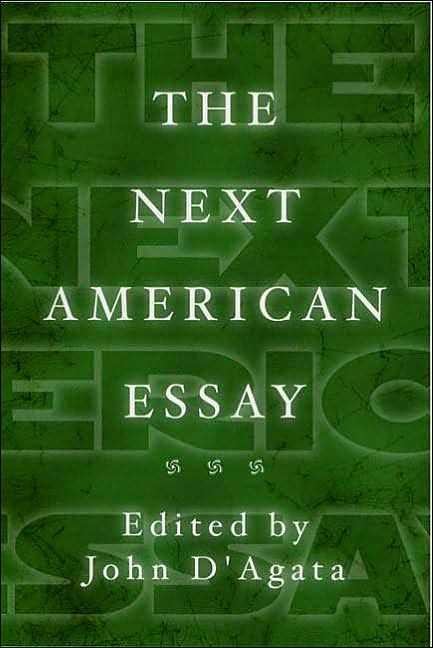
And yet, when I heard of the upcoming release of John D’Agata’s About a Mountain from W.W. Norton, I found myself again beginning to obsess over its event. Reading his Halls of Fame several years ago I become absorbed by it, some certain modes and designs therein feeling in my fingers a certain way, a manner of speaking that combines fact and vision, architecture and heart, packed in a style that looms and moves from page to page. As well, the two anthologies of innovative essays, The Next American Essay and the brand new The Lost Origins of the Essay (which I’ve also already torn through, all 700 pages, which is a whole other sets of posts herein forthcoming), each from Graywolf, have acted as buoys or maze-mirrors in the way of thinking about interpreting and approaching language as objects and objects as language in the world, tomes that anytime I’ve felt blank or stifled for new ways of writing I’ve opened them again and felt lit up.
Even in his anthologizing and therein collaging of others’ texts, D’Agata’s poise and manner has proved for me something magical to look after, and all of this at age 36: a blink of future by present day. Say what you want about the pursuit of ‘creative nonfiction’ (for which D’Agata, by hook or crook, is in some ways a young figurehead, with degrees in both nonfiction and poetry, his style a magic wedding of the two, and more), but in what can often be an over-stylized or navel-gazing (in a bad way) or simply a very difficult thing to make seem new, D’Agata not only wields that poetic essayist branch in a way that transcends any decoration, any term, but makes it something worthy of compulsion. Where for me great writing is great writing, some great writing is a true event, on par with any sort of aesthetic experience, and that is the most needed thing, what keeps the art of it in the body, and alive. It is what we need.
Such that, when About A Mountain finally showed up at my door last night in padded package, I did a little hop inside my shoes. My girlfriend pointed it out to me, “You did a little hop.” I was holding his new book: I had that feeling in me again, a door to open, in that rare glimmer of expectation. It even had blurbs from Wallace (“John D’Agata is one of the most significant U.S. writers to emerge in the past few years.” (which I remembered then that Wallace was likely the original reason I got into D’Agata back then in the first place)) and another one I look forward to with great excitement, Ben Marcus (“Here is the literary essay raised to the highest form of art.”), and as well, another charm, Nick Flynn (“Utterly amazing.”). I tried to convince myself right then I wouldn’t tear through it, that I would make this feeling last, and read the book slowly, taking time. Still, I sat down immediately and began.
Like the candy hog I am, three hours later, I held the book closed, read, on my lap, not even remembering how what just happened happened, how so much came out of such a frame in such an unexpected (even for D’Agata) and mesmerizing way.
Back up a little bit: this book is indeed about a mountain. Specifically, Yucca Mountain, an old hump 90 miles outside of Las Vegas, where D’Agata’s mother moves at the beginning of the book. The thing about this mountain, you may know, is that it for years has been the subject of extreme debate, a proposed site for the disposal of our nation’s nuclear waste. The controversy over this dumping, mainly centered around the hazards of it for the Vegas people, not to mention everyone surrounding (that is, all of us), becomes a centerpiece of the book’s strange turning, a trajectory that also includes a heavy dollop of suicide, Vegas being the suicide capital of the U.S. As it stands, intertwined with this mountain problem (which gets more and more hairy in quick, deft strokes) is a particular suicide, during D’Agata’s residence in the city, by a young man who jumps off the Stratosphere Hotel. (For a taste, there is an excerpt in this month’s Believer.)
This collision of local concern, both with the mountain (the city’s potential future) and, among other issues, the suicides (its black neon present), develops, in its own blinking, enthralling manner, a portrait of the quickest growing area of our country, a world many see as a mirror-hall unto itself. As D’Agata explores further the matter of the mountain, coursing through an oddly and beautifully connected association chain of facts and inquiries, he begins, in a style so immensely compelling and only his, to draw a relief portrait of the city, and in our surrounding of it, the United States. The facts of the absurdist bureaucratic method of such heavy matter are handled not as the potential deathmarch-making megalopolis that they are; instead a concern of how best to make a universal marker for the radioactive sludgehole as it survives us: how to speak to future civilizations among our changing languages to warn them of this sick hole we have created. A direct study, herein, implanted, of how words clear to many now might be seen by translators long after we are gone, as happens now with Old English, shows, in horrific calm, how transient and extinguishable anything we say might be, and how in translation, for the future, the slow (but rapid) smudging, resulting in a question of the means of creating space that transcends time.
About A Mountain, then, in its calm and innately-phrased 200 pages, becomes not just a recitation of the horror of our error, but a meditation on what drives a life, and death, how time changes the way we speak, how no way we can say a thing can outlast the products of our terror, how we try to hide the thing that could bring an easy end unto us all. And from out of this, what a scream means, the singularity of an object, how we communicate; how we are surrounded, every second, by neon light and fake meditations and an ongoing smudgery of some impending, more than death, more than a book is, more. I’d be more specific in elucidating the methods and makery of the book’s trajectory, but like the best tricks, it should stay something you experience of itself. However, simply put: from these facts and observations, D’Agata blends and bends a thing akin to mirrorhall. Whether extrapolating from a proposal of what might happen if the transported waste were to leak into our air, or how the nuke sludge could spread from containment into our bodies, how minor things can quickly become major against the odds; or whether exploring the fragments of a people, the suicided, the transitory make-up of one of the strangest and yet still human locations in our world, all of it operates in silent manic, a real mirage made out of what is right under our daily way.
What is perhaps most amazing, under the scope of what D’Agata is dealing with here, is how unassuming and navigable his object is. This is no headbeating, this isn’t navel-gazing. If anything, the magic of About A Mountain’s tone is how level-headed and clean it seems in its negotiation of such traffic, how quickly the slim but massive series of observations bead themselves together, wake. I found myself, as the book progressed, almost as if reading something in the calm adrenaline of shock: still and easy, having fun even, while in the book some kind of unnameable hole became peered into, opened up. I’m not hyperbolizing here: I really felt this.
And some things are worth hyperbolizing, because there is no other way to say. This is the power of the book, when in its best form it becomes an object separate both from the paper and itself, fused into a thing given from the author as if something he did not intend, and yet is wholly his, and only he could have ever said. If there had to be a single thing to learn from D’Agata, it might be his pristine taste, his eye: a thing far undermentioned in the way of approaching craft (perhaps because it is a thing, even more than talent, that you can not learn or buy, though if you could it would be from studying bodies such as what is going on in here). This is the kind of book that awe is made of, and without struggle, and becoming new. This book exits itself. It contains a kind of air. It is also the rare sort of creation that inspires both the want to talk about it reeling as I have here, and to keep it intensely against me, near to the self. As each person is Las Vegas, we want that glimmer sometimes only to ourselves, and yet can’t help building a taller sign.
With About a Mountain, John D’Agata becomes, if not remains, an author I would go to the store everyday to find again, again, if I could. While some books are so good they make you want to write, and some books are so good they make you not want to write, his is a vision, a building body, a sum beyond its parts. I hop." - Blake Butler

«A familiar cast of characters populates John D’Agata’s new book-length essay, About a Mountain. Activists, apologists, hucksters, linguists, lobbyists, opportunists, politicians, and rationalists—all take part in the debate over whether to store our country’s nuclear waste at Yucca Mountain, which stands about 90 miles northwest of Las Vegas, a suicide capital of the USA. If you keep up with politics, you won’t be shocked when facts get lost in the Senate’s formality. Or when stats abound but never match up. Or when everybody has opinions and the “science” to prove them true. Or when the Department of Energy (DOE) is the best improviser this side of Charlie Chaplin: Yucca is porous, you say? We’ll build a shield made of Alloy-22. Alloy-22 is corrosive? We have evidence to refute that—but sorry, those documents are classified.
I’m afraid that introduction likens D’Agata’s book to some stuffy tome about the eighth-grade dance we call the United States government, but that isn’t the case at all. On the contrary, About a Mountain avoids predetermined, pre-indexed conclusions. And smarty-pants rhetoric. And Clear Argument. And Evidence, put together in support of a Central Thesis. D’Agata’s book, in other words, is what people like me call capital-A Art.
Most of the book unfolds as follows: A scene plays out without commentary—no explaining, no editorializing. And then something sparks the writer’s curiosity, and the search for answers begins. Repeat.
After watching C-Span with his mother and her activist friends, D’Agata heads to the local mall, where between a Disney Store and a Cinnabons he finds Yucca’s informational center. Without a hint of irony, our writer describes the center, funded by the DOE, before shifting to a spokeswoman talking to students about her job correcting all the flubs in the local media. Here our writer supplies some information of his own: The DOE has wooed local teachers with nine hundred educational manuals, costing upwards of $800,000 to produce. The collage of story and fact continues: Information about Yucca’s porousness, and Alloy-22’s corrosiveness, is followed by a scene in which students use water bottles as containers, Silly Putty as Alloy-22, kitty litter as waste, and packing peanuts as a protective barrier, and try to form an airtight seal.
You can imagine the rest.
Having been told that waste stored at Yucca will be “safe” after 10,000 years, D’Agata tries to find out how this number could be so neat and tidy—a simple question which leads him to multiple agencies, to numerous acts and policies, to nonprofits and science academies, and, after many dead-ends and referrals and I-don’t-knows, to a waste consultant, who answers our writer’s simple question—Is the number arbitrary?—with a yes. And a no.
This is what D’Agata is up against. But he’s resilient, even when his pursuits proliferate and his inquiries lead only to other inquiries. What started as a book about a mountain changes into a book about Las Vegas and suicide and signs and language and death, and it reads like a wonderful and free-flowing improvisation.
We encounter our writer’s pursuit of meaning in his love of lists. And, boy, there are lists. There’s a list of doomsday hunches, from Genesis through Confucius and the Plagues, to Charles Manson and mushroom cloud novelties. There’s a list of the possible effects of a nuclear meltdown, which details the contamination of Vegas all the way down to the steel, the asphalt, hinges, bottles, nuts, and bolts. When referring to a linguist’s list of two hundred words shared across languages, our writer refuses to let the reader take his word for it—D’Agata lists each and every word.
At first this hyperattention to detail—the elevator’s “up” button, the page count of the local phone book—seems to be his way of reclaiming a little sanity, a way to revel in the hard details so lacking in the debate over Yucca, demonstrating D’Agata’s “faith in withheld meanings: the dream that if we linger long enough with anything, the truth of its significance is bound to be revealed.”
But those optimistic lines come early. As About a Mountain unfolds, the lists branch out and we notice how each item stands alone amid all that white space. We notice our writer isn’t cataloguing but attempting to reach a conclusion by accumulation. We begin to see that his task is immense, that he’s seeking answers to the Big Questions, the ones filed under: “The Unknown.” And we are thankful for the effort. But we also sense that at the end of these virtuosic riffs, our writer, despite his efforts, knows he may not know enough.
There’s enough here to fill a prescription for anti-depressants. The death of language. The suicide of a teenage boy. The politics. Vegas. Meanings unrevealed. Or do the meanings reveal themselves? Our writer has a nearly inhuman depth of perception, and readers can take hope from how, in the face of his uncertainty, D’Agata puts his fine improvisational mind to work, where meaning dissolves into nothingness, where low ceilings are protection from God, where suicides occur by the dozen, where cakes are the size of football fields, and where language is as porous and corrosive as that damn mountain.» - Kevin Evers

"I wanted to say a little about John D’Agata’s new book, About a Mountain, even though it wasn’t published as an essay in a literary magazine, to me, it is still an essay albeit one in book-length form. What makes it still an essay is the way it accumulates information after focusing intently on one laser-fine point. The way About a Mountain accumulates and asserts its topics parallels the topics themselves. So when D’Agata begins About a Mountain by describing Las Vegas’s centennial celebration, he is laying out the formal strategy for the whole book and subtly tucking in the issues the book will address. From this narrow focus, D’Agata lays the groundwork for the rest of the text: the population explosion of Las Vegas, the high-concentration of freaks in Las Vegas, the multitude of Elvis’s. From a single instance, 2005 at a parade for Vegas’s centennial celebration, D’Agata touches on all the subjects the book will address. Take for example the multitude of cash stores the parade passes: “We marched past Kostner’s Cash, and we marched past Super Cash, and we marched past Gambler’s Pawn and Loan and then an empty lot” (12). The issues addressed by the whole book emerges from these first pages examples. Things will explode here. Things will proliferate. The mold of Las Vegas had been cast long ago and time will accumulate enough neon, enough Elvises, enough cash, enough waste, to fulfill that mold.
Proliferation, explosion, exponential growth. Each of these are words to be ascribed to what appears to be D’Agata’s primary subject: Yucca Mountain and nuclear waste. Half-lives and millennia and the semiotics of language and the multitude of things that go wrong serve to parallel those first few pages’ promise. The essay, unlike other forms of nonfiction, creates from its first images, scenes and words choices the path and exertions of the text as a whole. Said more simply, the essay makes a metaphor of itself early on and, through that metaphor, guides the reader on how to read the essay.
So it makes sense that the idea of proliferation, desert-craziness, populations, the multitude of cash stores act early on as a metaphor for what D’Agata’s primary subject seems to be: nuclear waste storage. And so, when one learns on CNN that the whole Yucca Mountain as storage site has been quietly scuttled thanks to a deal between Obama and Harry Reid, you wonder, does this hurt the topicality of D’Agata’s book?
Since the problem of nuclear waste storage doesn’t go away with Obama’s signature, I’d argue no. But I’d also argue no based on the argument that the essay’s larger subject is about proliferation, form, explosion, and exponential growth and while this does work nicely with the issues surrounding nuclear waste, it also parallels nicely with what I think is D’Agata’s larger project: to understand how language does or doesn’t work. Language is meant to communicate, he argues, but language proliferates, explodes, dies outside our control. Therefore, when D’Agata investigates how we’ll create a sign that will tell our future selves—no, don’t go here into this mountain full of waste, he’s really talking about how language, like population growth, like nuclear waste, changes, and even escapes us, without our being able to predict or manage that change or escape.
The essay works then, like a Matroyshka doll with a set of images and scenes that repeat themselves, in larger and broader contexts. So from that straightforward centennial celebration scene at the beginning, to the descriptions of Vegas’ exponential growth, to the politics of nuclear waste storage, to the problems of scientific authority, to the nature of language, we finally arrive at the to the particular-to-Vegas, proliferating, political, scientific and language-failures attendant to suicides. D’Agata never abandons his formal essay project about proliferation, explosion, and exponential growth and it’s subject is as explosive, proliferate and expounding as the nuclear waste that becomes just one of the many subjects D’Agata juggles." - essaydaily.blogspot

«In Las Vegas, a city famous for its extravagant and perpetual avoidance of reality, even the natural disasters are unnatural. Lake Mead—the largest man made body of water in the world and chief water supply for the city—is draining at a staggering rate. A major drought in the city wouldn’t really be a drought, not technically anyway, but the terrain protesting its own facelift. Las Vegas is rightly a desert. A little over two hundred years ago, this changed. Aberrant rains pummeled the area, bullied its hard sands and dry brush into lush, green meadows. But this transformation wasn’t to last. The new vegetation had no roots, no intentions of staying. Soon enough, the land struggled to reveal its true nature. But Las Vegas was having none of it. The city pressed on, refusing defeat, solving one problem after the next in order to survive.
In the recently published About A Mountain, John D’Agata takes two hundred pages of meticulously researched narrative journalism and uses them to cast a wide net over the city of Las Vegas. More than the location where a story unfolds, it becomes an effective catchall for this: our very own impossible moment in human history. The jig is up, and people are taking notice. We’ve got loads of nuclear waste and no safe way, no place, to store it—seventy-seven thousand tons to be precise, and when it comes to numbers, D’Agata is nothing if not precise. From an array of what should be reliable sources—Senators, scientists, the Department of Energy, sociologists, semiologists—he relays information, the accurate and the inaccurate alongside each other. Weighted equally, the result is disturbing. He shines a light on contradictions, conflations, bent realities. All this in an absurd parade, outing as false the notion of absolute truths.
Enter Yucca Mountain, about ninety-miles outside of Las Vegas.
Until recently, when Obama pulled the plug on the dubious project, Yucca Mountain was the intended site to stash all that nuclear waste. D’Agata reports the various plans for waste storage—dozens of different ways and reasons to essentially shove the waste inside the mountain and patch up the holes. In the dark core of an unassuming mountain—D’Agata calls Yucca “a squat bulge”—the discarded remains of our nuclear pursuits would linger for hundreds of thousands of years. Yucca would become the biggest carpet under which the biggest mess would be swept. The Department of Energy cited a time frame of ten thousand years: an arbitrarily selected number, an effort to soothe the minds of an anxious and skeptical public with the illusion of a finite and presumably manageable period of danger. That comforting number and its five easy-to-imagine zeros persists in heated barroom debates, the local and national media, and all official records, making it all too clear how willing human beings are to accept a truth far closer to fantasy. If Las Vegas and its surroundings are any indication, we straight up crave it.
Las Vegas and its notorious strip are the epitome of fantasy gone fact. Crossing city lines is like cracking the spine of a novel: Vegas demands that we suspend our disbelief in favor of experiencing an alternate reality. The suburbs too: the newest housing developments have lush green lawns and homes built to resemble New England colonials. Voted 2003’s Best New All-American City, D’Agata presents Vegas as a city with a muddled identity, an analogue for the mirage of grave truths, the hard facts, the science and the assumptions of permanence that surround the Yucca Mountain waste disposal project.
More delusion than illusion, Las Vegas evolved rather quickly to believe its own hype. A city built not just on promise, but the promise of promise and so on and so on. In 2003, the New All-American City was also voted the Meanest City in America. With its glitz and gore, its attempts to counter darker realities with porch swings and picket fences, Vegas is more American than America. D’Agata captures all these angles with a well-examined portrait of a region where hyperbole and spectacle mask their opposite. Even the imposing natures of the structures that loom over the strip—mountains themselves, if you want to push an easy metaphor—are revealed as impermanent.
“If you build something and it fails,” a local art historian tells D’Agata, “you blow it up.” The city exists but for the whims of tourism—economics. “The city doesn’t assume anything’s permanent.”
That’s where the analogy gets frightening. If Yucca fails, Las Vegas—at the very least, Las Vegas—goes down with the ship.
About A Mountain leaves a reader with little doubt that the dumpsite is neither good nor safe—an assumption, I’d imagine, most would bring to the reading of such a book. So it’s in degree rather than revelation that the story of Yucca Mountain surprises, its method rather than its madness. As D’Agata trails the proposed project, he is shown, and shows us, again and again that the idea of Yucca Mountain as a safe dumpsite is a farce, a carnival, as phony baloney as the giant sphinx welcoming guests at the Luxor Hotel. D’Agata does all this with prose that is so engaging, so crafted and spare, often poetic in its density, its urgency, that it’s easy to forget he’s banging us over the head with statistic after statistic, poll result after poll result, expert opinion after opinion.
Our proclivities for being duper and duped both established, Yucca Mountain all but vanishes from the text. The book’s main digression—the suicide of an area teenager, Levi Presley—becomes its focus, thus expanding all that came before with one brisk step, a daring switch-a-roo.
During the summer he lives in Las Vegas, D’Agata volunteers at a suicide hotline. Three hundred people a year will kill themselves within the city’s limits. When D’Agata reads about Presley’s death, he’s fixated, convinced he spoke to the boy the night he killed himself. He seeks out Levi’s family, pokes around in his bedroom, visits his school. But D’Agata was wrong. He never spoke to Levi. Still, in his mind, the boy’s death and the Yucca Mountain debate remained enmeshed. In his book, the stories are intertwined from the beginning. They mirror each other, though D’Agata writes, “There is no explanation for the confluence that night of the Senate vote on Yucca Mountain and the death of a boy who jumped from the tower of the Stratosphere…in the center of the brown desert valley.” No reason, forget reason. As informative as About A Mountain is, it’s the book’s humanness, its un-reason, that make it more than an exposé, more than an exercise in narrative journalism, more than “cultural studies” as the market driven back of the book would have you believe. It’s a powerful and potent essay by a writer at the top of his game. It’s likely no coincidence that many of D’Agata’s crisp sentences are reminiscent of Albert Camus’ who wastes no time in his own essay, The Myth of Sisyphus, telling readers that the only philosophical problem worth considering is that of suicide. To be or not to be. All else is permutation. Forget about mountains.
D’Agata tells us very little about Levi Presley, thus the boy achieves mythic proportions. And it’s here, that About A Mountain treads dangerously close to an uncomfortable exploitation of Presley’s death, an easy device to further the book’s narrative drive. This can of worms is smartly avoided by the discretion with which D’Agata both reveals and conceals the details of Presley’s life and his death. He doesn’t try to understand Presley’s suicide. He makes no claims of sovereignty over his obsession. How tempting to do so. How easy. Instead, he details in careful simplicity the path the boy likely took from his bedroom to the Stratosphere’s roof where he jumped. Restraining himself from commentary, D’Agata solidifies his role as a savvy, yet idiosyncratic witness. We trust him not for his authority, but because—like us—he has no answers, no easy path towards wisdom.
“I do not think that Yucca Mountain is a solution or a problem,” D’Agata writes in the paragraph that functions as the book’s hinge; Yucca’s failed spectacle and Presley’s death begging attention on either side, each unaware of the other’s nearness. “I think that what I believe is that the mountain is where we are, it’s what we now have come to—a place that we have studied more than any other parcel of land in the world—and yet it still remains unknown, revealing only the fragility of our capacity to know.” D’Agata’s take on Yucca Mountain is eerily similar to the Las Vegas coroner’s take on suicide: “It’s a manifestation of doubt, the ultimate unknowable. Suicide is an ugly reminder that none of us has the answers.”
Levi Presley and Yucca Mountain anchor About A Mountain. Disparate topics to explore in such a short book, but D’Agata makes it work. He states early on that a number of other horrible things happened the day of the Senate’s Yucca vote—a murder and another suicide among them. Why, then, Levi Presley? In his notes, D’Agata admits to a subtle tweaking of the calendar, shifting a few dates, merging a few months, in favor of “dramatic effect”. (Presley actually died a few days after the Senate vote.) This admission is laudable—necessary these days—but it’s also revelatory. He isn’t giving us a textbook, a newspaper article. Despite his quest for accuracy, he isn’t reporting. D’Agata’s shooting for something else. About A Mountain is a portrait of a mind at work, something that doesn’t always rely on linear time to create logic. Why Levi Presley? Some things just stick. For a writer, these haunting images and events often require a linguistic exorcism. Levi’s presence in D’Agata’s book feels as arbitrary and unavoidable as it must have been in his mind. And, as with any good essay, it’s the writer’s mind as much as his material that we hope to catch a glimpse of.
Yucca Mountain and Levi Presley are static characters. About A Mountain’s narrative tension comes from D’Agata’s style—his quirky lists, his piles of statistics, his wandering digressions, his lengthy quotes from experts and the pointed few moments when he reveals his own fragile opinions. To seamlessly tell two stories at once, to admit they have no reason for being in the same book, and yet make them read as one is the great structural accomplishment of About A Mountain. By the end of the book, one can’t imagine separating the two.
D’Agata’s prose makes sense where there is none; reveals not the story, but the struggle of a mind seeking meaning: “The dream,” he writes, “that if we linger long enough with anything, the truth of its significance is bound to be revealed.” .To read on while a mysterious, young boy dies, to imagine seeing him wave his last wave on a casino security tape, is to look ourselves square in the eye and give our own little wave, timid and without the conviction of Levi Presley and the other 299 people who killed themselves in America’s suicide capital in 2003.
There’s not much hope in About A Mountain. And that’s a good thing. For once, the recovery narrative’s close cousin, the solution-based narrative—both so popular in our culture—is thwarted. We’re all implicated in the final pages. There’s no redemption, no last patch of white space dangling one more paragraph, the one we expect to clean up the mess of whatever came before. There’s just a vast freefall, a means to the same end whether you jump, watch, or look away. John D’Agata trades fantasy for fact and ultimately rejects both in favor of the indefinable: Truth. And, as with all significant truths, beautifully crafted literature among them, the effect is equal parts liberating and terrifying.» - Sara Nelson


"What’s most important to know about D’Agata’s book is that regardless of the objective slipperiness you may or may not feel, the burning central question he’s addressing in his book is riveting and worth all of our attention, and that question is: how does info get transmitted, get communicated? (see here–a recent interview) Ostensibly about Yucca Mountain and spent nuclear waste and whatever system will need to be invented to hip future generations to the fact that there’s wildly, hugely dangerous stuff buried within (imagine a life-almost-ending catastrophe and consider our present responsibility to the future to let them know about the nuclear shit we’re unable to clean up; imagine what the sign would have to say, or look like, and/or in what language[s]). Of course this stuff has to do with semantics and symbols, has to do with information encoded and transmitted in certain ways…
…which has everything to do with the darker, harder part of D’Agata’s book, which is threaded throughout (the whole book’s threaded: D’Agata’s not a straight-line-follower; things meander, and satisfyingly/beautifully) his considerations of Yucca, of the government’s decision-making process about Yucca, about Vegas and its birthday, and that darker/harder part has everything to do with the fact that Las Vegas has the highest suicide rate in the country. And of course the photographed and understood feel of Vegas is basically anti-suicidal (especially if we’re thinking Greek, thinking Eros/Thanatos), but so then why? What info is being transmitted or telegraphed to citizens of that city that ups the odds of fatal jumps, of swerved vehicles, of etc.?
There is of course no answer. More important, the answer itself (even if there was one) wouldn’t matter—the glory of D’Agata’s book is how he crafts his question and consideration. It’s a stunning book, and for anyone who isn’t aware, the new generation of nonfiction masters (if we’re looking at Conover and Vollmann and LeBlanc and Wallace and Weschler as the last generation) is here, and D’Agata’s right at the very front of the pack (tied, I’d argue, with Monson, who’s Vanishing Point‘ll be here covered closer to publication date)." - Weston Cutter
"(John D’Agata’s writing is one of the reasons why being alive in the present moment is fun and exciting. If you need a more thorough explanation of why that last sentence is true, you’re likely without two of the best anthologies ever, and/or you’re likely without two of the best pieces of literature in the last decade or so. Should you own his “About a Mountain” and “Halls of Fame“? Of course you should. Should you own “Lost Origins of the Essay” and “Next American Essay“? Obviously. We’ll run a review of his “About a Mountain” soon, but, until then, here’s an interview with the man).
Has writing always been something you’ve been drawn toward, or did you end up writing because snowboarding didn’t work out (or something like that)? And did you ever spend time working toward/in poetry and/or fiction? What ended up being the big draw for nonfiction–and, especially, the experimental sort of nonfiction you’re involved with?
- It was Latin and Greek not “working out” that led me eventually into writing. I’d been studying Classics for a long time as a kid (because my mom is funky and was always a little overly ambitious for me). And in college I was still studying Classics—pretty much only Classics—until after I returned from a year abroad in Rome where I had been spending every day attempting to do translations. And I actually like translating, but what I didn’t enjoy was the realization that these languages that I’d been studying privately for years with tutors were part of a world I really didn’t want to be a part of. What I loved about Latin and Greek as a kid was that none of my friends were studying these languages, so all of the writers that I was exploring at the time—very rudimentarily, of course—felt like imaginary friends, and their texts truly did feel like a secret language. Living in Rome for a year kind of ruined that immature fantasy for me. So, immaturely or not, I basically abandoned Classics and started an English major. And while trying to fulfill some electives, I bumped into creative writing, particularly essays. It was then that I realized that essays were what I’d been reading and enjoying all along as a kid. So it was destiny.
What/who are some of your literary and/or stylistic influences? Was there some specific book or author who pushed you into writing, and specifically into nonfiction?
- Didion. Not that I resemble her in any way as a writer, but I recall being astonished by the level of control she wielded over her essays. And while she’s changed a lot over the past ten to twelve years as an essayist, I’m still in awe of her work. I would say even more so perhaps, because it’s even more confident these days.
Regarding About a Mountain, did you set out to write the book that you ended up writing? If not, what was the book you were aiming to write? Or was the book initially about just the politics of putting spent nuclear fuel inside a mountain?
- I set out to write a funny book, actually. All I knew about Yucca when I started researching the mountain was that an obscure government panel had been formed about a decade earlier to investigate how to mark Yucca’s site with a warning sign whose message and medium could remain intact and coherent for 10,000 years. I thought that that was going to be entertaining enough to carry me for a few years. And my only real objective was to write amusingly about it. But in the midst of researching Yucca my mom moved to Las Vegas, which is just south of the mountain. And that suddenly changed everything. In the book it’s suggested that it was my mom who introduced me to Yucca, but in reality I had been poking around the subject for a few years thanks to a friend who was working as a subcontractor on the project. With my mom’s arrival in Vegas however, my attitude toward both the place and the project dramatically changed. Because now this nuclear waste that would be headed for Yucca Mountain was going to be traveling within a dozen or so miles of my mom’s new home, and so of course the book became more political for me. It became personal, and far less funny. Of course, it’s still absurd, but it’s tragically so.
In terms of craft and your own writing, what’s the process like for creating/discovering the structures that you end up using?
- I tend to need a form to work out of before I can begin really working on a project, but I also try to resist imposing form on subjects. I tried forcing a pre-conceived idea of a form on this new book, for example, and it backfired. That’s one of the reasons why it took me nine years to write About a Mountain, because I had to start over from scratch about five years after starting it. I was trying to jam the book into a form that it simply wasn’t meant to take. So my process is a lot of trial and error. For me form isn’t just an affectation; it’s part of the experience of a text. It needs to work in tandem with an essay’s argument. Otherwise it’s just a gimmick, a distraction.
The book is fundamentally about communication, and at book’s end you seem to close on settling on an idea of Las Vegas as a place which induces this feeling of despair/void…yet you marched in a parade for the city (and ate its birthday cake), and seem to like it quite a bit. Was Vegas itself what you wanted to write about, the draw and repel of it? Is any of the above accurate–do you actually not like it at all, and is the book not actually about communication?
- I like Vegas a lot. My first book actually featured a few Las Vegas subjects as well. And I marched in the city’s parade because I found out that I share a birthday with the city, which I honestly found exciting. So while that “despair” that’s felt at the book’s conclusion is real, so is my love for Vegas. The Las Vegas that is criticized in the book is a Vegas that, for me, is emblematic of America. Certainly, most of America doesn’t look or feel or function like Las Vegas, which is why Las Vegas is special. But, on the other hand, most of Las Vegas doesn’t look or feel or function like Las Vegas, which is a point that the book makes. Las Vegas is mostly an idea, it’s a conceptual tourist destination. I mean, it’s a real place that people visit of course, but it’s the idea of the place that people bring with them to Vegas that really makes the city what it is. Otherwise, Las Vegas is just a town with a big amusement park at its center. It’s not like the families that live there or the politicians that run the place have a looser sense of morality than the rest of the country. It’s not there are no laws there. I grew up in an adorable little seaside town of 5,000 people on Cape Cod and I can tell you without a speck of hesitation that the politics and the people of that place are a hell of a lot nastier than anything I’ve encountered in Vegas. So I like Vegas. It’s what we as a nation have decided to allow Vegas to represent in our culture that I find problematic. Because what it’s representing is inside all of us. We really do not leave it there when our vacations are over, no matter what the city’s advertisements like to tell us. We bring that shit with us and it follows us home.
On the issue of “communication”: sure. I think the book’s about information, personally. But information is a form of communication, so I think that works.
Just out of curiosity, what was the initial tug for compiling the essay collections? Simply their lack, and that you had the urge to see them realized? And did you know/sense from the start that you’d end up with three massive volumes? And how unbelievably tough is the compiling/editing process involved?
- I first started thinking about the anthologies in grad school. I was in school during the late 90s, right smack in the middle of the burgeoning memoir thing. So my interest in putting together a history of “this kind” of essaying was, admittedly, reactionary at first. I want to demonstrate that there was more to the genre than how we seemed to be interpreting the genre at the time—and, to some extent, more to how we are still interpreting it. So yes, it was in response to a lack. But not just of anthologies. There was a lack of conversation happening in the genre about our heritage as writers, or even about of our place in contemporary literature. I was far more cocky when I started the anthologies than I am now, and I thank the gods for that. Because I don’t think that I’d have the guts today to demand from readers what I demanded from them in that first anthology. Although, oddly enough, I think the second anthology—which is the newest one—is the one that’s gotten more people upset.
In editing the anthologies, you said the impulse was somewhat reactionary at first. How has the guiding principle or impulse changed since then, if at all? Do you think (in general, in publishing) there’s less an emphasis on the monumentally first-person-based stuff of a decade/decade-and-a-half ago?
- No, I think the publishing world would still like nonfiction to be history, commentary, or personal writing—easily marketable categories. It’s still uncomfortable with the more meditative stuff that has primarily comprised work in this genre throughout history. And that’s probably one of the reasons why the book industry shifted from using “essay” as a term to describe what goes on in this genre, and started embracing “nonfiction.” So my guiding principle hasn’t changed since I first started the anthologies. I’m working on the last one now, and I still feel the same need to remember that there’s a lot more to this genre than the achingly boring confessional stuff that’s been overwhelming us since the 90s.
What is experimental nonfiction? Further, does a distinction like that matter that much to begin with?
- The distinction doesn’t matter. You can call this work whatever you want. Just don’t call it “nonfiction.”
What’s the view out your window?
- Hmm. Something witty, I wish." - Interview with Weston Cutter

"D'Agata uses Nevada's Yucca Mountain, once a proposed site for storing the U.S.'s nuclear waste, to meditate on a variety of ecological, political, and personal topics, including the suicide of Levi, a Las Vegan teenager, in About a Mountain.
Why did Yucca resonate so powerfully with you?
- A friend of mine, a technical writer for a subcontractor at Yucca, knew that I'd find something peculiar in what was going on there. I toured the mountain and immediately found the project interesting. An attempt to hide nuclear waste for 10,000 years? That's kind of fascinating. At a Q&A afterward, someone in the audience asked a spokesman from Yucca, “How are you going to ensure the mountain is secure?” And the spokesman matter-of-factly responded, “We're going to build a sign, and we're going to make sure the sign remains physically intact and coherent for 10,000 years.” And I thought: that's preposterous. Written language isn't even 10,000 years old! I was hooked and spent the next few years researching the goofy government-sponsored studies that had been conducted in preparation for the project. But then out of the blue, my mom moved to Vegas, and my relationship to Yucca changed. I wouldn't have written the same book if my mom weren't going to be living in the path of high-level nuclear waste. I would have written an excessively ironic book about nuclear waste being sent to a mountain outside of Vegas, America's preeminent “throw-away” culture. Hardy-har-har. Thankfully, I didn't write that book. This project made me take Yucca and Vegas more seriously. And it made me try something as a writer that I hadn't attempted before.
The book covers so much ground. Did you follow various whims or did the issues ramify as you went along?
- Initially I found myself forcing a very “writerly” braiding of these issues, but these attempts felt too postured and overly processed. Eventually, I started juxtaposing material, allowing these issues to speak to each other more naturally. The risk in doing this of course is that everything can become metaphor. Is the boy who kills himself a metaphor for what's going on at Yucca, or is Yucca a commentary on this boy's suicide? But I like the ambiguity. I like not being entirely clear where the emphasis lies.
You perform a very delicate balancing act in juxtaposing Levi's suicide with a host of other issues without minimizing the tragedy of his death.
- It's crude to admit it, but before I tracked down his parents, I had only been thinking of Levi as a way to talk about Yucca. But that changed once I met his parents and saw his photos on their refrigerator and his art in his old bedroom. I started feeling as if I knew him in some way, and yet, I also know that I don't understand the first thing about what he felt before he died. But it took getting to know Levi through his parents before I could really feel the potency of that kind of unknowing. This book, for me, is about that not-knowing: whether it's concerning Yucca Mountain, suicide, or the delicate vulnerability of our future as a species. " - Interview with Parul Sehgal

John D'Agata, Halls of Fame: Essays (Graywolf Press, 2003)

"John DąAgata journeys the endless corridors of Americaąs myriad halls of fame and faithfully reports on what he finds there. In a voice all his own, he brilliantly maps his terrain in lists, collage, and ludic narratives. From Martha Graham to the Flat Earth Society, from the brightest light in Vegas to the artist Henry Darger, who died in obscurity, DąAgataąs obsessions are as American as they are contemporary. Halls of Fame is an absorbing, utterly distinct book that hovers on the brink: between prose and poetry, between deep seriousness and high comedy, between the subject and the self."

“John D’Agata is one of the most significant U.S. writers to emerge in the past few years. His essays combine the innovation and candor of David Shields and William Vollmann with the perception and concinnity and sheer aesthetic weight of Annie Dillard and Lewis Hyde. In nothing else recent is the compresence of shit and light that is America so vividly felt and evoked." — David Foster Wallace

“Here is an essayist who fears nothing.” —Andre Codrescu

“D’Agata writes masterful sentences, in all forms. Adept at collage, found poetry, paragraphs long and short, lists, characterization, direct quotes, the prose poem, fragments, spoofing, and a perceptiveness that sometimes only dispassionate description can achieve, D’Agata hovers like a moth around the sparks created where the known and the unknown rub against each other.” —Ruminator Review

“With the diligence of a manic tour guide, D’Agata exhaustively catalogues his encounters, inventing whole new ways of looking as he goes.” —Rain Taxi

“A special form of creative nonfiction lives in the territory between poetry and essay. These alluring hybrids are meditative, musical, artful, more imagistic than informational.” —Northern California Bohemian

“John D’Agata’s journey through genres, the American landscape, the history of thought, and the history of lyric action—a journey beautifully agonized over as he struggles between sentence and line—is the beginning of a journey for us as well with a voice that is changing our conversation with the world.” — Jorie Graham

“What I admire about John D’Agata is the restlessness of his mind, the way he writes to the directives of some internal imperative that drives him to continually seek out new shapes in language that might meet something crucial, urgent, insatiable in him. He makes his obsession palpable and irresistible to the reader.” — Carole Maso

“‘He had a knack, which was his lure, for both the mundane and fantastic’—so says John D’Agata about one of his book’s eccentric population, but he could be describing his own omnivorous self. His writing is marked by an exuberance of structural invention, by an ever-churning hurdy-gurdy lexicon of lingual play, and by citizenship in the mazes of the mind and in hallways that mimic Ripley’s Believe It Or Not. Or, to update that last comparison: Halls of Fame is to essays what the Museum of Jurassic Technology is to gallery dioramas.” — Albert Goldbarth

“The dialectic between showing and looking, between telling and knowing, is D’Agata’s subject and his supremacy; these lyric essays result in further questions, for such a process does not “lead” to mere answers; when such prodigies of mystery as Henry Darger or Martha Graham are at issue, this turn of mind, this trope of thinking, is a revelation; that is the discursive poet’s program: to reveal, and indeed his progress through the generality of our native offerings is a triumphant one; not since Butor’s Mobile have I learned so much about America’s creases and crannies, such learning being a complexion of pains and pleasures.” — Richard Howard

"An exemplar of the literary movement toward linking the genres of poetry and the essay, D'Agata, a recent University of Iowa nonfiction and poetry MFA graduate, blends both to create an inviting, elliptical puzzle of American life. In seven pieces (which have appeared previously in such journals as Paris Review and Ploughshares), D'Agata examines disparate American subjects that include the revered (Hoover Dam), the unknown (outsider artist Henry Darger) and the merely spectacular (the beam of light at Las Vegas's Luxor Hotel). Most of the lyric essays are structured as journeys, in which the melancholy narrator searches for meaning through others, like the founder of the Flat Earth Society and the Luxor light guide. But he finds their offerings limited and unsatisfactory: they explain different ways the world works but provide little solace. Similarly, "an essay about the ways in which we matter" surveys America's approximately 3,000 Halls of Fame, including the Billiards Hall of Fame and the Shuffleboard Hall of Fame, revealing longing and family discord. Although D'Agata's Hoover Dam essay pays homage to Joan Didion's "At the Dam," and his "Collage History of Art, by Henry Darger" spurs thoughts of Joseph Mitchell's "Joe Gould's Secret," D'Agata eschews the structure of the traditional essay, in which meaning accrues from paragraphs of prose. Instead, he offers a work that can and should be reentered several times from various points to generate effect, whether unsettledness about the world or pleasure at D'Agata's artistry. Like poetry, all of what D'Agata offers takes a while to sink in. (Jan.) Forecast: Blurbed by writers as diverse as Annie Dillard and John Grisham, this book may gain an MFA-school following, in which case mounds of imitators will be leaving lots of white space in their essays attempting to achieve what D'Agata does seemingly without effort. An author reading tour and national advertising will help bring this title to the attention of readers who like to keep up with the cutting edge of literature." -
Publishers Weekly

"I started reading John D'Agata's HALLS OF FAME before the vicious events of September 11th. It is a collection of essays that I was not certain I would be able to finish. The first section, Round Trip, focuses on the Hoover Dam, and not just the dam itself, but the dam as one of the seven wonders of the modern world. Hold that idea a moment.
As far as HALLS OF FAME being non-fiction, you might as well toss any ideas you hold dear of what is meant by essay and non-fiction. We are in that tricky terrain of experimental writing once again, so all definitions are off. As the borders between essay and lyricism, journalistic writing and memoir blur, the chances of becoming lost increase. At times HALLS OF FAME reads distinctly like personalized fiction. I have begun to think that two patterns might apply to experimental writing in general: (1) try not to be clear wherever possible (2) make the reader work right up to the edge of alienation in order to understand the text.
The other complication is that John D'Agata may really be a poet. The book, though, is billed as essay. Poetry is the genre of paring away to reach the essential. Take Robert Frost's poem, Fire And Ice, "Some say the world will end in fire, some say ice..." Instantly, you are placed within the poem. An essay, though, invites elaboration. Phillip Lopate praises Mr. D'Agata on the book's jacket--a maximalist's intelligence with a minimalist's style. But I often felt left out, as if I'd been strung off on a tangent of impressions without the supporting facts as to where I was, what I was supposed to be considering or coming to see.
But when Mr. D'Agata hunkers down to a particular local, takes us with him on a readerly journey to places like, August Hall Of Fame: An Afterward On Heat, Baker, California (the world's tallest thermometer) or the Hall Of Fame Of Groom, Groom, Texas (home to the world's second largest cross), or the Hall Of Fame Of Them; Rachel, Nevada (aliens in the desert), or The American Police Hall of Fame, Miami, Florida (1881, Judge Roy Bean sentencing a Chicano to be hung, his corpse left to the vultures--ethnic slurs included), he's right on target in his own idiosyncratic take on the hard-to-believe-reality of out there America--hall of fame style.
Which brings me back to the Hoover Dam, a phenomenon worthy of anybody's list of wonders. Seen through that context, the sheer vastness of the engineering marvel comes home. We are notified of the original seven wonders through Antipater of Sidon (from his lost guidebook, c. 120 BC): "...and I tell you, as a scholar and as a wanderer and as a man devoted to the gods, they are and always will be the Seven Greatest Liberties man will ever take with Nature." That, centuries ahead of liberties like the Golden Gate Bridge, the Apollo Space Program, the Trans-Alaskan Pipeline, Hoover Dam and, of course, the World Trade Center. Most of D'Agata's interviewees included the Twin Towers on their list of the seven modern wonders of the world. Remember, I read that part before September 11th. By that date, I had gone on to the rather murky section, Martha Graham, Audio Description Of. (Audio?)
With Martha, I had slowed down to the point of sleep. I apologize, but if I have to work that hard to read a book, my eye lids begin to take on poundage. I gathered Ms Graham had a thing with drink and that she treated her men badly. She had this bit with a red scarf that she spun in--famously--in one of her ballets, and maybe John D'Agata saw her perform the red scarf spin as a boy sometime around the time his mother left his father, but maybe he didn't and maybe his mother didn't leave his father. I was lost and tired and confused and at that moment I just didn't care.
Two high-jacked planes had sliced into the World Trade Towers like they were big, stacked cubes of soft, silver cheese. My aunt called me with the news. I was dragging a cup of coffee up to my desk when she phoned from her high rise in Manhattan. From the perch of my small roof garden I was able to see two long ribbons of black smoke exhaling from wounds in either tower. My view was of the top third of them beyond the Williamsburg Bridge. The gashes did not yet seem mortal. But then came big licks of flame and I thought, this is going to be ugly. Some of the black smoke turned white and began to billow from below, and when it cleared for a few seconds it became stunningly clear that only one tower was standing. Soon the other one sucked its breath and fell too; no fuss, no blow-out, no big bang, just folded up like a house of cards and was gone.
After that it was days before I could concentrate.
I couldn't figure out what to think. I'd look outside and see this toxic plume where the Trades used to poke into my skyscape. I never liked them, architecturally speaking. They were such ridiculously high buildings, and the WTC was not part of my stream. I swim the world of art, they were the epitome of world commerce. Also, I had a fear of the sheer height; nothing could ever induce go to the top, let alone work in the towers. But on Tuesday I kept imagining all those people inside that did.
A friend told me of a friend whose job is watering plants in business offices. A freelance waterer. (Apparently they can't lift a watering to their own potted greenery.) This fellow's day to water at the World Trade was Tuesday. He got a call on Friday asking if by any chance he could do the watering on Monday-- Now, see, watering plants is something I could do, and even feel good about, and maybe, just maybe I might have been convinced to do so in the World Trades--for a vast sum of money--though I'd have gripped the elevator walls the whole way up, and back down, palms sweating, breath irregular each time I did, and no way would I have even glanced out a window. Anyhow, the friend's friend saw to the plants on Monday, September 10th, so they were well-watered on their last day of life.
On the morning of maybe the fourth day into the new reality, I thought of a brand new hall of fame for John D'Agata: Vanishing Buildings.
After the part on Martha Graham comes, Flat Earth Map: An Essay. There is a society, headed by an eccentric who lives in the Mojave desert, that believes the earth is flat. Sincerely. I wondered, after reading it, if the flat earth folk know that the World Trade were dug seventeen stories into the earth--each--and that the stuffing that came out of the trenches make up the landfill upon which now sit much of Battery Park?
The next section is about kouros, those early Greek figures, Hall of Fame: An Essay About The Ways in Which We Matter. I found this section hopelessly inconclusive. Hall of Me also left me blank. Notes at the back of the book, explaining that D'Agata work at a Cambridge, Massachusetts, sperm depository while he was a student, didn't help.
My favorite piece was the last, And There Was Evening And There Was Morning. It takes place in Las Vegas, and is about light. This section is brilliant, no pun. The Luxor Hotel and Casino boasts a light so bright, that shoots so far into the sky, astronauts can read by its light when they pass overhead. There is no sunset in Vegas, we learn, only a slightly noticeable dimming of natural light all but canceled out when the lights of the casinos rip on. Bigger, better, brighter, an artificial world based in the most powerful force of all--let there be light. Party more, drink more, gamble more, sex more; cease sleep. Life is light, the theory in the desert oasis goes. PS: Las Vegas is also home to the largest number of sleep disorder clinics in the world.
I walked through Times Square the other evening at around dusk. I happened to be in the area with some friends and we decided to walk instead of jumping on the subway. The artificial lights did blot out the sense of a setting sun, and people did seem less weighty in their gait. I almost forgot about the wreck downtown until I remembered Robert Frost's poem, "I think I know enough of hate to say that for destruction ice is also great and would suffice."
The lights on Broadway, post apocalyptic-Tuesday: I mused over the wisdom of bigger brighter better. From HALLS OF FAME, "If you want, you can trace the etymology of fame back to "famish," to the Latin word for hunger. Fames. A thirst. But most likely fame has its roots in "to speak." Latin Fama." I lied a little up top, I once gave a reading at the World Trade Borders Books, under the towers in the mall. I was there, and in my way I had my own fling with the WTC. The firemen say the books are still intact under the fallen debris of cement and steel, marble and flesh.
I guess some bigger brighter thinker better gear up now that there are only six wonders of the modern world. But don't halls of fame everywhere begin to look sort of silly?" - J Stefan-Cole
John D'Agata, The Lost Origins of Essay (Graywolf Press, 2009)

"An expansive and exhilarating world tour of innovative nonfiction writing
I think the reason we’ve never pinpointed the real beginning to this genre is because we’ve never agreed on what the genre even is. Do we read nonfiction in order to receive information, or do we read it to experience art? It’s not very clear sometimes. This, then, is a book that tries to offer a clear objective: I am here in search of art. I am here to track the origins of an alternative to commerce.
John D’Agata leaves no tablet unturned in his exploration of the roots of the essay. In this soaring anthology he takes the reader from ancient Mesopotamia to classical Greece and Rome, from fifth-century Japan to nineteenth-century France, to modern Brazil, Germany, Barbados, and beyond. With brief and brilliant introductions to seminal works by Heraclitus, Sei Sho-nagon, Michel de Montaigne, Jonathan Swift, Virginia Woolf, Marguerite Duras, Octavio Paz, and more than forty other luminaries, D’Agata reexamines the international forebears of today’s American nonfiction. This idiosyncratic collection makes a perfect historical companion to D’Agata’s The Next American Essay, a touchstone among students and practitioners of the lyric essay."

"From Ziusudra of Sumer to Antonin Artaud and beyond, the essay in all its glory is on full display in this ingenious anthology. The title doesn't convey the volume's range—the spirit of factual expression, worked on by the imagination, transplanted into many times and in many cultures. This is a book to dip into or read through, certainly to savor for its diversity. The essay tent is wide, and under D'Agata's (Halls of Fame) editorship and astute eye it includes hybrid forms, from William Blake's “The Marriage of Heaven and Hell” through the prose poems of Aloysius Bertrand, Baudelaire and Mallarmé to a “performative essay” on Bob Marley by Kamau Brathwaite. Readers will be familiar with the aphorisms of Francis Bacon, somewhat less familiar with the eccentric virtuosity of Sir Thomas Browne and much more so with Jonathan Swift's “A Modest Proposal.” But readers are perhaps most likely to be turned on for the first time by the prose artistry of Matsuo Basho, the avant-garde musings of Clarice Lispector on the (not-so) simple egg and the obsessive documentarylike musings of Marguerite Duras. Overall, this imaginative international collection showcases the art of short nonfiction at its best." - Publishers Weekly

"In this second of a three-volume series on the genre, following The Next American Essay and preceding The Foundations of the American Essay, editor D'Agata (English, Univ. of Iowa) studies the essay as a form. Short and well-reasoned introductions accompany selected essays from the ancient world through the present that explore the international roots of contemporary nonfiction. D'Agata believes that the best of writers—over 40 luminaries are included—are willing to use significant details from anywhere and everywhere to create essays that are imaginative, memorable, and true. By returning to the original concept of the form, he encourages readers to question the ways in which the essay has or has not been encumbered by an obligation to expound facts. VERDICT This should be of particular interest to English teachers and writers of creative nonfiction. Nonfiction readers will enjoy D'Agata's intellectual approach and will appreciate the varieties of the essays included." — Pam Kingsbury

"What do you call literary works that defy the conventions of ordinary prose or poetry? John D'Agata, in this hefty anthology, prefers to call them "essays" rather than the more popular "creative nonfiction." And his global selections, spanning centuries, establish an alternate tradition of genre-bending art that transgresses our sense of the essay as a source of information or argument. So don't expect to find the great English stylists of the 18th and 19th centuries -- D'Agata's playful introductions pooh-pooh the reason and clarity of Johnson, Addison, or Hazlitt. He favors writers who wander, and freely associate, and, most of all, avoid any rhetoric. His survey includes the origins of writing in ancient Sumeria (Ziusudra's "List"), stops in for a some classical eccentrics (Heraclitus, Theophrastus, Plutarch, and Seneca), and plunders the East for some true wonders of expression, including Sei Shonagon's unique Pillow Book and Li Shang-yin's odd collection of observations ("Miscellany"). A few warhorses survive D'Agata's argumentative history: Montaigne's quotation-heavy "On Some Verses of Virgil"; Thomas Browne's meditation on death, "Urn Burial"; and Swift's exercise in irony, "A Modest Proposal." But D'Agata's postmodern agenda finds its best support among his later choices, from the manic visionary poetry of Smart and Blake to the drunken revelries of Baudelaire and Rimbaud to the lunatic rants of Artaud and Pessoa. It's hard to disagree with D'Agata's notion that we've too readily counted many modern masters as writers of fiction. The dazzling and lyrical prose of Borges, Cortázar, Butor, Lispector, and Duras -- all included here -- challenge our sense of factual reality. In short, D'Agata's counter-anthology won't show up in too many composition classes. But readers looking for a real aesthetic challenge will find much to puzzle over, and enjoy." - Thomas DiPietro

"Central question: How can we read the history of the essay as a history of art?
Every history is a story, a marshaling of evidence to support a particular reading of the past. Of the Silk Road or Nordic myth. Of Alexandria or pirates or the atom bomb. John D'Agata's history is of the essay, that redheaded stepchild of literature which, he laments, is often mistaken for "a genre that is merely a dispensary of data -- not a true expression of one's dreams, ideas, or fears." There is a problem, he argues, with thinking that the nonfiction tradition originates in records of fact, as in how many bushels of wheat a man once owed his neighbor. It denies the genre a tradition as art. "I think this misperception is prevalent today because we haven't yet laid claim to an alternative tradition.... I am here in search of art. I am here to track the origins of an alternative to commerce."
This search soars across centuries, continents, and literary forms, from an ancient text by Ziusudra of Sumer to The Pillow Book of Sei Shonagon to the prose poems of Baudelaire to a "performative essay" on Bob Marley by Kamau Braithwaite to a stunning meditation on love, lust, and the lyric by Lisa Robertson. Along the way, D'Agata carves out a story about the art of nonfiction that is plausible, and possibly even true.
Faced with the fabulous diversity of the pieces collected here, a reader may begin to wonder: What is an essay? Blake's "The Marriage of Heaven and Hell"? (Surely the poets claim this one.) Borges's "Tlon, Uqbar, Orbis Tertius"? (Didn't I just see that in Ficciones?) Artuad's "Eighteen Seconds"? (Is there a genre for impossible theater?) To complicate matters, some of these "essays" are excerpts from longer works, and others are new translations prepared specifically for this anthology. The skeptic may suspect the editor is tampering with historical evidence. And yet, if you follow D'Agata's reasoning in the brief introductions that frame each text, you cannot help but see the family resemblance across "a form that's not propelled by information, but instead by individual expression -- by inquiry, by opinion, by wonder, by doubt... a mind's inquisitive ramble through a place wiped clean of answers." Thought happens; imagination happens; the actions of the mind are events as real as the passing of wheat from one hand to another.
Asking what an essay is leaves us groping for an answer to the wrong question. Perhaps we should be asking what an essay does: "think through," "mak[e] arguments," "set into motion the imaginations of... readers" [58]. According to D'Agata, this action is always directed toward the internal acrobatics of the writer's mind. "Montaigne was... the first to call it essai -- literally, an attempt -- a term that conveys the tentative, the speculative, the non-definitive, a term that turned inquiry officially inward... a term that finally freed this form from the argumentative posturing of the political, religious, or scientific treatises, granting it the credentials to be recognized at last as what it has always been: art." But does this suggest that something like a political treatise functions only as the dreaded receptacle of information (the Declaration of Independence springs to mind), or that rhetoric in service of a thesis is less artful than rhetoric that goes searching for one?
It seems that even as D'Agata throws open the doors to the house of the essay, he closes a window somewhere else. Yet if we carefully consider his project -- to search out origins for nonfiction rooted in art rather than commerce -- his penchant for writing that looks inward doesn't seem to undermine his credibility or his argument. He has gone searching for art. Look here, he says, I have found it. That any such tradition can be traced is his success. Whether this is the essay's only tradition is another argument altogether.
So then, the essay can be seen as a method rather than a product, an act of investigation that speaks from a place of inquiry, not conclusion. As "'a test,' 'a trial,' 'an experiment' -- the essay is the equivalent of the mind in rumination, performing as if improvisationally the reception of new ideas, the discovery of unknowns, the encounter with an other." The writing produced by this elastic method might be called many things: a prose poem, an essay, a book.
In fact, if you read the pieces in this anthology as extended quotes between the main text of D'Agata's own writing, you begin to see this book is, itself, an essay. D'Agata's thoughts continue from one interstitial section to the next: "Sometimes the essay is where we end up when everything that we know must change... Sometimes it's a journey that cannot ever end, to a place that might not exist... And sometimes it's just a listing of those things we think we know." These introductions reveal a single line of thought that moves forward and changes across the course of the book. After eight pages of Francis Bacon's aphorisms, a form which D'Agata has introduced as "very much like a thesis," he pauses and checks his reasoning: "And yet, a thesis statement, like an aphorism, precludes real essaying. It denies a text the possibility for reflection, discovery, or change." Here, D'Agata is enacting the very movement he seeks to describe. He picks up his train of thought, shakes it out a bit, and lays it down in a new direction. This, then, is the great achievement of this book -- that in searching for the origins of nonfiction as art, it creates the sort of art for which it searches." - Meehan Crist
John D'Agata, The Next American Essay (Graywolf Press, 2002)

"In this singular collection, John D'Agata takes a literary tour of lyric essays written by the masters of the craft. Beginning with 1975 and John McPhee's ingenious piece, "The Search for Marvin Gardens," D'Agata selects an example of creative nonfiction for each subsequent year. These essays are unrestrained, elusive, explosive, mysterious—a personal lingual playground. They encompass and illuminate culture, myth, history, romance, and sex. Each essay is a world of its own, a world so distinctive it resists definition.
Contributors include: Sherman Alexie David Antin Jenny Boully Anne Carson Guy Davenport Lydia Davis Joan Didion Annie Dillard Thalia Field , Albert Goldbarth, Susan Griffin, Theresa Hak Kung Cha, Jamaica Kincaid, Wayne Koestenbaum, Barry Lopez, John McPhee, Carole Maso, Harry Mathews, Susan Mitchell, Fabio Morabito, Mary Ruefle, David Shields, Dennis Silk, Susan Sontag, Alexander Theroux, George W. S. Trow, David Foster Wallace, Eliot Weinberger, Joe Wenderoth, James Wright.

"D'Agata avows love of the diversity of the essay form, and it is palpable on every page of this unique, esoteric, beautiful book. He tells the reader that he first became enamored of essays when his mother read him the news of the day while he was still in her womb. It is this kind of fantastic, myth-making perspective that runs through each entry of this anthology, whose contributors include such master essayists as John McPhee, Susan Sontag, Joan Didion and Annie Dillard. Hopping from one genre to another-biography, poetry, philosophy, travel writing, memoir-D'Agata makes the point that the essay is not just one form of writing but can be every form of writing. Although it may occasionally seem that D'Agata has chosen a selection to illustrate how erudite he is-such as Theresa Hak Kyung Cha's "Erato Love Poetry," a set of bewildering fragments and (literally) blank white space-many other choices convey the wondrously infinite possibilities of the essay form. Standouts include "Unguided Tour," Sontag's cranky philosophical dialogue with her inner self; "Life Story," David Shields's string of aphorisms composed entirely of bumper sticker slogans; "Ticket to the Fair," David Foster Wallace's colorful, compassionate tour of the Illinois State Fair; and "The Body," Jenny Boully's postmodern pastiche of autobiographical (or not) footnotes. D'Agata's idea of an essay-or lyric essay, as he comes to call these writings- conflates both art and fact, blurring the line between objectivity and subjectivity. The lyric essay, he says, has a "kind of logic that wants to sing." Readers, listen up, then: here is a book that makes some beautiful music." - Publishers Weekly

"D'Agata, a poet, journalist, and writer of creative nonfiction, has selected 32 pieces from such authors as Joan Didion, John McPhee, Albert Goldbarth, Lydia Davis, Annie Dillard, and Sherman Alexie for inclusion in this competent but unremarkable collection. For each year (1975-2003), he has chosen and introduced an essay, commenting on world events that year and how the essay in question developed. In the introduction to the 2003 essay entry (Jenny Boully's "The Body"), for instance, he describes lyric essays as hybrid forms of the personal and public essay, which "seek answers, yet seldom seem to find them." D'Agata's essay choices are thoughtful and his commentary interesting but hardly definitive-and seemingly not intended to be. This collection will be of interest primarily to academic libraries or large public libraries that collect modern American literature extensively or support creative writing programs. - Nancy P. Shires

"A sometimes challenging anthology that expands the usual definition of essay.
Iowa Workshop grad D’Agata, who collected his own unconventional essays in Halls of Fame (2001), here selects one per year starting in 1975, when he was born, bookending them with Guy Davenport’s prologue and Joe Wenderoth’s epilogue. D’Agata’s choice for 1975, John McPhee’s "The Search for Marvin Gardens," is a relatively conventional essay by a widely read author; other choices falling into this category are Joan Didion’s "The White Album," Susan Sontag’s "Unguided Tour," Barry Lopez’s "The Raven," Annie Dillard’s "Total Eclipse," Alexander Theroux’s "Black," and David Foster Wallace’s "Ticket to the Fair." Some selections are fragmentary, such as Theresa Hak Kyung Cha’s "Erato Love Poetry," or stream-of-consciousness, such as Albert Goldbarth’s "Delft." Goldbarth and Anne Carson are among several writers here who are known for their poetry at least as much as for their essays. D’Agata’s interjections between each piece sometimes comment on the year represented, sometimes discuss the author presented, sometimes appear to have nothing to do with the piece that follows. The editor is partial to making lists. He is also partial to wordplay, as when he mentions that his mother read to him while he was in the womb: "And as we now know, but did not know then, a fetus at eight weeks has developed its ears but not yet the ability to hear. What this means is that anything you read to a fetus will go in one ear, but not come out."
In a note about the title, D'Agata says that by "next" he means "the essays that might be inspired by these." Based on this anthology, that could mean pretty much anything." - Kirkus Reviews

Label