Tampilkan postingan dengan label Jefferson Hansen. Tampilkan semua postingan

Kyle Muntz - They just don’t know what it means to hear at an angle: internal space populated by living ideas

Kyle Muntz, Voices, Enigmatic Ink, 2010.

"Taking place in a kind of 'internal space,' populated by living ideas, Voices utilizes broken
typography within the context of an equally broken narrative to examine an existence in which
identity and self have become, themselves, imaginary, but have allowed human thought and feeling to reshape the very nature of perceptual reality. Language is given a new, unfamiliar shape: complete freedom to explore the framework of an intricate semiotic landscape."


"The narrator of Kyle Muntz's Voices remarks of his friends as follows:
They just don’t know what it means to hear at an angle.
Then he proceeds to demonstrate exactly what it means to hear—and to see, think and feel—at an almost incredible number of new, oblique and affecting angles. This is a remarkable display of
narrative suppleness and vitality, pleasurable all the way through. Kyle Muntz should be hailed on such an auspicious debut, and Enigmatic Ink should be congratulated for publishing it." — Tom Bradley

"At a time when influence can be so easily dampened by the persuasiveness of the periphery and the use of the written word is so often utilized not to assert a message but only to enforce an author’s opinion, the creative perspective is the first to perish. In Voices, authenticity is enabled in the only way it can – through the terminal phase of space and personal signature, where one’s pitch may seem minuscule and muffled by setting and the sequencing. Lines dart across the page and threaten to surpass its margins. Kyle Muntz has created a mesmerizingly catastrophic evening of discourse through a meticulously spare, radiantly experimental prose; the sequencing of words are denotative and interpretive opening a forum, as suspected, where the solitary space can safely enclose the individual voice from the punishing media impression of commentary and invasive celebrity." — Michael J. Seidlinger

"What Kyle Muntz does in Voices is beautiful. So much innovative writing is purely cerebral and
emotionally dead stuff. Muntz refuses to go that way. His work is as clever as the work of any other innovator—his use of homographs and their ensuing ambiguities and double- and triple-entendres is as deft as any author has ever accomplished. But here, what happens to the narrator is grounded in the senses and emotions. There is an emotional truth to the work that just plain hits home and makes one wonder why more innovative writers of fiction don’t do this. There is a sensuousness to the prose, to its sounds and rhythms, to its shapes, that makes one want to stop and linger on each page, to feel it, to let it work its pleasures over one, like a bath filled with exotic oils and aromas all known to stimulate the emotions. This is the kind of work that gives innovative writing a good name, and Kyle, bless you for it! Sure, I can think with the narrator, but so what? In Kyle Muntz’s wonderful work, I can feel with him. It’s a profoundly human piece of work, humbling, disquieting, and beautiful. Just touch it. You’ll see what I mean." — Eckhard Gerdes


"Since you are a new writer, how about beginning with your biography. Was your family artistic or literary? What has your education (formal and informal) been like?
- When I think back, I’m not sure how I came to be a writer—or at least, one who works with experimental fiction. I don’t come from an artistically inclined family (my grandfather was a painter, but that’s about it), but I’ve read for as long as I can remember, though I don’t know exactly when I began to write. I was exposed to Joyce at a very young age (and soon after, some of my other initial influences, such as Pynchon, Barthelme, Barth, etc), which really affected the direction my writing took later.
I’m in my second year of college right now, so I still have relatively little formal literary education. Voices was written when I was a junior in high school, and was largely influenced by the writings of Roland Barthes, Lacan, and Sartre, despite my avoidance of existential and poststructuralist vocabulary in the novel itself. I can’t be sure of my stylistic influences at the time, but looking back, I detect strains of Haruki Murakami, Samuel Delany, Borges, and Pynchon as well, who continue to be some of my favorite authors today.
If you were asked to describe Voices in a few paragraphs, what would you say?
- Voices is a strange (and hopefully, unique) exploration of narrative structure/form that touches on, among other things, the relationship between the Novel and the Idea, manifest in various forms of experience. When describing it, I prefer to avoid descriptions of the plot, so I generally address the concepts themselves: the stipulations, limitations and context of selfhood; the position of the individual in reference to society, in particular, the artist, and the extent to which we are semantic extensions—fabrications—of that context; and also, oddly enough, a very modern take on the Platonic Idea in reference to gender perception and the semiotic “mythologies” (as Barthes would put it) that comprise subjective experience and form our—only—notion of the world around us. In Voices, to the greatest extent possible, the external is a reflection of the internal, rather than the other way around—but if the components of individuality are solely “a distorted mirror of the external,” what is left of selfhood? Much of the novel is an indirect exploration of this concept, and an (equally indirect) attempt to answer some of the questions that ensue.
That said, it isn’t an excessively dialectic novel, but simply an attempt to harness language, form, and concept to create something as beautiful as possible. There’s a very serious difference between discourse and the object of discourse (or, in this case, the predication of discourse in motion), and Voices is made up primarily of the latter. The main emphasis is on the contours of language and feeling; its philosophical (and even structural) underpinnings serve largely to facilitate the formation of the text, rather than dictating the manner in which it is read.
How does the title of the book relate to the book itself?
- The notion of voices—or simply “voice”—is built into various levels of the novel as a symbol, narrative device, and also stylistic preoccupation. Voice assumes its immediate symbolic context as the expression of individual identity, stipulating presence and expression, but also comes to represent society itself (a conglomerate of many voices), and even the echoes of the past—that, heard together, form a monotony entirely without speech. At one point early on, the narrative becomes a conduit for various disembodied voices, describing one of the central characters (who, herself, represents something akin to Platonic beauty, in a psychological, as opposed to traditionally metaphysical context) from various conflicting perspectives. The text itself is composed entirely of voice; arguably (at the time, I agreed with Lacan, though now I’m not so sure), even thought is composed entirely of semantic units (language), of which spoken voice and written speech are a derivative, and that gets touched on in the novel as well.
[If you go to page 4, which is excerpted on the Amazon page for the book, you will see the use of poetic space and line breaks about halfway down on the left. Muntz throughout the book uses such poetic devices to present his characters' thoughts. Most of the time, the poetic interventions are much more extreme.] What do the poetic forms allow you to do that straight prose does not?
- In Voices, my primary stylistic aim was that the narrative itself be “broken,” but not disharmonious. The disparate placing of words across the page draws attention to the individual delineations of each sentence, the contour of each phrase. Yet the writing itself still feels distinctly like prose, with a focus on narrative exposition. Despite the line-breaks permeating the text, the paragraph is still its foundation, even when each is broken into many pieces, or concrete shapes, and stretched over multiple pages. The overall effect is something I’ve started to call “narrative cubism,” implemented on the level of the individual sentence as well as the overarching narrative. Initially, it served as a means of differentiating Voices even from other experimental pieces (though similar things have been done by Federman, Gass, and doubtlessly many other authors I’m not aware of), but rarely so fixated upon modulating the singular unit of the paragraph.
I hesitate to call your narrator "first person." How would you describe him?
- The narrator does, indeed, speak in first person, but the presence behind the voice—the terminal subject—is strangely absent, to the point it seems the narrator has become only voice. The notion of the simulacrum (a copy that has become detached from its original, so much it might have no original at all) is especially evident here. Because of his inability to escape what Sartre calls “Bad Faith,” the submission of self to societal identity, prior even to the beginning of the story, the narrator’s persona has actually been divided into two separate entities. Even then, of course, the separation can’t possibly be complete: as long as one exists within the context of an external environment, they are subject to that environment, but this attitude is evidenced in his almost completely unrestrained behavior and disregard of social norms. One of the most enigmatic things about Voices is the narrator himself, but this is largely because he doesn’t understand either.
In many places, particularly early in the novel, you have your narrator write "I am hearing voices." How is this comment related to the structural concerns of your novel? Without giving the book away, how would you describe the wider structural concerns of the book?
- In Voices, symbols have a tendency to become physical objects. When the narrator says “I am hearing voices,” he is referring, literarily, to the symbolic hierarchy I mentioned in question 3: the individual, their society, and the past, attempting to be “heard” in the present, but, altogether, muffling themselves. At one point (in one of the character’s basement, where no one would hear them), the voices literally take shape, to form a frail “shadow creature” that, after standing for a moment, collapses to the ground and dissipates. More than anything, this illustrates the position of the individual voice in our commercialized society—particularly that of the artist. Eventually, this becomes so prominent that when the narrator himself speaks, no one can hear him, simply because he is an artist.
The entire structure of Voices is a simulacrum, whose very reality (not to mention its individual components, down to the “self” so essential to the narrator) has become uncertain. The setting is both mental and physical—not to be confused with traditional philosophical idealism, because the mental contours here are primarily psychological and sociological—and therefore neither. The narrative has been taken apart and put back together. The different sections are usually out of order, but on occasion, one event will transition continuously from one to the next. At such a late stage of digression, the most one can do is outline its parameters, rather than isolate any singular cause—especially when, now, that cause has been obscured, and has taken so many disparate forms.
Your prose is often quite lush and rich. Could you discuss why you chose this writing style?
- I’ve always had a notion of the literary text as an aesthetic object, and I try to incorporate that to the greatest extent possible in my writing. My work never pretends to duplicate film or other physical-oriented media, but focuses principally on the strengths of language itself: the expression of gradations of perception and feeling, emphasizing conceptual depth and exploration. Descriptions are primarily subjective, rather than objective; in fact, often the exposition is concerned solely with mental reality, utilizing associative logic, though rarely verging onto true stream-of-consciousness. The text is sometimes difficult, but rarely opaque—I’m not interested in using technique to abolish narrative, but, to the greatest extent possible, enhance it. When writing, I try to work at the level of the individual sentence: if one sentence doesn’t work, then neither does the paragraph. If the language is faulty, then the text (that is, we must remind ourselves, composed entirely of language) doesn’t work either. The aim, though, is simple: beauty. That beauty is sometimes complex, sometimes obscure, even cerebral, but always anchored in fundamental experience, even if the only experience is the experience of beauty." - Interview with Jefferson Hansen

Lily Hoang - Calligraphic patchwork of sadness, at once a fractal fairy tale, a fortune, and a translation told through the I Ching


Lily Hoang, Changing (Fairy Tale Review Press, 2008)

"Besides being a powerful novella with an emotional heft that weighs you down with sadness, with the burden of a woman’s history, a woman calling herself “little girl,” Lily Hoang’s Changing is also a puzzle, a game, a manual, and, through some kind of magic, an oracle. Actually, that last part isn’t true because the fluff of hocus pocus is not the stuff of great fiction. In fact, Changing doesn’t provide definitive answers so much as it asks more questions, creates doubts and uncertainty; it provokes, prods, and befuddles the reader. As the narrator explains in “Viewing,” she’s sick of giving “answers so easy & I / want you to look at this I mean / really look at this & from these / stories find your own future.”
Reading Changing you might consider starting at the end, with the novella’s appendices, where you’ll find a “Letter of Introduction & Instruction” and “Handouts.” Or you could, like me, begin at the beginning and try to figure out for yourself exactly what is going on. If you see yourself opting for the latter, you might wish to stop reading this review and immediately pick up a copy of the book from Fairy Tale Review Press.
The novella uses the form of the I Ching’s hexagrams as a structural device. Divided into the 64 hexagrams, the text itself mimics the symbol’s form, as it’s broken up into “Yang” sections that run margin to margin and “Yin” sections that are divided in half. This experimental structuring, however, is not simply a fancy frame, but an energetic way of allowing the text to virtually continually change. Borrowing an idea developed by Alice Fulton in her essay “Fractal Amplifications: Writing in Three Dimensions,” Changing is “fractal.” Here every section is as complex as the larger piece from which it’s derived, is full of infinite nesting patterns where digression, disruption, and disintegration counteract conventional notions of continuity.
The I Ching translates as the “Book of Changes” and Hoang’s use of the active verb derivation of change for her title suggests in an even stronger way movement, and lack of fixity, lack of permanence. Like fractal forms, her prose fragments exist in a paradoxical space of movement and stasis. Another interesting device (one that I usually find annoyingly self-conscious and twee) in Changing is the universal use of ampersands. Here its curvilinear aspect acts as a kind of connective tissue to the text fragment’s angularity. Very smart that.
Without giving too much away (one of the pleasures of reading this book is piecing together its threads), Changing is a meditation on what gets lost in translation. Throughout the refractive narrative, the “storyteller” points to the inadequacies of various translators’ translations, mistranslations really, and their concomitant interpretations of the hexagrams. She writes of the “[t]ranslator translating & I not / liking it,” and in the hexagram “Innocence,” she shares the burden of her responsibility:
Translators translating for this one telling me how the innocent often befall misfortune & even though I don’t understand I don’t get it I try to translate au- thenticaly [sic] to authenticate texts of straight & broken lines to give fate.
Hoang’s novella is a collection of tiny time capsules. At times it reads as a kind of textual family photo album, each fragment a snapshot from the narrator’s life. Most of the memories are anguished, but some are joyous, even whimsical. Here is one of my favorite passages from the book:
Memory of bathtub filled & me pretending I’m a mermaid & me pretending to sing the Siren’s song even though I’m only four & I don’t really know what the song is I make it up & me pretending I’m the little mermaid only with out such red hair & me splashing up side of tub as if it’s a rock & me seeing water rise higher & higher & me not wanting to make a mess in the bath but still wanting to be a mermaid until a chin cracking open on porcelain & water being ruby red
Passages like this (and there are many others like it in Changing) beautifully navigate through childhood fantasy while allowing submerged pain to unexpectedly rise to the surface. In Changing, we find reflections on how one is shaped by circumstances, by memories. Here images collapse together, are obscured by contradictory feelings. Here time moves “differently than / straight & so leader leading to- / day will be gone & even perse- / verance can’t change it & even / being great won’t change it…”
There’s so much that my review hasn’t even touched on: the novella’s wonderful repetitions, the bouncing back and forth between “flatland” and the “city of heat,” its numerous interpolations of the Jack and Jill tale, its passages that tumble breathtakingly along. This is a book meant to be reread until the various fragmented memories and stories in Changing finally intertwine, then mesh, then cohere into a captivating story of love, illness, regret, sadness, betrayal, yearning, doubt, and fear. That said, it’s also a book meant (after picking a number out of a cup) to be read at random with each individual story offering direction, illumination for the reader’s—the seeker’s—path. Read this book. It will stretch you." - John Madera

"Admittedly, I occasionally look to the back cover of a publication to give me pointers on how others might have read the book that I am reading. This often happens when I am not completely sure about how I “should” be reading. Take for instance, Lily Hoang’s experimental “fairy tale,” Changing, which is described in this way: “At once a fairy tale, a fortune, and a translation told through the I Ching, Vietnamese-American author Lily Hoang’s CHANGING is a ghostly and miniature novel. Both mysterious and lucid at once, the book follows Little Girl down a century-old path into her family’s story. Changing is Little Girl’s fate, and in CHANGING she finds an unsettling, beautiful home. Like a topsy-turvy horoscope writer, Hoang weaves a modern novella into the classical form of the I Ching. In glassine sentences, fragmented and new, Jack and Jill fall down the hill over and over again in intricate and ancient patterns. Here is a wonder story for 21st century America. Here is a calligraphic patchwork of sadness.” While the description seems clear enough, one knows that there will be a challenge levied upon the reader when the phrase “mysterious and lucid” is used to describe the text. Indeed, the “fairytale” does not operate in a realist fashion, proceeding along a relatively linear trajectory. Instead, the text jumps from one narrative configuration to the next, but there still seems to be a rough geometry, as each page possesses textual blocks. Having read Lily Hoang’s Parabola prior to this point, I was well aware of the mathematical way in which her work tends to be structured. In Parabola, the title already clues the reader into the way that the novel will appear as a kind of boomerang. With Changing, Hoang structures it in relation to the I Ching, which employed 64 hexagrams in its arrangement. As such, the updated “fairy tale” does possess 64 sections that each seem to mimic the ideographic nature of the I Ching. It is difficult to describe exactly what this looks like, but suffice it to say that on some pages there are six separately blocked sections in two columns with three “text boxes” each, where it is confusing to think about whether to read “downward” or “across.” Because each “text box” is already so fragmented, it almost doesn’t matter what direction you read. Not all pages have six different text boxes, some have three, others have five, but all are in blocked form and each seems to exist independently of the others. When taken together though, strands do begin to emerge.
While one of the immediate impulses is also to re-envision the “fairy tale,” Hoang seems content with the metaphorical nature of what the fairy tale provides. While the description at the back does make mention of Hoang’s Vietnamese heritage, there is very little reference to that except in the form of indirect and oblique references. For instance, “Mother & father coming here from the country of heat from the country that was their home coming here to a land without their language a cold land & Mother & Father bowing heads complicity dreaming”. “The country of heat” might refer to Vietnam given its tropical climate. Their migration to “a cold land” already suggests the challenges they might face. Another block explains, “That my mother & father don’t speak the language fluently that they take insults from strangers with regularity like pills like medicine swallowing without water like humility like theirs doesn’t need lubricant”. The updated fairy tale is very invested though in the question of translation and if we are to take the possibility that the “narrator” of Changing is indeed someone facing the challenges of assimilation, the fairy tale structure serves as an entire metaphor for such acculturative obstacles, that language is itself a process of Othering and we see this element all throughout the fragmented narrative: “Translator translating this Prevading & me with my humility & embarrassment not knowing what this word Prevading could mean & me searching dictionaries & maybe it’s misspelled or simply the wrong word”. If we understand the “narrator’s” parents as suffering due to their lack of English fluency it would seem vital for the “narrator” to establish a link with English that would allow to use it in such a way as to overcome its power to Other not only her, but her parents as well. Family is a larger motivation as it recurs over and over again; brothers and sister appear repeatedly throughout, and the mother “character” seems to endure a cancer illness that leaves the “narrator” struggling to find her bearings. Other portions of the text seem to invoke a more experimental aesthetic; one block reads: “Return: point a to point a to point a…” and another reads “When I grow up, I want to be a _______ or a _______ or a _______ or a _______ or a ______ but never in my life had I wanted to be a ________ or a ________ & yet that is what I am”. Fred Wah and Myung Mi Kim has used similar techniques in their poetry to leave the reader to “fill in the blacks” themselves. The other major “fairy tale element” is the repetitive motif of “Jack and Jill” which become a riffing device for Hoang; one characteristic riff is this one: “Jill holding the pail & water sloshing & Jill asking Jack to help & Jack saying I thought you’re Ms Independent & Jill saying Of course I am Jack but this is really heavy & I think I might & Jack stepping in front of Jill & Jill falling down & the pail no longer containing & Jill with her head hit & Jack running off & Jill dreaming dreams of seven men no taller than her knees & Jill dreaming dreams of a man with hair yellow & fine & dreaming dreams of a life without Jack”. What is of course interesting here is that the Jack & Jill fable is retold from the perspective of a ruptured relationship and placed in a feminist context. It also has a somewhat serious undertone in that it disrupts the playfulness of the rhyme for a scene of domestic violence in some sense.
The I Ching was supposedly an oracular text, a way to find order out of seemingly random events, and one wonders what sort of predictions that Changing provides the reader. Hoang does not make it clear for us and that I believe is part of the fun. Towards the conclusion of the novella, Hoang intrudes in the form of the translator, “If you are still confused, dear readers, here are more guidelines, but they are unimportant. This can be read any way you want, but I dream of you friend standing & thinking your questions needing resolve & I dream of you extending your arm into the cup & removing a sheath of paper & this is what you read & this is all you read until your next question”. Clearly, Hoang understands the importance of the reader in making meaning out of text, but those meanings can be derived independently of writerly intent. To a certain extent, this makes Changing an absolutely interactive and liberating text. I think taking a very flexible mindset when reading this novella is the only way to make “sense of it” as the translator doesn’t ask us to read it in any one way. There is no handholding, no specific signposts. If I were to invoke my own fairy tale in this review it is to liken this text to a positivistic reading of Hansel and Gretel, where there is no need to follow the bread crumbs, because you can make the bread crumbs out of the hexagrams that appear in the novella. You will find your own way out of the forest, eventually that is. In this respect, I agree with the blurb on the back cover (to be circular if only momentarily), that the text is both mysterious and lucid. I especially appreciate the use of the word “glassine” to describe, as glassine is a type of translucent paper that can be made opaque in the presence of dyes, both transparent then and possibly not. On this seemingly paradoxical terrain, Changing is its own chameleonic force." - Stephen Hong Sohn

"I love this novel. Yes, I like this book and I am impressed by it, but more importantly, I love it.
Let me explain: this book is unique, touching, intimate. It almost feels autobiographical, but it is not. On page after page Hoang's riffs on Jack and Jill and other nursery rhymes, on romantic relationships, on cruelty and tenderness, on family, feel so intimate that to not love them would seem inhumane.
Changing, a 2009 Pen America Award Winner, is based on the ancient Chinese uber-text I-Ching or Book of Changes. The book is composed of 64 hexagrams, each one with six stacked horizontal lines. Some lines are composed of just one dash (­—) an­d some are two (--). The unbroken lines are associated with yang, the creative principle, and the broken with yin, the receptive principle.
For our purposes, it is enough to know that these 64 hexagrams refer to combinations of concrete natural phenomena; namely earth, mountain, water, wind, thunder, fire, swamp, and heaven. For each hexagram, the first three lines refer to one of these phenomena and the second three refer to another. (This is how we get the number 64; there are 64 such possible combinations.) Water, as an example, is composed of a broken line followed by a solid line and another broken line, respectively.
To use the I-Ching for divination, you ask a question then randomly pick a number. Studying that hexagram should help you understand your question better. In an appendix at the end of the book, Lily says that she wants the book to be read that way. For all practical purposes, we can assume that the book need not be read sequentially.
Hoang's book is a new translation of the I-Ching. And it works by, for each hexagram, riffing off of its implications for two pages. (i.e. Each chapter is two pages.) A chapter is divided into six blocks of text, three on one page and three on the other. Some of these blocks are broken into two columns and others are completely solid. They correspond to the broken or solid lines in the hexagrams.
To see what Lily does with three hexagrams, go here. Note that there are six text blocks under each hexagram, and that in the book a page break takes place between the third and the fourth ones. Since it is easilly accessible on the net, I will use this excerpt as an example of what happens throughout the book. I will concentrate on the first one, "Obstruction."
The most direct discussion of the hexagram itself is in the text block that begins "This hexagram is not..." Since heaven is the ultimate creative force (with its three solid lines) and earth the ultimate receptive one (with its three broken lines), it would seem that this hexagram would be water. But it is not: it is obstruction or barricade. Hoang imagines the Princess Jill living in a castle behind a moat. Where did this come from? Throughout the book, in every discussion of a hexagram, Lily goes into Jack and Jill at one point. What's more, other nursery rhymes and fairy tales are quoted. So here, Jill is a princess, evoking all sorts of other tales. This quoting while riffing is very similar to what many jazz artists do, who, while soloing, "quote" the melodies of other songs as a playful and generative act.
This riffing and quoting occurs throughout this excerpt and throughout the book. Each chapter is composed of more than six riffs on the title coming from different imagist, allegorical, and conceptual frameworks. For an example of an allegory, look at the text block beginning "That us lovers..." The whole piece is about the narrator's inability to play chess well and, by implication, the lover's "clean" ability. This is an allegory about the narrator's difficulty with bringing intense emotional scenes (what else could the chess game suggest other than arguments, stressful decisions, an inability to be decisive?) to a conclusion. Perhaps they tend to fester.
Other text blocks under this hexagram are equally interesting. If we remember that with the bottom three lines we are dealing with ultimate receptivity, the block beginning "Impossible for the great..." becomes fascinating. It is a paean to the Taoist idea that the insignificant and nonfunctional (the traditional example is of a severely bent tree) will not be hurt. Here we see how crafty and impossible to catch are the small ones. The very nature of ultimate receptivity implies a strength, an ability to take powerful pressure and yet still remain. The total obstruction of the receptive is impossible (and this is also in keeping with the Yin Yang philosophy) no matter how hard anyone tries.
In the long text block beginning "Memory of the city..." Lily works the notion of water and rain as obstruction once again. Using conjunctions, repetition, and agrammatical structures she causes us to plunge down the text block like heavy rainwater. And it ends with the rye comment "before we're real stuck." The playfulness in this section is quite typical. There is a bouyancy to this novel in spite of its many tragic elements: cancer, growing old, homophobia, racism, breaking from family, and so on.
The playfulness, perhaps, comes from the the conception or intuition that animates the novel, the use of the I-Ching— coupled with the wildly free, agrammatical style. What's more, the play seems inexhaustible. Each chapter could be discussed for hours in terms of how Lily is riffing off of the hexagram. In the sections of the hexagram "Obstruction," she deals with memory, fear, sadness, definitions, Heaven, Earth, small vs. great, family, translating, allegory, and housing. All in two pages!
What's more, this intricately textured novel is not dense. There is so much room to breathe, so much tenderness — the mother lying next to a sick little girl and asking her to give the illness to the mother, and the little girl not wanting to get her mother sick; lovers hearing "how sounds move in groups to our ears"; & Jill walking "into a forest & there she sang with rabbits & birds & a very charming prince overheard melody. And there is tremendous pain — cancer and chemotherapy, racist comments aimed at the little girl and her parents, love affairs breaking apart, a young man almost completely rejected by his family because of being a homosexual. Each of these, returned to again and again under different hexagrams, causes us to read each text block in at least two ways: one in relation to the hexagram it is under, and the other to the other text blocks under different hexagrams that deal with the same issue.
I love this novel because of its tenderness, its playfulness, its ability to look at some of the most horrible aspects of experience yet not despair. To read this novel and inhabit its world is to feel that almost anything can happen, and it might be horrible. It also might be beautiful. But in that very randomness is the possibility for a a spaciousness and openness that is the source of endurance, perseverance, play, and good fortune." - Jefferson Hansen

"Lily Hoang has created something truly unique and altogether fantastic (in nearly every sense of the word) with this book.
I find this a hard book to really talk about. It’s perhaps best described as a book of oscillations, in craft and syntax as well as meaning and direction. It’s a book that circles in on itself as well as outward, swelling upward like an explosion while sinking into the depths like a whirlpool. Deafening in its unsuspecting force, but also at times in its silence.
This is a book that raises big questions (Are we to believe in fate? If so how seriously do we (should we) take it?)) while keeping itself grounded with an authentic, enjoyable poignancy and honesty that is generated in part from autobiographical themes that seem to course through a lot of Lily’s work. It’s an experiemental endeavor while at the same time struggling with its roots as a retelling of ancient fortunes.
Most importantly, it’s a delicate yet strong book; beautiful and ugly but always enjoyable." - R. Sanford

Lily Hoang, Parabola (Chiasmus Press, 2008)

"The simple act of a butterfly flapping its wings, and our journey begins. A tracing of modern day mythologies, Parabola weaves through genres, mathematical formulas, and photographs, all while following the curve of a parabola, stopping at various points to pick up strands of intersections or stories. Lily Hoang's debut novel offers readers tender snapshots of an Asian American girl coming-of-age juxtaposed with the Pythagorean belief in numerology placed right beside a physical manifestation of dark matter contrasted with interactive IQ, personality, and psychological tests. Smart, challenging, sad, and kind, by the end of Parabola, you will have moved through every emotion, and you will end right where you began, with that simple act of a butterfly flapping its wings."

"A work of proportion, grace, tenderness, ferocity. The easy intelligence and genuine audacity of Lily Hoang’s Parabola makes it a wonderful and disarming reading experience." — Carole Maso

"Lily Hoang’s Parabola deploys a calculus of composition that always already approaches the absolute of… Or I was going to say something like that, but this book exhausts the conceits of mathematics, physics, heavenly bodies, and the human heart. The story problems have all been proven; the figures figured. Parabola is a tour de form with force multiplied further. Elegant vision is the constant and ever-changing. And imaginary numbers are the least part of the imagination evident here, and everywhere, in this sublimely sublime book." — Michael Martone

"Lily Hoang's Parabola is the kind of text that solicits a rereading, but you aren't dutifully bound to return to its beginning. Instead, you can rewind to the middle and branch out both forward and backward, deciphering chapters that match up along the Y-axis of the titular structure.
This novel — or un-novel, since it's the winner of Chiasmus Press' Un-Doing the Novel Contest — stops at disparate intersections to tell its stories. Hoang has created an experimental work that communicates with the reader through fragmentary exchange. Whereas some postmodern narratives feel stale due to their headiness, Parabola manages to include heart and humor within an innovative, interactive storytelling style. It chronicles the inner life of a first-generation American daughter of Vietnamese immigrants. The resulting so-called coming-of-age story explores the gap between expectations vs. reality, incorporating numerology, myth, astronomy, and other mystical wonders in the process.
Reminiscent of Nabokov's Pale Fire, Parabola features similarly beautiful and elaborate word games, such as an entire paragraph alliterated with the letter B that corresponds to quadratic form. Hoang's novel has a similarly dizzying effect, frequently compelling you to flip from one chapter to a parallel one 100 pages prior. But it stands alone, challenging categorization by presenting holes filled with words (surrounded by black matter) and playful collaborative components like personality tests and even a Word Find." - Michelle Broder Van Dyke


While reading the book [Parabola] I was fascinated by the juxtapositions between histories of astronomy, first person narratives, and seemingly private voices that we may find in a journal (among others). Am I correct in observing that you are playing with the similarities and differences between the close and the distant?
- Yes and no. I don't necessarily see a difference between the two. I consciously chose the subject for each chapter more as things I considered to be mythologies than questions of distance and closeness.
Many of my favorite authors use geometric shapes as the basis for plots. The Brazilian Osman Lins, for instance, works with a spiral in his novel AVALOVARA. What interests you in the geometric shape of parabolas? Is this related to your interest in various 'scientific' tests that purport to measure intelligence, personality, and so on?
I first conceived of this novel as one that would explore the occult & religion as mythologies, but as I started researching, I found a lot about numerology and mathematics. Since I was little, I wanted to be a scientist or a mathematician (I'm not quite sure why I'm not, to be completely honest!) so I decided to use the superficial constraint of the form of a parabola to shape this text. Again, while researching, I came to understand that there were so many more mythologies out there than just the occult & religion. As such, I expanded the scope of my novel. I wanted to create a work that dialogued within itself. As for the shape of the text, I wanted to mimic the traditional triangular structure of a novel, but I wanted to invert it. A parabola was a perfect fit! I love interactive novels. I think the various tests that appear throughout the text add a new level of interactivity. Ideally, readers would actually take some of the tests. Additionally, I know many people (myself included) who put a great deal of weight on personality tests, IQ, and psychology. I see these as modern-day myths, a new form of "religion" and a method of categorization. To me, IQ seems to be especially troubling, particularly because of the mass sterilization in the early to mid 20th century based on the Army Beta IQ test. I based some of the questions on my test on that original test.
At each point of the 'X' axis, there are two different stories, one as we come down the left side of the parabola and one when we go up the right. Many of the two points are in direct dialogue, most particularly number 5, which is a continuation of the same story. Sometimes, however, there does not seem to be as much dialogue. For instance 9 juxtaposes a history of astronomy with what appears to be an actual intelligence test. How do you see the interaction of the 'X' and 'Y'?
As for Chapter 9, personal equation is one of those really fantastic scientific truths that has a whole mythology to it. First off, I should explain what it is for your readers who haven't read my book. Personal equation essentially says that everyone sees things slightly differently because of our reaction time to light. The whole myth or story to it is that an Astronomer Royal fired one of his assistants because his data was incorrect. Quite a while later, it was discovered that the assistant's data was, in fact, correct. The slight aberration in numbers came only because he had a different reaction time to light. Then, as I was researching personal equation, I found a great scientific article that tied reaction time to a person's IQ. I came up with the thesis that IQ then has something to do with reaction time, which is almost arbitrary, if that makes any sense. So both chapter 9's are in fact related. I actually thought that the chapter 9's had more of a correlation than some of the others. I did my best to have each chapter reflect its opposite chapter. Some of the reflections are harder to see than others, which I can readily admit is my fault.
I was charmed by the many places where you worked stories into stories, almost like the wooden Russian dolls. I am thinking most specifically of the second Chapter 3. Is this related in any way to your interest in layering text (scene here to the right)?
- I'm not quite sure I understand about stories within stories. I can say, though, that I work best with little pieces. Especially now, I feel like I have a hard time writing anything more than 500 words long. But when writing Parabola, I was working on my MFA, and it was expected that you would produce "short stories," as one would traditionally think of short stories. Most of the chapters in here are my attempt to "cheat" the system by putting little pieces next to each other & seeing what that juxtaposition does. As for the layering of the text, I used it twice, well, three times technically. The first two instances, with short shorts inside geometric shapes, were my attempt to show how easily truths are covered & to mirror the jumbled nature of this world. It's hard to distinguish what is what. I simply wanted to reflect that feeling of almost helplessness. The third instance - the dark matter story - should be fairly obvious. I tried to have as much fun as possible with this chapter, once I came up with the basic conceit. I have to give all the credit to Tom Philips's A Humument though. It was his idea to create a new text by highlighting an original text. What I found, however, was that by covering 95% of my original Chapter 6 did create an entirely new text. Again though, I was just having some fun!
This is the big question, but your book I think demands it: Some will probably claim that your book does not cohere. How would you answer such a criticism?
- I could go into all the small way this novel coheres (please do keep in mind that this book won the Chiasmus Press Un-Doing the Novel Contest), but I'm not sure it's really necessary. There are themes that tie this together, and the mathematical structure of it makes coherence a lot easier to achieve. I think the more interesting question would be why it's a novel & why I've chosen to call it a novel. & I suppose I'll turn it back over to you now, readers. Do you think it's a novel? Does it cohere? Should it cohere? & finally, what exactly is coherence & should that be a function of a novel?" - Interview with Jefferson Hansen
Lily Hoang, The Evolutionary Revolution, Les Figues Press, 2010.

"What if evolution was decided by committee and revolution by mere chance? What if man was a subspecies? What if man, as a subspecies, was woman, with tiny red wings on her thighs and pasted shut eyes? What if she flew in the sky or slept on the moon, and what if the earth was a saltless water world filled with forgetful, vengeful two-headed mermen? Welcome to The Evolutionary Revolution, a fabulist story of sense-making for the 21st century. In this twinning tale of freak shows and prophets, tract homes and impending doom, award-winning author Lily Hoang collapses time and narrative into a brilliant novel of beginnings and ends, where sentences undo each other and opposites don’t cancel each other out. As Anna Joy Springer notes in the book’s introduction, “In literature, as sometimes in life, it’s a scary kind of fun to be manipulated by a pretty girl, who changes the game on a whim.”

"This is a book about evolution, about a failed evolutionary revolution, and in a layering deftly handled by one of the new queens of fairy tale play, the text itself also evolves and the language is used for revolt: "A long time ago, long before man walked upright, the earth was filled with water. It was a sphere of pure ocean. During this era, man flew in the atmosphere with tiny wings attached to her thighs. Back then, man as a sub-species was kind." There are plenty of books that sturdily house a story within a story within a story but Lily Hoang has taken it upon herself to evolve this conceptual foundation, making her stories in The Evolutionary Revolution the stories of the stories inside the stories told by the stories to break the stories and build new stories. This is, to put it mildly, a book that is doing something masterful and glorious: "She was gentle, never provoking arguments, never killing other beings for sustenance, or even pleasure. It’s said that man’s language didn’t account for cruelty. Acts of aggression were nameless and silent, as if they never existed. During the day, man flew over the ocean, playfully chattering about this or that, and at night, she slept on the moon."
When The Evolutionary Revolution opens it proposes to be about several stories all tied together in tandem, and it doesn't take Hoang very long to get us mixed into and caring about all of these narratives that are, in reality, mere threads into a new beginning – a beginning that we must surpass in order to realize that Hoang is telling the same story and all different stories and no story at all. This book evolves and blooms as we turn its pages, and the flower that opens is a magnificent beast: "The Evolution Council was unhappy when man started using her eyes again. They had done a great deal for man when she decided to seal her eyes so long ago. They had, in fact, convened a special meeting just to help man cope with the loss of one of her most valuable sense."
There is obvious depth and complexity in Hoang’s book, the narrative divides and multiplies, turns away and turns back on itself; however, it is in the simplicity of her language that Hoang achieves so much: "Back before the daughter was born, the father waited until his wife was asleep, and when he saw her breath move in the calm of silence, he bent his mouth close to the fetus. His hand cradled her body and whispered a story into her unformed ears." There are moments when the arc of The Evolutionary Revolution teeters on the edge of philosophical cliffs or environmental diatribes but Hoang steers her ship artfully and carefully way from those falls by basic language and gentle moves, just at you worry the journey is lost: "He told her that two decades later, they would meet again, and he would forgive her for killing him, that she should be unafraid. He told her she needed to maintain strength, to build her focus to help her brothers, that not all revolutions end with death. He told her this as a preface to the story, a private conversation between father and daughter."
In this moment of literary time, when the broken narrative and fragmented through-line are so often being employed by writers and, seemingly, against readers, Lily Hoang’s The Evolutionary Revolution is breaking and un-breaking language alongside her readers. Hoang is carrying us within her earthquake, within her tumbled rearrangement of the world and her unrelenting manipulations of these fairy tale elements that we have always held and cradled, until we realize just what terrors and haunts Hoang has us holding so dearly to our chests." - J.A. Tyler

"Before starting this book I thought, "No, Lily could not possibly do it again." She has written two terrific books in the last couple years, Parabola (Chiasmus) and Changing (Fairy Tale Press). Finally, Les Figues has just come out with The Evolutionary Revolution, a wild fabulist book where a number of remarkable things happen, among them females living in the sky and eating on the fertile moon at night. So far in my reading, it would seem she did it again.
Since I am not finished with the book, I would just like to share some of Lily's fine prose at this point. She writes in very short, half-page to two-page chapters that are often discontinuous. In one, entitled "Merman's Dream," these sentences appear:
"Emily is caught in a merman's dream... Once, she tried to sing, to comfort herself, but her voice came out as soft cashmere... Then, out of nowhere, she hears him singing. His dream is a muted song and Emily uses her fingers to draw out the lyrics, which she must translate into Man, and when she has, she will be able to talk to the merman... Emily doesn't know about the merman's vengeful nature. She doesn't know that the merman isn't dreaming at all, that he's letting her think he's dreaming so she can waste the little breath she has left in interpretation. He has no problem killing little angels... He laughs broadly. Emily hears this. She thinks it's another clue to help in her escape."
This parable about interpretation, which I take to suggest that interpretation often has absolute limits beyond which is profound misunderstanding, is part of a larger narrative in the book about mermen and women with wings on their thighs and wax on the eyes. It's a remarkably inventive book, sentence after sentence right on. I am looking forward to the rest." - Jefferson Hansen

"Micro-chapters that can stand alone or be read in a linear fashion, Lily Hoang's The Evolutionary Revolution is a book of sly stepping stones, stepping away from the world as it is now. The world as it is now is assumed by many to be out of our hands, something unstable, something that both affects us yet is not within our reach to fix or improve. Hoang's chapters have grandiose names such as “The Imperial Council,” “Man Emerging” and “How the Sea Became Salty,” for the times beg for at least grounded, surefooted beginnings -- even if many find themselves wading in obscurity after a story unfolds. Hoang creates lush yet monstrous, hybridized versions of humanity disguised as imaginative fables, somewhere between the familiar and unrecognizable. They are lovely, weirdly knowledgeable in their goal to un-educate (i.e. perhaps, one needs to un-teach the self before the self is capable of learning) the reader regarding treatment for any sanctioned story's future.
There are so many possibilities in The Evolutionary Revolution - choices that provide the reader with adventurous scenarios, concocting piece by piece a sense of renewal and strength upon finishing the text. Hoang brands complex, coiled fable into memory with ease:
'Of course, back then, man lived underwater with all the other species of human, and because water was translucent and the sun's brightness never waned, every dream was a daydream, bright with anticipation and hope. It must have been the sunlight that tainted their dreams, giving their tree, their meeting place, a golden hue, and it must have been all that vivid light that made these men at this very first meeting decide that man should no longer live with other humans, that man should take to the atmosphere, and at night, to hide from the luminous brilliance of the sun, man should harvest a home on the moon.'
One can see how addictive these scenes can become. With each chapter, it becomes easier to locate at least one line that is like nectar to an anxious hummingbird, instructive and wise (“There is no hero, no savior”). Phrases like “Back then” and investigations into what “man” used to be and no longer is prevail. This subject matter never ceases to be of interest to those searching for what they truly are made of - especially in times when despite being flooded with catchy technological trends, remnants of pseudo-knowledge and emerging Wikipedias galore, there are still so many heavy questions left unanswered regarding human nature and the origin of the species.
Hoang's text refers to a timeless epoch that is both ours and not ours simultaneously -- one where many are more obviously influenced by moral storytelling, twisted fable, myth handed down generation to generation. Hoang hypnotizes, deliberately repeating introductory phrases, such as “A long time ago...” or “It is said...” or “At the end of this winding road...” or “The truth is...” or “Back before...” or “One of those early days...” or “At this point in time...” or “There was a time...”. It is difficult to avoid feeling that a poignant conclusion should be reached at the end of each chapter, yet oftentimes, Hoang ends chapters magically, abruptly - as if fairy dust was an intrinsic part of this readerly equation.
This ineffable energy that Hoang illuminates can also be found in current film and music, as well as in other more classic samples of literature and art. For instance, consider accessible works such as Pablo Picasso's La joie de vivre (1946) or Marc Chagall's Der Spaziergang (1917). Humanity has an ongoing rapport with bliss, illusion and auspicious escapism. A more modern version of this fixation is present in Jay-Z's hit “Young Forever”:
So we livin' life like a video /
Where the sun is always out and you never get old /
And the champagne is always cold /
And the music is always good /
And the pretty girls just happen to stop by in the hood
Jay-Z and Hoang both have a talent for fabricating thriving metaphors for this life force. Both share hopes of basking in an eternal sun, yet these euphorias are most rooted in the examined life. Perhaps, only the examined life has the capacity to be recognized as phenomenal or “bright with anticipation and hope.” The world's foundation is made of daydreams, and what a shame it would be to deny the art and literature of today the right to feel uplifted. Hoang explains:
'Unlike storytellers, who had a utilitarian function, poets weren't very useful. It was the poets' duty, their task and purpose, to retain the stories of the past in the various cavities of their bodies. Poets were created with many empty sacs. Rather than real livers or lungs, they survived on the memory of these organs. Their bodies were essentially empty pockets, a hollow skeleton holding up skin.'
It can be argued that it is the poet's role and inclination to preserve and protect stories such as those produced in The Evolutionary Revolution. The poet is most equipped to build a palace from nothing but memory alone." - Jacquelyn Davis

"As an admitted follower of Lily Hoang’s already admirable body of work, young as it is but growing at an almost obscenely prolific pace, the expectations I approach each new work with have yet to be disappointed.
One of the most intriguing aspects of her work is the way in which her authorial tone from book to book manages to evolve and shift as one might hope it would while retaining similarities in confidence, intelligence and whimsy that never let the reader forget Hoang’s presence behind the scenes. There’s an ever-present slyness and impression of trickery, the execution of which is brilliant in that Hoang manages to walk the line between solely emphasizing the performance itself or that behind-the-scenes finesse; both are important, and the sense of play always gives way to a cohesive focus and momentum that leaves no doubt as to how seriously one should take the themes of the book. The word ‘whimsy’ seems to be one I always cling to when pondering Hoang’s works, but it does feel a bit imprecise as I don’t feel it communicates the proper weight of this book, as well as her others. While Hoang indeed seems to have mastered this kind of playfulness reminiscent of the classic fairy tales, I don’t feel I can emphasize enough how well she pushes this playfulness toward something larger and arguably more lasting; let there be no mistake when questioning how much intellectual stunt work is going on in this novel.
To me, the most enjoyable element in ‘The Evolutionary Revolution’ is the constant, open-ended criticisms of memory and nostalgia, the way we (as a person, as a society, as a culture, as a nation, etc.) look backward and interpret not only the past as it stands objectively, but how we even deal with the act of remembering itself, how we question or do not question ‘facts’ and other types of cultural givens that affect how we interact and behave. There’s quite a bit going on here that makes one think about ‘where we’ve come from’ on so many levels and in so many voices that the reader will no doubt find herself trying to answer them long after the book ends. This doesn’t even scratch the very large surface of Hoang’s delving into the nature of stories and fairly tales in particular–where the monsters come from, who has to fight them and how, and why? What makes a hero, if a ‘hero’ can really exist at all? The power of all of this is the questioning; Hoang seems to stop short of pushing forth too many answers, which to this me allows her to take a place comfortably alongside the reader rather than some place above, a trait I admire quite a bit.
My only qualm with the book is in not feeling certain how to feel about the rather overt, ‘preachy’ messages regarding issues such as global warming. If these are indeed as ‘preachy’ as they seem at times, I think this is a bit disappointing and something I think the book could have / should have been better than putting forth. If they were intended to be more self-conscious, I probably would have liked them to be more clearly so, and to play with that in a larger and more complex way. Overall there were small places I felt the book could have been slimmed a bit, a few sections that wandered perhaps a bit too far into an awkwardness that seemed slightly too aimless, but these were few and far between. The quirks here nearly always create the appropriate space for themselves and never use up any credit they haven’t earned.
This book, like the rest of Hoang’s books is certainly worth your pennies, and more importantly your time." - White Walls / Black Ink

"The latest release from Lily Hoang, The Evolutionary Revolution is a history unto itself. Both a fable and a myth (“Myth is about the past, fable is about the future.”), this title revolves around stories of an ancient, watery Earth populated by “subspecies,” one of which is man, although she does not physically resemble modern homo sapiens. (I know I’ve used “man” and “she” together. It’s an oft-employed technique from the book, one of many contradictions of language that whirl about and simply shrug off their own existences, adding to the intricate mystery and progression of Hoang’s work.)
This old Earth shares a deep bond with contemporary society in the form of a mysterious and power-endowed family, the Sylphs, including a two-headed boy, Eliot and Sylvester, a thigh-winged girl, Chloe, and other curious beings. This is one of The Evolutionary Revolution’s greatest strengths: the rich yet subtle characterizations and interactions twist in ways exotic and unexpected. I simply could not put the book down, beginning to form a very strong bond with these characters and the fate of their world(s).
It’s difficult to explain too much about the Sylphs, the Imperial Council, mermen, or the beast with three thousand sets of eyes without spoiling some of Hoang’s experimental techniques. Here we can see a short example of her myth-unfolding style, the casual yet profound tone she gives to this history:
'Just one day of physical separation, and the Sylph boys are losing their collective memory. Their singular memories – that’s fine – but anything they experienced together is beginning to erase. Their earliest memory is the day they chose to be conjoined. Their father, a man they barely remembered even when they were double boys, appeared in their small, unformed ideas and persuaded them to hold each other tight. They were, at this point, not even fetuses. They had no body, and even as ideas, they were scattered, barely coherent, but they remember their father’s words and when they were given bodies, they held each other with such force, with such passion, that their bodies melted together.'
There’s an uncanny depth to Hoang’s style, choppy and full like salty ocean waves (an image of relevance to the novel). At times, Hoang’s individual sentences seem daringly simple, but this effect only furthers her fable/myth motifs. The wider tapestry is voluptuous and exquisite, each small chapter ending on a note of poetic toast. The novel can feel more like a series of prose poems tied by a number of recurring narratives (which is appropriate, given Hoang’s status as a recipient of Chiasmus Press’s Un-Doing the Novel Contest). But like any good work of multiple narratives, the intermingled plotlines take a turn towards each other and the namesake event, a collision of ancient past, tumultuous present, and predestined future. The Evolutionary Revolution is a thoughtful and endearing work that will leave you dreaming in Hoang’s imaginative past for days." - Caleb Tankersley

"Is Lily Hoang's The Evolutionary Revolution" a "feminine feral" book, as a Naropa graduate student, Janna Plant, wrote to me today, towards: genre, an independent study... I've been reading it on a dark, spring-time, rainy afternoon, with the off-dazzle that comes from having said the word "mermen" aloud earlier in the day, and, in another context, "mermaid," then reading this, from a chapter called "The Extinction of Poets and Philosophers:"
"There was a time when all men lived in water. Back then, there were more than ten species of humans, some of whom have survived, such as men, mermen, and arguably, poets and storytellers. Many others have gone extinct."
Poets can't handle the gravity, apparently. Or their gills rupture.
I've been mapping out the Summer Writing Program sentence/species class, and this feels useful. Also, Erin Morrill in her knickers and bra, in Oakland most recently, photographed in a gorgeous, startling and ruined landscape, in a bear/wolf/tiger wrestling mask.
How can I merge the studio practice of the body with a paragraph, in which the sentences lie down next to each other, exchanging their blood non-violently, all night*, but in a way that's guaranteed to kill them off by dawn? A sentence is an addict. You just have to open a novel written in the late nineteenth century, or anything written by Michael Ondaatje since 2001, to see it: the sentence, lying down forever, right there, on the ground, on the forest floor, on the carpet, barely breaking eye-contact with the one lying next to it, when you open the book to read." - Bhanu Kapil

"Struggling to review Lily Hoang’s The Evolutionary Revolution, I recently witnessed a confounding concert by Rufus Wainwright. How Wainwright’s enigmatic music connects with Hoang’s peculiar novel will grow more obvious. Trust me.
Rufus Wainwright is the child of two famous musicians: his mother was Kate McGarrigle (recently deceased and the mother of another popular musician, Rufus’s sister Martha Wainwright). His father is Loudon Wainwright III, folk singer who has fathered other musicians with other women (at least one I know of: with the Roches’ Suzzy Roche, the singer Lucy Wainwright Roche).
Over his career, and even within albums, Rufus’s music swerves theatrically from pop to ballad, from Baroque-flavored pop-opera to funky progressive. I’ve seen Rufus Wainwright perform many times, but this show presented a puzzler like I’ve never before paid $50 to witness.
We the audience were instructed not to respond (not to applaud, Rufus hoped—not to feel, I supposed) when Rufus entered, performed, and exited the first set. And so the lights dimmed and out funeral-marched Rufus, wearing a cape that married Count Chocula’s work outfit (for Gothic darkness) with the Duchess of York’s wedding dress (for length of train).
Performing solo, Rufus accompanied his singing with melodramatic piano. Although the music took a sophisticated poperatic stance on his mother’s death—and I’ve never buried a parent—it wasn’t the music that flummoxed me. Far from it. Much like reading Hoang: the writing itself is some of the clearest, plainly-structured prose I’ve ever encountered in a novel. In fact, having recently tossed aside Jose Saramago’s Blindness because the dialogue refuses quotation marks or paragraph breaks—and all prose contains innumerable comma splices and run-on sentences—processing Hoang’s language reminded the reading part of my brain of life’s simpler pleasures.
What perplexed me about Rufus’s performance was the eyes.
Looming behind Rufus and his grand piano was a screen showing sometimes one, sometimes two or three or more eyes…eyes looking vaguely human but strangely animalistic… almost like dangling tarantulas, lower lashes drooping more lushly than the top… eyes glistening with moisture… leaving me to wonder: is the moisture tears or some other indication of human emotion? ...or is moisture simply how any animal’s eyes work?... whose eyes are these; why even ask these questions; I just want to enjoy this work of art—why should I even care?!
When you read Hoang’s The Evolutionary Revolution, similarly prepare for a flummoxing. Darken the stage on which Hoang’s supposed drama will play. In fact, forget a simple dark stage with spare spotlight. Imagine a grey surreal landscape, drips and drabs of brilliant color smudged with black. Think painter Yves Tanguy’s 1942 “Indefinite Divisibility”—a suitable backdrop for the Earth in The Evolutionary Revolution, when our planet was no more than water and sky and the first few species populated it simply.
Back to those eyes, those inscrutable reptilian eyes, striking chords of human familiarity but insisting on bestiality. The Evolutionary Revolution melds mythology and fables with science fiction and fantasy. It requires readers to imagine a time when human-like creatures could fly—some modern-day human characters awake to find atavistic wings appended to their legs like little Mercurial propellers—and their extremities bore talons. Their eyes were cemented shut by mucus and hair-tangles… and, instead of sight, these proto-human creatures relied on senses such as (interpersonal) memory and (the crudest, most fairy-tale beginnings of) kindness. If painter analogies work well, try Hieronymous Bosch (1450–1516), whose technicolor Renaissance take on mythology and religiosity imbued human epiphany and torment with eerily contemporary skill.
As when I sat stone still at the concert, haunted by those eyes, you will feel the creatures of The Evolutionary Revolution haunting you. Hoang thrusts you into a world where pre-humans are more like creatures, gender warped or erased from your perspective. Before humans, “man” was identified by “she” or “her,” and instead of “mermaids” there were sexless “mermen” who, instead of charming and soothing, seduced with song and imprisoned and then tortured, killed, and/or ate the “men” they captured.
And like the concert of a skilled musician—confusing, unsettling, throwing you off with switches of genre, time signatures, mosaics of themes and images—this book will never let you settle into comfortable understanding… of its story, characters, even language itself. Overlapping genres constantly, Hoang wittily glides from fable to myth, from novel to intermittent stabs at something like personal essays (each chapter bears a title to headline the action or propose an abstraction to ponder). If prose writing had time signatures—describing not rhythm or pace but grounding you in verb tense or setting—then Hoang seems hell-bent on disorienting. The narrative bolts between present (with satiric nods to contemporary technology) and various stages of the past, when our civilization was still forming and our ruling forces perseverated over what to do with us. Here time elides, warps, blurs, and bedevils.
The mosaic of themes and images animates a cast of characters you might loosely call a family…one even more outrageous and far-flung to map out than a literal band of Wainwrights. Hoang’s tale begins with the conjoined twin boys Eliot and Sylvester Sylph, the sons of Mama Betty Sylph and Ralph Sylph. Here’s where reality flings far: Eliot and Sylvester Sylph have a sister named Sylvia, more prophet than human actually. Sylvia also has a twin sister, in another family, Chloe Henklemeyer…whose adopted mother is Susan Henklemeyer (also a prophet) and whose father/brother is one Stanley Henklemeyer, who was born…yes…Stanley Sylph. Bend your mind around the modern-day Sylph/Henklemeyer clan(s), where daughter Sylvia kills father Stanley before she was even born, when he commits suicide; where Stanley’s sister/other wife Susan brings him back to life, allowing him to save his conjoined sons (now separated, at least in their dream lives) from beyond the grave.
If you’re sensing Oedipal and Electra myths strewn together in a sloppy yet tightly-controlled stew, you know you’re struggling to swallow The Evolutionary Revolution. Just like I did.
How did I make sense of it all? I thought of it as one woman’s take on the modern-day tussle between evolution and literal Christianity, between science and religion, between rational thought and faith. It’s an emotionless, deliberate yoking together of binaries: using evolution to explain our shifting understanding of our bodies and souls and our place in the universe. Or, if you prefer: using mythical and fabulist writing to illustrate how man, long before our current scientific knowledge, first pondered concepts like evolution.
The concept now seems as elemental to me as… well… mourning one’s mother and playing out the love, angst, incestual drives, and anxiety associated with death. With poperatic piano articulating the language of loss. And a giant hovering eye to blink out the tears and highlight an artistic vision." - Matthew Katz

Excerpt:

A Caveat

We cannot be held responsible if some of these events are not quite in order, if some of the facts are slightly out of place. We did not live through this, and what few facts we do have are difficult to verify.
We have tried our best to make this clear and simple. We have tried very hard to reconstruct this history as it happened, but it’s impossible to do so without some errors so we apologize in advance, before it becomes too murky. We have tried, and while we hope that is enough, we’re afraid it isn’t, that the inevitability of the future is already set, that maybe the prophet wasn’t talking about the Evolutionary Revolution, that maybe the prophet was talking about something we can stop, if only we can get things right. We are trying. We’re trying very hard, but we can’t do it all on our own, if only we could have help, if only we could get you involved. We’re weak and few in number, but that does not mean that we do not try, lord only knows, it does not mean we do not continue trying.

A New Baby Boy

Stanley was born a single boy, but when he was in his Mama Sylph’s belly, he had a twin sister. The doctors didn’t know about them being attached, but his mama did. Mama Sylph picked out the name Sylvia for her. She loved the idea of twin babies, attached by a small piece of skin, little wrinkled blobs of baby attached like friends. It was her idea, them being attached like that, but Stanley didn’t like the idea of a sister so he made her disappear.
Sometime along the twenty-ninth week, fetus Sylvia disappeared from his mama’s belly. Mama Sylph was at the doctor’s office getting a sonogram. Both babies were there. They were holding their small hands. Mama Sylph swore she saw Stanley gentle rubbing Sylvia’s hand, soothing her, and then, just like that, Sylvia disappeared. No heart beat, no remains, nothing.
It wasn’t uncommon for fetuses to be miscarried, especially with a tentative pregnancy like Mrs. Sylph’s, fragile twins and all, but the doctor had never seen anything like this. There had to be remnants somewhere, bits of baby floating in Mrs. Sylph’s body somewhere, but there was nothing. There was nothing anywhere, almost as if Sylvia had never existed at all, almost as if someone had gone in and erased her from the manuscript, only it was more than just erasure. You can see the imprint of remains after erasure. No, it was more like someone had just hit the delete key while typing and had deleted all of Sylvia.
The doctor didn’t tell Mrs. Sylph about this sudden change in her body. He thought maybe it was in his own head, but later that night, he went over her file, and in all the other sonograms, there’s another small, distinct body. Up until she gave birth, Mrs. Sylph expected to have conjoined twins, and when just one small wrinkled glob of baby came out instead of two, and after it smashed its eyes and cried, suddenly, no one remembered he should have had a sister. Even the pictures forgot.

A Rumor Dispelled

The sea has not become any more or less salty since that one decisive moment. We would like to think differently, that eventually, we can actually correct the mistakes someone else made at some other point in time, but we can’t. This is the state of things. We must accept it. The sea is full of salt, and it will remain so until we can invent a mechanism to remove it, and even then, the mermen will make sure the memory of salt remains, if only as an afterthought, if only as a final act of revenge.

David Ohle - Apathy noir, radical prose style, deadpan surrealism: the familiar battles the strange, and the duel ends in a delirious tie


David Ohle, Boons & The Camp (Calamari Press, 2009)

«Boons, co-written with an eccentric and anonymous South African professor of entomology, deals with the cultivation of half-bird half-simian creatures called Boons. The professor travels the world in his search for a Boon he can mate with, perhaps love, and finds Ruthie, the object of his dreams and the subject of his oddball experiments.
The Camp takes place around a provincial mill that spins sheep’s wool into theatrical and Santa beards. In the mill camp, workers live in brutal poverty under Mr. Ganzfeld, a cruelly whimsical boss who lost his nose in a lightning strike and will commit any depredation to find a “real” replacement, including murder.»

«David Ohle knows how to evoke the unsettling. Whether describing a subtly altered twentieth century or reviewing his childhood in New Orleans, his talent for quietly jarring imagery never flags. This volume collects two novellas, one that suggests the gender and geopolitics of the last century interwoven with Cronenbergian body horror, the other evoking economic exploitation with abundant, and bleak, comedy.
Start with Boons, about a disgraced South American professor with an obsession with the bird-people of the title. It is, literally, a visceral read: infections are described in grotesque detail, and worms and intestines make prominent appearances. (There’s also the professor’s own medical condition, in which his body occasionally produces bone “relics.”) It’s set in a world that strongly resembles our own in certain respects, though the fact that Pol Pot is among the historical figures to make an appearance indicates that we’re in a place, morally speaking, where atrocities are all too common. The boons of the title occupy a strange place somewhere between mythology and allegory. The Professor’s fixation on boons is both scientific and sexual, and is every bit as unsettling as one might expect. His tendencies in other matters, including the forging of false religious artifacts and the aforementioned encounter with Pol Pot, are no less comforting. And yet both the Professor and Ruthie, the boon with whom he becomes obsessed, are compelling and distinctive, their interactions tragic and horrific.
The Camp is set in a world that, at least on the surface, appears more recognizable, closer to our own. Its characters are, relative to Boons, much more stylized — almost figures from an archetypal melodrama. At one end are the Chungs, a comfortably married couple working in the kind of factory that leads to anti-capitalist protests. The fundamental decency of the Chungs is sharply contrasted with the rapaciousness of Mr. Ganzfeld, the owner of their workplace. Ganzfeld is a villain from an earlier era: Snidely Whiplash with a fake nose. (More precisely: a series of fake noses, each more horrific than its predecessor.) And while Ohle sets this story in a nebulous time and space, his characters seem taken from a masochist’s morality play: the virtuous remain exploited and abused, while the rich go to their graves with bloated wallets and heady satisfaction.
One quality shared by these novellas is Ohle’s ability to evoke unknown landscapes: the harsh industrial topography of The Camp feels every bit as vivid as the deconstructed exoticism of Boons, and each world feels fully inhabited. These are places where atrocities happen on nearly every level, but it’s hard to look away. Ohle’s craft is precise, and his funhouse reflections of our own anxieties, oppressions, and obsessions make for a grimly compelling read — it dwells in the place after the sense of wonder has been debased, spiked liberally with horror.» - Tobias Carroll


"Paired here are two delightful, equally brief and absurd novellas. "Boons" echoes Burroughs and Paul Bowles in depicting heading abroad as a messy business, wont to invite disease and exotic death. Ohle's version of Southeast Asia is gooey, gross, and gory—and, as in many a traveler’s tale, a mélange of specific and invented details. But the true horrors lie in what the travelers carry with them. The novella’s monstrous protagonist, “The Professor,” is Kurtz and Marlow combined, by way of Doctor Moreau. He scours the world for “boons,” indeterminate creatures variously described as having the features of birds, primates, reptiles—perhaps even seals (they “ride the waves”). Boons are also enslaved females who occasionally castrate their rapist male owners (although the Professor’s boon, named Ruthie, sticks to writing nonsense poetry). As in Ohle’s other dystopian works, “Boons” oozes disquietude: nonchalant deaths, gruesome medical details, cannibalism, self-amputations, and disturbing parallels abound (one character is born without any leg bones, while another fishes bone splinters from an open wound in his thigh, preserving them as relics). But the tone here is one of arch politeness, well suited to such an abruptly concise yarn. Even more forthright, but no less brutal, is “The Camp,” which records the trials of a couple, Mimi and Jerry Chung, as well as other “hopeful workers” employed at a sheep farm-cum-textile mill-cum-labor camp. These poor unfortunates are mistreated daily by the deranged, deformed Mr. Ganzfeld. Here, the narration assumes an air of detached resignation more reminiscent of Ohle’s classic Motorman and its sequels; the result is to make “The Camp” the more sentimental and moving of the two novellas. Its brusque style at times evokes an oddball fusion
of Jane Bowles and John Steinbeck—especially as it recounts how its bewilderedly wearied characters, victims of impassive and impulsive cruelties, struggle on. Unsettling pleasures, opposite sides of a single blasted coin, these whimsically perverse novellas offer further proof that Ohle is one of today’s best experimental fantasy writers." - A D Jameson
David Ohle, Motorman (3rd bed, 2004)

«For a long time I was scared to read Motorman. It had come recommended to me in such hushed tones that it sounded disruptively incendiary and illegal. Not only would the reader of this crazed novel burn to ashes, apparently, but he might be posthumously imprisoned for reading the book—a jar of cinder resting in a jail cell. Books were not often spoken of so potently to me, as contraband, as narcotic, as ordnance. There was the whispered promise that my mind would be blown after reading Motorman. There was the assurance that once I read it I would drool with awe, writerly awe, the awe of watching a madman master at work, David Ohle, awesomely carving deep, black holes into the edifice of the English language.» - Ben Marcus

«Motorman is the only book ever given to me photocopied in full. That's how hard to get it was, and how badly I wanted it.
David Ohle's legendary first novel was published some three decades ago, in 1972, and it has since been out of print. Ohle himself, while continuing to write and intermittently publish, has remained almost completely unknown. So this earlier book, reprinted to coincide with the release of his new novel, The Age of Sinatra, enters the world as something fresh that is also the secret ancestor of the most daring speculative fiction of our time.
Motorman tells the story of a hapless everyman named Moldenke, who gets by in the gray areas of a world that's almost all gray areas - a science fiction world with two suns, a number of "government moons," man-made humanoids called jellyheads, and mock wars where soldiers volunteer for injury. Moldenke receives some menacing phone calls from a man named Bunce, who claims to have tapes of everything everyone's ever said about him. To escape from Bunce, he sets out to find his old mentor, Dr. Burnheart.
Motorman is a quest narrative, of a sort. But you won't read this book for the plot. It does have a narrative thread, but one composed of snippets whose ends barely meet. The language, too, is not quite English as we know it. Attributes and effects coagulate into strange new objects" a building with structural moans" while familiar objects are defamiliarized. Here's Moldenke taking notes on some birds: "Rapid pecking followed by pauses." Got it. "Long, agile tongue coated with a jellylike substance." OK... "When the tongue is retracted it apparently wraps around the brain." What? That "apparently" is the kicker here. This is a world that does facts we're not in the realm of pure poesy but the rules have all been changed. Don't expect Ohle to spell them out for you, either. Like very few other writers - the Joseph McElroy of Plus, the Burroughs of Nova Express - Ohle maintains a high level of indeterminacy in both his fictional world and the language he uses to tell us about it. The result is disorienting, vertiginous, thrilling: "Roquette pierced the water with his stick. 'Good,' he said. 'It's thick enough to walk on.'"
It helps to be light on your feet. Like one of the novel's geographic oddities, the River Jelly, this book is only semi-solid. The tiny chapters (sometimes no more than a few lines long) appear adrift in white space, which starts to feel like a positive substance, something Ohle himself might invent in his fiction: a sort of viscous fog from which unrecognizable objects emerge. "He felt something without form, something edgeless, rushing at him from the direction of eastern light." But before you float away on this nebulous fare, Ohle gives you something solid: a name. "Is that you, Bunce? Mr. Bunce?"
Bunce. A goofy name, a bounce with just a little of the air let out of it. There is something clownish about Bunce and his threats. But clowns are scary, and all is not right in this world of incessant, pointless surveillance, petty bureaucratic meanness, decay and graft and moral inertia. All is not right inside Moldenke, either, and that's obvious not just from the arrhythmia in his four sheep hearts but from the arrhythmia in the narrative, its stutter and lurch. By the end of the book, we have lost track of time (easy to do in a world where six "technical months" can pass in a single day), and neither we nor Moldenke knows exactly what has been going on. Moldenke thinks he might have let the goo out of a pair of jellyheads with a letter opener. Or was it a screwdriver? It's dizzying but exhilarating for a reader to be given so much room to play. A typical mobile might seem too pretty an image to serve as a descriptive metaphor for a book by Ohle, but I have a different image in mind. A friend from high school once called me in tears: He was trying to make a mobile out of dead bugs but was having trouble bringing them into balance. If he had succeeded, that mobile might resemble this book: delicate and grotesque, tragic and hilarious, precarious but perfectly balanced.
The Age of Sinatra picks up Moldenke - last seen heading into the floodplains of the River Jelly - after one of the periodic spells of Forgetting that sweep his world, erasing personal and social history. He is still more done to than doing, but while Motorman crepitates with secret agency, in The Age of Sinatra almost everyone is someone's patsy, as befits a world that worships the half-remembered Lee Harvey Oswald as the god Arvey. President Ratt keeps changing the rules, so you can be indicted today for what was mandatory the day before, and the hapless Moldenke, between arrests, finds himself involved in a plot to unseat the leader. He also develops a disturbing growth on his chin - a flocculus - that ripens with the plot. Something's going to give, but will anyone know the difference? Another Forgetting is coming soon. But even on the Titanic (where the book opens), you gotta eat. In this book, it's always time for lunch.
Do not read The Age of Sinatra while eating an egg-salad sandwich. It is to your average novel what "Great, Green Gobs of Greasy, Grimy Gopher Guts" is to "Twinkle, Twinkle, Little Star." I'm told the manuscript's future hung in the balance as its own publisher gagged over the "green gland":
"He's showing his gland to us," Ophelia said excitedly. Within the flocculus, the green gland passed from top to bottom, paused there a beat or two, then extended its tip through the flocculus opening. Vink grasped the gland with the long fingers of his three-digit hand, pulling it out to its full extent. "Have a bite, folks."
It is a considerable achievement to conjure up an imaginary substance so vividly that something strange happens under the reader's tongue. An art critic once sniffed, "This painting seems to have been made for the sense of smell." If a book can reek, rot, ooze, swell, burst, flake, and fester, The Age of Sinatra is that book.
Why this obsession with the body afflicted? "I took a job one summer working for the Louisiana State health department, not knowing what it would be," Ohle said when he e-mailed me recently. "Turns out it was testing shit. Hundreds of jars of it came in every day from all over the state. It was my job to streak it onto agar in petri dishes and incubate it... Another thought is that my mother was dying of colon cancer when I was a freshman in college. I spent a lot of time with her and saw some very unpleasant things like oozing, bursting, and stinking." A caution, then: Let's not forget that "great, green gobs" can cohabitate with what is most heartfelt. Ohle's gross-outs come with belly laughs, but also with a strained tenderness. The Age of Sinatra, a litany of symptoms, is less like an ordinary novel than it is like a patient history. But those might be the stories we feel most keenly of all.
Motorman's scope is personal; The Age of Sinatra's is scenic; it's a sort of travelogue of hell. In the new novel, Moldenke is a roving eye rather than an actor, a decaying Candide whose suffering is meant to instruct us in the ways of the world. Bunce, with his air of a peculiarly private demon, has disappeared, to be replaced by the multiple eyes of a panoptic society where judgment is swift and brutal but transgression nonetheless rife. It's not a culture of control but one where punishment produces desire and vice versa in a febrile cycle of expenditures. Ohle's inferno shows some of Dante's gift for the grisly, but not his implacable sense of just desserts. If you have a waiver, the authorities will cheerfully punish the guy standing next to you. Possibly it doesn't matter much. The perks of this world (having your head cut off and sewn on backward tres chic!) are little better than its punishments.
This dystopia is a tour de force of scabrous invention. It is also uncomfortably real. As a kid I flipped through Science News and got an unpleasant shock when I inadvertently put my finger on a close-up of a spider's mandibles. Similarly, something about Ohle's prose closes the gap between the representation of a disturbing thing and the thing itself. You feel you ought to wash your hands after touching the page. But if you think that wiping will remove the stain, consider this: Doing time in the French Sewers (don't ask), Moldenke learns that they supply the bakery where edible paper - "for money, for waivers, for wiping, for books" is made. Shit is books, books are food, food is shit. The conclusion? We're in it. Deep.» - Shelley Jackson

«I came to read this novel because I heard Brian Evenson recommend it during a talk he gave at the Fiction Collective 2 conference I attended last summer. Am I glad I read it.
It was first published by Knopf in 1972, but Soft Skull brought it out again in 2004. I read the original version: there was a barely touched copy at a local college library.
The book enjoyed cult status for a long time, and it is not hard to see why. It is close to wholly original, and it deals with a dystopia more gripping to me than the prophecies of either Orwell or Huxley. (Yes, you read that correctly.)
The book is divided into 109 sections over its 116 pages. Some sections are only a few sentences long. But, as with many if not most books that could be dubbed 'science fiction' on some level, the setting is perhaps the most important factor.
Ohle never tells us anything about this setting. He simply lets it sink in. Apparently, early in his life Moldenke, the main character, lived in an atmosphere similar to the one we inhabit: there was only one sun and one moon, people did not have to wear special goggles, and people had only one heart.
By the time Moldenke is more mature, artificial suns and moons compete with the real one, 'jellyheads' rather than people do a lot of the work, and, most bizarrely, he has four hearts, three of which came from sheep. And there is a river so thick and polluted it can be walked on.
It is very difficult, if not impossible, for us to fully orient ourselves to the timeline in this book. There are a lot of unnanounced flashbacks and, to make matters more complicated, undated letters that could come from any number of places on the time line. I have figured out a rough timeline: perhaps a future literary critic will complete the job (and I have no doubt there will be a lot of critics writing on this book).
1. Childhood - "they kept him in a crumbling home."
2 &3 - Working as a bug taster at a lab run by a jellyhead named Featherfighter - Working at Tropical Gardens. Meets Cock Roberta, the love of his life.
4. - Fights in "mock war." He agrees to sacrifice a minor broken bone and the continued ability to feel a list of feelings, including it would seem love.
5. After war he and Cock Roberta exchange letters, but never seem to meet again. Moldenke tries valiantly to feel again, but fails.
6. Kills two jellyheads
7. I am a little unsure about this, but I believe Bunce, a hardboiled talker who seems to control most everything in this more and more artificial world, imprisons Moldenke for the crime.
8. Bunce calls Moldenke on the phone repeatedly and threatens him. A Dr. Burnheart, who implanted the sheeps hearts in Moldenke, tells him how to escape.
9. He wants to 'go South' across 'The Bottom' to where he believes Burnheart is
10. Stops by Shelp, the weatherman's place. Learns that Bunce orders the sort of weather he wants, and Shelp is to announce it.
11. Runs into Roquette. He helps him walk across the Jelly River. They get on a boat that seems to be like a cruise ship. Cock Roberta is on the ship but they never meet up.
12. Things get really crazy: the boat seems to be, at the same time, a boat, a vehicle on a street, a vehicle in a tunnel, and so forth.
13. The end, which I won't divulge.
Let's just say that this book is about the overwhelming artificiality that threatens our very human dignity. In the end, poor, lonely Moldenke, makes a stab at reasserting his dignity. It might not work, but the attempt alone is enough: it proves that Bunce and his crew have not completely destroyed who we are.» - Jefferson Hansen


«The legend of David Ohle was born in 1972 with the paragraph,
'Moldenke lived the hainted life. As a child he was kept in a crumbled brick of a house where thickwindows moaned in their frames through summerfall and gathered ice by winter.'
This was on page 98 of the January issue of Esquire, opposite a surrealist painting of a dismembered hand holding a telephone receiver on a stool swarming with insects. The story was called "Some Moldenke," a strange, fragmentary piece starring a listless, almost translucent observer in a bizarro world.
Esquire was the first place Ohle's work had ever been published. The other piece of fiction Esquire chose to print that issue was by Gabriel Garcia Marquez. He would win the Nobel Prize for literature 10 years later. Ohle was a master's student in English at the University of Kansas. He was in his early 30s and had shoulder-length hair.
Paragraph two reads,
'In the prime of his boyhood an ether tree patiently died in the view from hisbedroom window. In the spring a green woodbird flew down and pecked spiralsaround its dry trunk. Moldenke would fold himself in his chair and watchseveral suns rise behind the ether branches, studying the woodbird'shabits.'
The story got published after Stanley Elkin, a prominent American novelist and short story writer, was brought to KU to visit with the creative writing students. Ohle showed Elkin his thing about Moldenke.
"This is pretty interesting," Elkin said. He told Ohle to send the story to his friend Gordon Lish, the fiction editor at Esquire. After it was published, a high-profile literary agent named Candida Donadio called Ohle. She represented Catch-22 author Joseph Heller, among others.
She marketed the Moldenke piece to publishing mogul Alfred A. Knopf. Not long afterward, Knopf published Ohle's 117-page novel, Motorman. Ohle graduated, with the novel as his master's thesis, and landed a job teaching creative writing at the University of Texas at Austin. They did not interview him. They just read Motorman.
Back to Esquire, page 98, paragraph three:
'Days would rush on a klick a minute. All things were tight then. Moldenke was free and green, bright suns behind him, spirals ahead.'
Motorman went out of print a few years after it was published. Ohle's next novel was a sequel called The Age of Sinatra. One-hundred-sixty-eight pages. It was published in 2004.
I met up with David Ohle for an interview at the Bourgeois Pig. When I got there he was sitting in the corner in front of a painting of the moon with a drink called a horsefeather in front of him.
From the KU Spencer Research Library's "Guide to the David Ohle Collection," on what happened after Motorman was published:
"Over the next few years, his short fiction appeared in the Transatlantic Review, Paris Review, Harper's and elsewhere. He also edited the non-fiction oral history, Cows are Freaky when they Look at You: An Oral History of the Kaw Valley Hemp Pickers (Watermark Press, 1991).
"Ohle taught at the University of Texas in Austin from 1975 - 1984. He then returned to Lawrence and continued to write and publish. In 2002 he began teaching fiction writing and screenwriting as a part-time lecturer at KU."
He was denied tenure at Texas because he couldn't get a second novel published. He sold his house in Austin and made about six times what he paid for it. He moved to Lawrence and worked various jobs. He wrote for a small advertising firm for a number of years. When it went tits up, he got a job teaching English at KU.
He became good friends with William S. Burroughs, who lived in Lawrence from 1981 until he died in 1997. He ate dinner with Burroughs and friends on Thursday nights, often cooking for them. He also typed up and did some initial editing of Burroughs' manuscripts, including "Queer" and parts of "The Cat Inside" and "The Western Lands."
In 1993 the Lawrence Journal-World published an article about Ohle, a New Orleans native, called "Getting his gumbo fix":
"To make it taste right, you have to have shrimp heads to make the stock,' he said, explaining that the fat and the richest flavor in a shrimp is in the head. 'The only place to get shrimp with heads on around here is at Asian markets.' "There's always a fall back, however. 'If you can't get shrimp with heads onthem you can use the shells to make a passable stock,' Ohle said. Thelast-ditch solution is to use bottled clam juice."
The article, diverting briefly from Ohle's gumbo secrets, mentions: "Of late, he's written The Flum, a sequel to his novel Motorman, which was published in 1972 by Alfred Knopf. The Flum is excerpted in the current issue of the literary magazine Conjunctions."
The truth was, The Flum had been finished in some form for years, and would wait in the wings for more than a decade further.
Pieces of it were published all over the place, from the Paris Review to the Missouri Review to the Transatlantic Review to the New Mexico Humanities Review.
But he could not get his novel published. He had an agent sending it everywhere. Each time it was rejected, he changed it and sent it off somewhere else, where it would get rejected again. At various times it was called The Neuts of Wall Street, On Oaken Homer, The Necronaut, Now and Then, and The Age of Oswald.
Publishers said it would not sell. It was too weird. Nineteen-seventy-two was the time and place for a guy like Ohle. People dug weird. Then the world returned to normal. The hippies lost. Ohle lost. Vince Lombardi and Raymond Carver won.
Ohle tried to change his writing style. He could not. He wrote screenplays and stage plays. He read them before small groups in New York. He hoped something would sell. Nothing did.
"Any number of times, I sat down and said, 'All right, I'm gonna write a novel now that's gonna be normal and it's gonna appeal to a wide market and I'm gonna make some money,'" he says. "I'd sit down and two or three paragraphs later, (clap). Can't do this. It's not my thing.
"I write that way because that's the only way I can do it. I have no choice."
Another thing was that The Flum et al. was weirder than Motorman.
Although Motorman is a very strange little novel about a guy (Moldenke) with four hearts (sheep hearts), it is a simple narrative and easy to read. The Flum demanded more patience. It covered a broader scope. It jumped around. It was not a simple narrative.
The catalyst for Ohle's change in style was a newspaper he published calledThe City Moon. The City Moon was kind of like The Onion. Except instead of running satirical headlines like, "Bush Proud U.S. Economic Woes Can Still Depress World Markets", they were more like,
"DREAMER DEAD AT TENSLEEP," "submarine guts peculiar boy," or "TITANIC RAISED: 3 DEAD 6 HURT 11 WILL HANG."
The paper was set in a bizarro world with reoccurring characters like the "Ape of Golf" and someone named Oneba, who at various times was the president. From 1973 to 1985 Ohle and his friend Roger Martin published 18 issues, distributing them exclusively in Lawrence (although one issue proclaimed "Life in Ancient Wichita" at the top.)
They had no ads, except fake ones ("Gons Hotel" [Picture of Transylvania-style castle] "Very Choice"). They did sometimes charge a nickel for the papers, sold at the KU Bookstore, and ask for donations. Martin taught English at KU, so they had access to the KU presses. They once got a grant for about $180 from the National Endowment for the Humanities.
In 1976 they received a little notoriety when Chancellor Archie Dykes ordered the paper removed from the student union. The predominant headline for the issue in question was,
"MAN SUCKS WETNAPS; BELLED BUZZARD SEEN; NECRONAUTS CRUISE."
That same year, The American Spectator fingered The City Moon as the worst example of "sewer journalism" in the United States, saying that only in the sewers of liberal New York could such smut conceivably be created.
Today you can find every issue at the Spencer Research Library, a bizarre place to read such things. Don't rest your elbow on the paper. They will yell at you. (I went to Martin's house instead.)
"The motto that I carried away from The City Moon was to always stop just short," Ohle says. "That was our motto. To never, ever completely tell enough detail for anyone to figure it out. And I think that applies in almost everything that I write. I don't want to over-explain things. Leave it kind of vague and uncertain.
"Motorman was different because that happened before City Moon. That was its own thing. Everything after that came after The City Moon, I developed all these notions of taking real stories and breaking them down and cutting them up, processing them and changing them. That's how that happened."
When we last left Ohle: He was writing advertising copy, etc., getting things published here and there, but no novel. In 1991 he co-edited Cows are Freaky When They Look at You, an oral history of hippies in and around Lawrence. Motorman was dead, The Flum unpublishable.
At some point in the early '00s, Ohle went to a literary hangout in New York called KGB Bar to read some stories. Somebody had read Motorman, realized Ohle was still alive, and invited him. Many more people showed up at the reading than he had expected. They had photocopies of Motorman.
"We've been reading this," they said. "We've been passing these copies around for years. We love it. Would you sign it?"
Listen to Ben Marcus, born in 1967, author of novels, head of the master's of creative writing program at Columbia University, big shot (he's got a wikipedia entry [unlike Ohle], with subheads, the whole shebang.)
He heard of Ohle from Gordon Lish. Lish is the guy who published Ohle in Esquire in 1972. Lish "was always talking about the classic forgotten books that he published," Marcus says. "David Ohle was sort of this legendary figure."
Legendary in the sense that Marcus heard all about how fantastic Motorman was but couldn't find a copy. He and his buddies got obsessed and searched all over New York. Finally he found one, read it, loved it, shared it with all his friends, anybody who would take it.
This occurrence had been happening, in small circles where such things happen, for years. My father, at some point in the 1970s, photocopied the thesis page-by-page from Watson Library. Photocopies like this became scattered across the country. Ohle was oblivious.
"I honestly had no idea, not one idea, that anybody was reading it at all," he says. He mentions his thesis. "I don't know if it's still there or not. Somebody might have stolen it."
Someone has, in fact, stolen it. KU library records show that it went missing in 1993. Another copy of the book went missing in 2002. Another copy is currently checked out. (The Lawrence Public Library doesn't carry it at all these days. Otherwise it would probably be missing there as well.)
The last few years have been somewhat miraculous. Not in the sense of Ohle becoming famous or making a lot of money, but in the sense that he's gone from forgotten author to, at least among some fans, "forgotten genius," and Motorman has gone from a forgotten book to "cult classic."
Motorman was reprinted by a small publisher called 3rd bed in 2004. Ben Marcus wrote the introduction. The Flum was published that same year as The Age of Sinatra by another small publisher, Soft Skull Press. Ohle also edited a nonfiction book last year on Burroughs' son, called Cursed From Birth: The Short, Unhappy Life of William S. Burroughs Jr.
In a storyline somewhat resembling the Flum debacle, Ohle was supposed to have another Moldenke book, The Pisstown Chaos, published by Soft Skull Press. The cover was designed and everything. But the publisher didn't get enough orders from booksellers to cover the cost of printing.
In other news, Ohle wrote a short novel with his long, lost, strange childhood friend who's a professor in South Africa, called The Duck Ladies. Ohle sent it to a publisher and is waiting to hear back.
How Motorman ends
As always, I remain, Moldenke.
The Duck Ladies is a novel Lawrence writer David Ohle and his friend Randall Hepburn wrote together. Ohle and Hepburn grew up together in New Orleans.
Beginning in first grade, they'd spend their days together playing in the graveyard and the racetrack when it was empty. Hepburn went to a seminary for high school, Ohle says, but was kicked out for heresy. They went to LSU together and then Ohle moved to San Francisco and applied to various graduate schools for writing but didn't get accepted.
Meanwhile, Hepburn was at KU getting his PhD in entomology, the study of insects. Ohle asked him if KU had a writing program, and it did, so he came to Lawrence.
In 1969 Hepburn moved to South Africa and got a job teaching at the University of the Witwatersrand in Johannesburg.
Ohle did not hear from him for 36 years. Then, several months ago, he got an email from him, asking if he wanted to collaborate on some kind of writing project. Ohle said sure, and Hepburn started sending stuff based on his world travels as a bee expert.
"They would be one or two pages of this bizarre, really interesting stuff," Ohle says. "He was always a good writer, but this was way over the top. And I thought, 'That's great.' He would send me two pages, I would write two pages. He'd send me one page, I'd write one page."
One day, after four or five months of this, the writing from Hepburn stopped as abruptly as it had begun.
"He just said he'd run out of words," Ohle says. "He still sends emails but no more writing. : We had about 100 pages done at that point, so I thought, 'Well, that's it. Each of us have done about half of this thing, and it's just 100 pages long, that's all. It's just a short novel.' And that's where it stands."
Ohle has sent it to a publisher and is awaiting word." - Frank Tankard

David Ohle, The Age of Sinatra (Soft Skull Press, 2004)

«"If David Ohle's writing is any indication, modern fables with sharp political critiques are definitely on the upswing." In the Lawrence author's newest book, he Age of Sinatra," Ohle (rhymes with cannoli) documents and caricatures political and social observations over recent years. His story explores a dark and bizarre society where unimpeded leaders use mass mind control techniques, surprising objects are edible, law and jurisdiction are arbitrary, hair is smoked, and the smack-down of one (regardless of guilt or innocence) is good for everybody. The Age of Sinatra is written in a unique style that mocks much of what we see in politics and society by watching "ordinary" people live in a grim reality.
Fighting the good fight, in the most passive way possible is hero, Moldenke. He unwittingly becomes a major player in an attempt to assassinate the president by just being at the wrong place at the right time. However, the political uprising is rarely directly addressed, as none of the main characters care about it any more than they care about the daily gossip in their edible newspapers. Tragically, even though everything Moldenke does is a direct result of something that happens to him, he is still at the brutal whim of fickle authorities. This forces a sense that both thoughtful action and submissive inaction yield the same results, giving an oppressive despondency to the book.
While the plot can be boiled down to an attempted government coup, this really isn't the gist of the book. Because the revolt aspect only becomes obvious after the halfway mark, it seems almost like an afterthought-a storyline that was merely laid on top of the twisted, dystopian world that Ohle needed to channel into print. But while a reader idles in Ohle's reality, waiting for him to get us to where he wants us, there is plenty of information to soak in. This is the point.
The setting is heavy on quasi-real elements, observable today, like stylish self-mutilation and media that can be bought for political marketing. Ohle describes these traits out of proportion and to a grotesque extreme. As an example, there is a widely acclaimed doctor that performs the best elective deformations on people-one character is literally all-thumbs, all the time. While many of the characters have some sort of trendy surgery, the most pervasive aspect of The Age of Sinatra is the regular radio announcements performed by President Ratt. It is law that everyone must stop and listen to the public broadcasts of the president as he decrees new outlandish regulations and repeals rules from days before. These radio announcements, it is speculated, are also responsible for the periodic "Forgettings." Not surprisingly, attitudes toward the Forgettings go as the president says, "Come rejoice. Every Forgetting is a renewal, not a loss." And perhaps that's what makes Ohle's hopeless world worth living. To calm a prisoner who was unjustly sentenced to break up sludge in the French Sewer, Moldenke's mother says, "No sense in worrying. A great Forgetting is on the way. All this will be gone." These Forgettings, a reader can hope, are the only reason characters see fit to divulge every disgusting and intimate detail of their personal lives with each other while sitting around smoking hair.
All aspects of this repulsive world are written about in a tone that is dark and organic. Ohle focuses intensely on human flatulence, secretions and decomposition. Vivid descriptions of putridity riddle the pages and because of this, there is a constant, perceivable background that mires the story in filth. Oddly enough, inspite of the muck-or aided by it, perhaps-Ohle manages to be funny. Whenever a character mentions a Forgetting, invariable another character quips about something that slipped his mind. And then there's the rhyming. In an interview with Moldenke's mother (famed inventor of edible money), a reporter's first question is, "Is it true, about the glue?" To which Agnes Moldenke then describes her insatiable appetite for drinking the stuff.
Rhyming is just one way Ohle reveals his fanaticism about playing with not just words, but language as a whole. He explores how language-play, when controlled exactly, can extract a precise sentiment from a reader. For instance, there is a character name Hilter who appears on the cruise ship Titanic. Even with two letters of his name transposed, a reader instantly suspects a fellow with a name like that to display cruel or racists traits. Not so. Ohle does the opposite of what is expected and never treats Hilter's name any differently than those of Moldenke or another character, Ophelia Balls. And just when I was lulled into not taking any name at name-value, the Titanic sinks and forces me to rethink my assumptions.
When I first began to read the book, I put it down about a third of the way through. The style of The Age of Sinatra is designed to keep the author in control o the reader. There are no chapter divisions in the book and no wasted words. Ohle leaves holes in his descriptions that forces readers to trust that he will reveal more details later. When I looked at the book again, I knew I needed to start over and just plow through it. This, surprisingly, was a satisfactory way to read The Age of Sinatra. It gave me a useful familiarity with the unrealistic setting, the characters and style that allowed me to cringe and laugh and gag in all the places where the author might have intended» - Katie Greene

"The Age of Sinatra by David Ohle again features the protaganist of his early 70's novel Motorman, Moldenke. While in Motorman we experienced a world wildly divergent, but with startingly similar parallels, to the one we live in, THE AGE OF SINATRA offers an alternative reality teasingly similar to ours. Ohle achieves this mostly by using various powerful words out of context — the Titanic, President Kenny — in addition to adding more "realistic" dialogue.
The characters in the book are quite concerned with temporal eras, which are named according to the year of forgetting that originated them. The first era is The Age of Sinatra. Right before the end of this age an excavation unearths a corpse, with the middle name of Arvey, that all, at least early in the book, are required to worship. The Age of Sinatra came to an end with the Forgetting of '64. We learn little of this time period, because most of the book is set after the Forgetting of '69.
It is thought by many that the apparent leader of the society, Radio Ratt, creates these mass forgettings to keep himself in power. That said, other characters wonder if he is simply a 'semiotic construct'. At one point Ratt is quoted as saying that there have been 12 forgettings, but, like most everything else in this book, we need to take this with a degree of skepticism.
In order to locate some firm ground from which we can begin to make sense of this book, it helps I think to consider what remains stable throughout: the class system; borders between human, machine and animal blurred; laws and the legal system. There seems to be three, possibly four classes, or maybe races, of people: Settlers, Stinkers, and Neutrodynes, or 'Neuts' for short. (I assume that 'normative' characters, such as Moldenke and the characters he spends his time with and treats as equals, are 'settlers', but I could be wrong.) Both the Stinkers and the Neuts seem to be treated more or less like slaves. We frequently see them in cages of one sort or another. They seem to be required to do what the Settlers tell them to. And, probably because it is sometimes taboo to mate with them, many Settlers find them sexually attractive.
That said, the class structure seems to be a cultural construct, for we learn that Ratt himself is part Stinker. In addition, Moldenke begins to grow a flocculus on his chin, which is characteristic of the Neuts. This cruel and arbitrary hierarchy is held together not through any true differentiation, but through violence and the threat of violence.
Categories are furthered blurred by cross-specie surgeries. This book has characters who engage in elective surgery in order to have infected limbs or three eyes. It is thought that these come from animals, but there is evidence that Stinkers are harvested for their parts. This society is one where the boundaries between human, machine, and animal, between healthy and unhealthy, have been blurred and at times completely dissolved. Yet the class system remains.
The final frequent and clear referent is to the legal codes and the criminal justice system. The system is arbitrary in two ways. Laws may be decided on by Ratt about ridiculously random issues. And he often contradicts himself. One day reading on the bus is punishable. The next day people are required to read on the bus.
What's more, guilty people, even those who committed heinous crimes, are considered innocent if the have a 'waiver,' and rumors seem to abound as to where they can be picked up. On top of this, all crimes must be blamed on someone, so if a person has a waiver, another, innocent person is arrested in their place.
Such absurdities go on and on.
So what is this book about? It is about controlling a population as told from the perspective of those being controlled. It is about how people can be distracted by the unimportant. How they are encouraged to sugarcoat cruelty. How they are encouraged to forget what they most need to remember. It is about the narcissism of profoundly confused people.
Sound familiar?» - Jefferson Hansen

«David Ohle is a natural born terrorist — insofar as Naked Lunch is the definitive English translation of the Koran. And if — as was provocatively asserted in Don DeLillo's Mao II — the terrorist has hijacked the novelist's role within our culture, is it then somehow supercilious of me to report that Ohle has written a novel that will behead his readers? Said novel is The Age of Sinatra, in which, it should be noted, "elective deformation" of one's body is the predominant fashion trend. Readers, in this case, can attire themselves however they see fit (the orange jumpsuit is optional). And I'd like to propose that getting your head lopped off by Ohle's fiction is a strange and unforgettable experience.
Some essential backstory: The Age of Sinatra is billed as a sequel to Motorman, published in 1972 by Knopf, and just reissued by 3rd Bed. Here we first encountered Moldenke, the stonepick-smoking, compulsive letter-writing, Beckettian hero ("At best I can say that I am here, although I don't know where. I am at large and about") as he journeys to and through a place dubbed the bottoms. Moldenke, suffering from a heart condition, consults his physician, Dr. Burnheart, who installs four sheep hearts in Moldenke's chest, and removes one of his lungs. Moldenke is also a veteran of the "mock War" in which citizens enlist for an injury of their own devising. He, in a moment of guilt-induced heroism, volunteered to give up "a list of feelings" and to receive a "minor fracture," whereupon a nurse promptly smashed his kneecap.
Motorman's landscape is chockablock with multiple suns and moons (Ohle effortlessly strafes the traditional tropes of science fiction, the epistolary novel, and the picaresque), and is populated with a nefarious breed of faux humans called jellyheads. Here is a scenish bit of prose in which an otherwise listless Moldenke combats two hitchhiking jellyheads he unwittingly picked up in his k-rambler: "Moldenke exposed his letter opener. 'You first.' The man came forward. 'Bend over.' The man bowed. With the letter opener, Moldenke opened a small hole in the back of the neck, enough for two fingers. He put a thumb and forefinger in and widened the hole, a clear jelly spilling out, down his trenchpants. He did the woman, her jelly more clouded, her rubber skull a little thicker than the professor's had been. In the morning, with two suns behind him like stray moons, he examined his vehicle." This is a textual torture so pleasurable that Motorman generated an ominous subplot while out of print—that of readers' reverent anti-chatter about the novel's spiritual effects. Forget cult status: Motorman birthed its own sleeper cell.
In The Age of Sinatra, Ohle has seemingly concocted some sort of covert Oulipian recipe regarding the fantastic versus realism. Yes, there's still a wealth of joyful, invented terminology (edible books, contraband hair) in the sequel, but this time around there's substantially more reality injected into Moldenke's world, which paradoxically bolsters the novel's bizarro quotient. Familiar historical icons (the Titanic, the name Hitler, etc.) are invoked in such a light as to make them seem alien, heretofore nonexistent. When we catch up with Moldenke in The Age of Sinatra, he's aboard the Titanic, and suffering from the most recent "Forgetting," which amounts to an erasure of the citizenry's collective memory. One day in the Titanic's bistro Moldenke is convicted of a crime he did not commit ("Crime is not a failure of the individual, but of the culture. As long as someone is held accountable, and punished accordingly, that's jolly good for the commonweal") and is sentenced to do time in the French Sewer. His daily task is thus: "The procedure is simple. Use the rabot to break up the clumps when you see them. Push the material along." After serving his sentence, Moldenke's heart and scrotal sac are replaced with those of an actual "French pig," although in reality the heart probably belonged to a "Stinker," the latter to a "neutrodyne." Moldenke eventually gets entangled in the one-eyed prison guard Sergeant Montfaucaon's campaign to have President Ratt assassinated (the same President Ratt who in his radio address declares the number 11 should be called onety-one). Think The Phantom Tollbooth in a Technicolor, head-on collision with the Book of Job.
So how does the sequel measure up to the original? Both novels are required reading, and one wishes 3rd Bed godspeed in their apparent mission to exhume innovative works of contemporary fiction from our nation's literary graveyard (their other resurrected title is Gary Lutz's syntactelicious Stories in the Worst Way). American readers should take note of this insurgent fiction writer, David Ohle, who flays the human condition to singular, hallucinatory effect.» - Gabe Hudson
David Ohle, The Pisstown Chaos ( Soft Skull Press, 2008) )

«The Pisstown Chaos is a novel about disease and forced-relocation. Political power seems to be solely in the hands of one Reverend Herman Hooker, an “American Divine” who revels in the peoples' suffering as they are “shifted” (separated from — and then randomly coupled with — one another) by decree every five years. There are up-shifts, down-shifts, and side-shifts, but no attempt to make harmonious pairings. Chaos rages on as parasitic infestations spread and the Reverend rules with an iron fist from his Templex headquarters, spouting platitudes to the ever-moving masses.»

«Ohle's 1972 classic, Motorman, and its sequel, The Age of Sinatra (2004), made him a legend. Fans will rejoice-in their own dystopian way-at the arrival of this mesmerizing installment. Ohle presents a parallel universe where people travel in vehicles called Q-peds; subsist on starch bars, urpmilk and perhaps some imp-meat; and get drunk on Jake and stoned on willywhack to dull the anxieties of the age, which are many. The blighted landscape is overrun by "stinkers" suffering the final zombie-like stage of a parasite infection, and an unspecified "Chaos" perpetually threatens Pisstown. Then there is the deranged authority, the "American Divine," led by Reverend Hooker. In this world, readers follow the fortunes of the Balls family. Grandmother Mildred is quarantined with a mild parasite infection and must protect a corral of stinkers from wild imps. At the family estate, Mildred's granddaughter, Ophelia, battles stinkers burrowing under the house until she receives orders from Hooker. Ophelia's brother, Roe, eventually comes under Hooker's sway as well. Ohle's creation of a vivid world, both familiar and foreign, dark and slyly humorous, makes the book a grim delight.» - Publishers Weekly

«In Motorman, David Ohle's dizzying 1972 debut, we first meet Moldenke, the author's hapless, indelible alter ego. Moldenke is as unfortunate as his name might suggest: passive, inert, afflicted. In one Motorman scene, he has four sheep hearts installed in his chest at the casual recommendation of his physician, whose prescription for post-op convalescence is: "Imagine yourself in a mock meadow, grazing."
Though Moldenke has now played the ostensible protagonist in two of the three novels Ohle has published, it's the world he endures that is Ohle's true subject—whether Motorman's Texaco City, with its multiple suns and "government moons," The Age of Sinatra's Titanic cruise (on which Moldenke is arrested and sent to a prison known only as the "French Sewer"), or Pisstown, the plagued, vivid setting of The Pisstown Chaos.
In Pisstown's ailing landscape, a parasite is turning citizens into decaying "stinkers"—"dead, but not enough to bury." Moldenke is infected, a "death traveler" glimpsed passing through Pisstown's Bum Bay. But it's the Balls family—Grandpa Jacob, Grandma Mildred, and their grandchildren, Ophelia and Roe—that the novel most closely chronicles. Forced apart by arbitrary "shifting orders," which come down from the Reverend Herman Hooker (a mad-despot heir to Motorman's Bunce and Sinatra's President Ratt), the family must wander, weathering episodic periods of chaos. Mildred falls prey to parasites and ends up in isolation in a prison colony, where she's cured by the bite of a fiddleback spider; Ophelia becomes first the consort to the Abbot of Bum Bay, a carnival giant formerly known as Dimitri Machnov, then an investigator of unsolved crimes; Roe ends up working as a special assistant to Hooker himself, where his duties include masturbating the great man over a sink.
Part epistolary satire, part Fénéon's Novels in Three Lines (the narrative, such as it is, alternates with cryptic and alarming Pisstown news bulletins), Ohle's book pulses with the cool logic of the insane—the kind of deadpan surrealism that Ben Marcus once memorably pegged as "apathy noir." The familiar battles the strange, and the duel ends in a delirious tie.» - Zach Baron

«One could thumbnail The Pisstown Chaos, David Ohle’s third novel in thirty-odd years, as a dark-comic fantasia, and the author himself as a long-term toiler in the fields of postwar American experimentalism. And yet he remains elusive, far more obscure than he deserves to be, and the book, like the rest of Ohle’s small oeuvre, is a bit hard to account for. His first book, Motorman, from 1972, could be situated within the vein of Barthelme et al.; but what came after—well, what came after was silence. Decades passed, the debut accruing cult status all the while, until the appearance of the extraordinary The Age of Sinatra (2004), a kind of sequel to Motorman, set in a dystopian future America and crafted, seemingly, on another planet.
Pisstown follows to some degree on Sinatra’s heels, after a gap of only four years, and makes with the previous works a disjointed trilogy. If you think the Bush years have been bad, wait until the era presided over by Pisstown’s Reverend Herman Hooker, whose pseudotheology accommodates both the nonsensical and the sinister, with proverbs like “Travel is the serious part of frivolous lives” and “Too much learning is a dangerous thing.” His administration’s brief is twofold: to quarantine the innumerable poor bastards infested with parasites, which over years turn their hosts into living-dead “stinkers,” and to destabilize the populace with continuous “shiftings” and forced matings. Society’s ills include rampant violence, scant power beyond that provided by human-pedaled flywheels, and a mania for the repugnant commodity of tooth gold, harvested on occasion from the living. The diet consists more or less entirely of starch bars, eel, grasshopper, something called urpmilk, and various cuts of imp, a creature that the cagey Ohle avoids describing physically but that behaves, like his universe, in both playful and savage ways.
Unlike the writer to whom he is most often linked, William S. Burroughs, Ohle eschews radical prose play; the characterization of his writing as experimental derives from his grim absurdity, the flatness of his characters and tone, and his rejection of traditional novelistic arcs. His style is approachable and precise; he writes with dry humor in detailing the bizarre: impregnation by suppository, a Russian giant receiving a leech treatment, a job deliberately misfolding parachutes. Like Burroughs, however, Ohle locks on to dehumanizing situations and processes; his characters speak in a benumbed, perplexing blend of blank Americanism and stilted B-movie dialogue. And check the baroque carnage chronicled in the popular newspaper The City Moon:
After an evening together at the Bones Jangle a steam press operator and his stinker paramour returned to their hotel, The Gons, where he plunged a knife into his companion’s body. She, in turn, quickly unsheathed the blade from her taut, sunken belly, and plunged her lover twice. Still, they laughed until other guests complained.
The faux-journalistic deadpan of these entries, which echo the stories in Thomas Bernhard’s The Voice Imitator, sets the tone for the book’s approach to emotional life and humanism, and the chapter openings they comprise provide some of the book’s finest writing.
Pisstown resembles the United States at the turn of the last century; we encounter patent medicines, house hands with names like Red Cane, and a lack of indoor plumbing, from which the scatologically obsessed Ohle seems to derive no end of pleasure (I have never read a novel with so many enemas and colonics or a writer with such a grasp of the erotics of discharge). This last emphasis is to a point, however. In foregrounding both the abjection of the body and desperate small power plays, Ohle recalls Beckett. In particular, he does so during the book’s single eruption of nuanced psychology, when one of our heroes, a simple young man named Roe Balls, accidentally plunges headfirst into a latrine while trying to retrieve his only wad of cash. As things get grim (“That’s when I got sick and vomited the first time”), Roe begins to panic, hallucinates, and is struck by a feeling unglimpsed in the rest of the book, one of a lesser order and all the more human for it. He is embarrassed:
I thought that the waste might start rotting my skin. I worried about catching diseases. But the main thing I started worrying about was, what will Grandmother think when I get out? I was humiliated, extremely shamed. I was mortified. I thought about suicide. It might not be worth getting out if Grandmother was going to tease me and make fun of me. And I knew she would. I felt like ending my life right there. It wasn’t worth coming out. . . . But I didn’t kill myself. I waited, and I cried until the dawn finally came and I saw the first light through the hole, the hole that led up to life, real life, not life in the pit.
Roe’s account of his ordeal, offered to a magistrate trying him for the crime of “privy dipping,” stands in for a conventional climax. It seems that Ohle wants to show the reader that the toy-theater cutouts he moves about so masterfully could, with a shift of light, reveal a third dimension at any moment. They don’t, but the possibility of our being made to feel causes the tale to turn quite bleak, and Ohle’s rich black comedy becomes, as you go on, a bit harder to laugh at.» - Domenick Ammirati

«When Motorman (1972), David Ohle’s surpassingly weird first novel, was brought back into print four years ago to coincide with a long-awaited sequel, The Age of Sinatra, acolytes appeared from the blue, professing devotion (“awesomely carving deep, black holes into the edifice of the English language” was how Ben Marcus described the book) as if they’d been waiting all their lives to testify. Because, as another author/fan, Gabe Hudson, remarked, it wasn’t a cult Ohle had generated; it was a sleeper cell.
With the publication of The Pisstown Chaos, Ohle’s siren call has rung again. His third novel takes place in the same menacing cartoon of a dystopia as his earlier books, which means that its chronological relation to those books is also kind of fuzzy. Time has never had much purchase in Ohleland. Although some folks can still recall when “Kenny” was president and when “Arvey” assassinated him, at some point—in ’64 to be precise—something called the Great Forgetting officially expunged the nation’s collective memory. And as for Moldenke, the stoic everyman who persevered through all the gross-out iniquities Motorman and The Age of Sinatra could throw at him (including a surgery to implant four sheeps’ hearts), he’s no anchor for the reader. Moldenke makes only cameo appearances in The Pisstown Chaos, as a touring performance artist.
These days, Moldenke and his countrymen live in a theocracy under the Reverend Herman Hooker. Determined to limit the spread of a parasite that turns its human hosts (Moldenke included) into odoriferous “stinkers,” Hooker has instituted a national program of enforced “shiftings,” dividing up families seemingly at random, and relocating them to trailers, shantytowns, prisons, and labor camps. Among those ordered to abandon their homes and assume far-flung bureaucratic assignments are the hapless protagonists of The Pisstown Chaos, wealthy widow Mildred Balls and her grandchildren, Ophelia and Roe.
Yet, as usual, it is Ohle’s topsy-turvy mise-en-scène that’s the real main character. Like his precursor Beckett, Ohle knows just how funny, and also how frightening, a world without memory is (“Stars? Moon? I don’t know. I never looked up much”). Each of the novel’s twelve chapters opens with excerpts from the City Moon newspaper, and Ohle’s exquisitely rendered journalese is awesome in its deadpan illogic: “Moldenke, the touring stinker, has filed a deed to purchase certain properties in the afterworld. Local legals say the properties do not exist. Moldenke says they do, at the edge of the city, and that he has seen them as recently as two nights ago.”
Ohle has lived in Kansas for decades, but he has always identified himself at the backs of his books, presumably with pride, as a “native of New Orleans.” And so in this macabre novel of a people dispossessed, written in what for him must have been an unprecedented hurry (thirty-two years passed between Motorman and The Age of Sinatra), it is difficult not to spot the imagery of Hurricane Katrina. Still, Ohle didn’t dig those black holes with mere political allegory. Or by writing politely. No amount of description will prepare you for the icky, cavernous, taboo places in your mind to which he’ll lead you, hand in hand, Virgil to your Dante. You’ll recognize some of these places, of course. The question is, how did he get in there?» - Benjamin Strong

«Moldenke, the touring stinker, has filed a deed to purchase certain properties in the afterworld. Local legals say the properties do not exist. Moldenke says they do, at the edge of the city, and that he has seen them as recently as two nights ago. "They are vast. Their earth is black, rich and fecund," he told the City Moon. 'It has arable soil, surprisingly rich in nutrients. A white cabbage grows there in profusion.' With a wink to one of the Guards, the legal asked Moldenke, 'This afterworld of yours. Do the wicked on Earth continue in their wickedness there, and the good in their goodness?'
Moldenke's answer: 'Yes, in churches and nice homes. The wicked get worse, the good go bad, only the indifferent remain the same. The average Joe can't understand it.' " - David Ohle, The Pisstown Chaos
The Pisstown Parasite has transformed masses of people into stinking, decaying wanderers. An all-powerful leader, Reverend Hooker, American Divine, is continually shifting people all over the place, from Pisstown to Indian Apple to Bum Bay to Permanganate Island, at random.
Folks don't drink beer. They drink Jake. They don't smoke pot. They eat willywhack. They don't drive cars. They pedal Q-peds. They live off of imp-meat, starch bars and urpmeal bread. Water is usually contaminated. Corruption is widespread. Manners are crude.
The Balls family-Mildred and her two grandchildren, Ophelia and Roe-are torn from their wealthy estate through Reverend Hooker's shifting program and kept on their toes by the whims of circumstance and Hooker's fickle, impulsive decrees.
Characters come to accept their fates, protecting their sanity through passivity as their lives bounce from one random occurrence to another. Order isn't expected. Resistance seems useless.
This dystopian world that 66-year-old Lawrence author David Ohle has created in his third novel, The Pisstown Chaos, may take a while to acclimate to, but once this occurs there is a profound joy to be discovered in being enveloped by it.
The novel is preceded by the following quote by Reverend Herman Hooker, a real-life 19th century American preacher: "We die that we may die no more." In the world in which Pisstown takes place, this quote becomes the first and most important aphorism of the fictional Reverend Hooker's Field Guide, which every good Hookerite is expected to memorize.
Ohle says he was flipping through an old reference book, The Dictionary of Thoughts, when he came across the quote under the heading of "death."
"The Reverend Hooker in the book believes that death is insignificant, it doesn't matter, it's actually good for you," Ohle explains. "This is the fundamental philosophy of his way of looking at things."
Such distortions-social tenets sometimes spun backwards, other times in more arbitrary directions-are one of the defining features of Ohle's novels.
In the 1970s and '80s, he and local journalist Roger Martin sporadically published an absurdist newspaper called the City Moon - which survives as the name of the newspaper in the world of Pisstown-and the unofficial motto that guided them was "stop just short."
"I don't want to over-explain things," Ohle once said of his writing. "Leave it kind of vague and uncertain."
The material is so strange-one critic compared reading The Age of Sinatra to "getting your head lopped off" - his novels are often misclassified as science fiction, which many small bookstores don't carry. "Satire is all it is," Ohle says.» - Frank Tankard
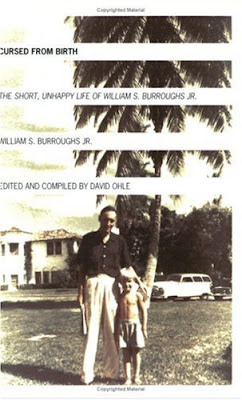
David Ohle, Cursed from Birth: The Short, Unhappy Life of William S. Burroughs, Jr. (Soft Skull Press, 2006)

David Ohle, Roger Martin, Susan Brosseau ,eds., Cows Are Freaky When They Look at You: An Oral History of the Kaw Valley Hemp Pickers (Watermark Press, 1991)

Label